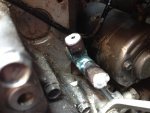
White Calcium like scale in engine direct cooling system

Mel

Well-Known Member
Joined
18 Jun 2001
Messages
192
Location
Live in South Norfolk
Visit site
I have experienced an accumulation of a white material practically blocking the engine block entry tee piece on my 1GM10 Yanmar. The water pump entry and exit have no sign of this, but the pump outlet hose goes to the Tee piece as shown in the pictures ! The white stuff is easily scraped away with a screw driver !
Engine has full anode protection and as far as I am aware is otherwise normal.
Used on River Orwell - could it be the water quality there ?

Can anybody explain what is happening here?

IMG_0403.jpgIMG_0404.jpg
 
First thing I would do is to test the stuff to determine if it is a calcium carbonate deposit or not.

Does it fizz with some dilute acid ( vinegar if you have nothing stronger) ?
 
Last edited:
It's carbonate, mostly magnesium I believe, and happens in most seawater systems. There have been countless threads about treating it, using hydrochloric or phosphoric acids, Rydlyme and other commercial products. You can either fill the coolant passages of the engine with it or circulate it via a bucket collecting the discharge from the exhaust. I suggest you search as there is much useful stuff in the forum archives.
 
Quite normal on a 1GM and a well known cause of overheating, as I discovered the hard way. Often overlooked, so worth cleaning regularly.
 
Thanks for the replies.
I remain puzzled by the way the blockage occurs at the end of the two small connections as shown - the blockage is only a thin layer across the ends - Why doesn't the calcium simply build up as a layer on all hot surfaces ? The position shown is the block entry so will normally run warm -- not hot !!
 
Thanks for the replies.
I remain puzzled by the way the blockage occurs at the end of the two small connections as shown - the blockage is only a thin layer across the ends - Why doesn't the calcium simply build up as a layer on all hot surfaces ? The position shown is the block entry so will normally run warm -- not hot !!

What metal is the T piece? Copper?
 
looks like brass or possibly bronze

Copper alloy then.

Thinking perhaps that galvanic current might lead to a calcium / magnesium carbonate deposit. The Cu alloy will be cathodic relative to the engine block so Na+ ions will migrate towards it, raise the pH locally and cause calcium carbonate to be deposited from the dissolved calcium bicarbonate.

Does not explain why the build up is at the ends furthest from the block though!

Therefore trying to think of some explanation where the anode involved will be nearer to the affected areas.
 
I had this on the raw water pump inlet on both my Cat engines, discovered when changing the impellers. Cleared out with a screwdriver. Nothing on the outlet side of the pump. According to one technician, made worse by overheating, which there were signs of on one of the pumps where the bearings were failing. I am not sure when the impellers were last changed but I suspect at least 5 or 6 years ago.
 
First thing I would do is to test the stuff to determine if it is a calcium carbonate deposit or not.

Does it fizz with some dilute acid ( vinegar if you have nothing stronger) ?

Took some bits of the white material home today and dipped it in "Limelite" -- definitely fizzed and seemed to dissolve a lot

Took boat out onto the river today and all is well at full speed, now that I have cleared the material from the "Tee piece"
 
Took some bits of the white material home today and dipped it in "Limelite" -- definitely fizzed and seemed to dissolve a lot

Took boat out onto the river today and all is well at full speed, now that I have cleared the material from the "Tee piece"

That confirms that it is a carbonate deposit.

I can think of only two ways in which a deposit like this can form. Thermal decomposition of bicarbonate in the water or a local increase in pH due to some electrochemical process.

Since its the cold water inlet thermal decomposition seems unlikely.

It would be interesting to change the tee piece for one made of a different alloy ( aluminium ??? ) or plastic.
 
Top