
Which type of rivet?

Pkewish

Well-Known Member
Joined
14 Mar 2012
Messages
78
Location
Dorset
Visit site
I noticed that one of the rivets that hold the mast foot to the mast on my 21 footer has gone AWOL. There should be 4 in total, 2 each side, 1 fore and 1 aft of the mast. How much work/load do these things take? and what type of rivet should I replace it with, brass, aluminium or SS. The remaining three look to be something like brass but won't polish up much so maybe some sort of alloy? Also, while I'm at it, should I replace the other three or go leave well alone.

See picsIMG_0325.jpg
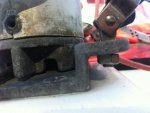
Pete
 
I noticed that one of the rivets that hold the mast foot to the mast on my 21 footer has gone AWOL. There should be 4 in total, 2 each side, 1 fore and 1 aft of the mast. How much work/load do these things take? and what type of rivet should I replace it with, brass, aluminium or SS. The remaining three look to be something like brass but won't polish up much so maybe some sort of alloy? Also, while I'm at it, should I replace the other three or go leave well alone.

See picsView attachment 28459

Pete

Monel rivets it's what the my rigger is using. You should also use some insulating compound like Duralac.
Would be concerned about the cracks around the rivet holes, not a good sign.
Seems you could need some sleeving also.
 
The crack has been there for about 10 years and not got any worse, what would be your advice? Please tell me more about 'sleeving'?
 
The crack has been there for about 10 years and not got any worse, what would be your advice? Please tell me more about 'sleeving'?

Sleeving is to add e sleeve around the mast to reinforce a section - It can be made of a piece of thin stainless steel plate wrapped around the mast and riveted in place.

If the these cracks have been stable for 10 years - you could ignore.
I would mark/measure where the end of the cracks are and monitor for any changes..
 
The load from the mast is compression. If that crack is allowed to develop, there is a danger that the mast could spread open, and come down over the heel. Possibly a band of stainless sheet, say 50mm wide, in the form of a bandage round the bottom of the mast, and riveted through using monel rivets, would be in order.
 
I agree monel rivets

Set them in with some Duralac paste as suggested to prevent corrosion due to dissimilar metals.

Youll need a decent riveter eg long arm type or lazy tongs

( very happy with the lazy tongs riveter I bought from Toolstation for about £16 )

Consider sleeving it as suggested but some extra new rivets may save the day.

Most chandlers will stock the rivets in prepacks a few will have them loose, Check min order value if ordering on line
 
Last edited:
If the crack has been stable for ten years I wouldn't be overly worried about it.
I might think about putting a large jubille clip arond the bottom of the mast as a belt and braces cheapskate way of making sure that the mast doesn't open up.
 
Not sure of your location but if you need some Monel Rivets let me know, we buy in by the 1000 and if you need just one happy to sell just one! If your local I can even lend you a rivet gun! Monel rivets come in two sizes 3/16 and 1/4, if you have the smaller size you could put the larger ones in.
+ 1 for leaving alone if been like that for 10 years, if you do put a Jubilee clip around the mast think about dissimilar metals as this could cause more problems
 
Monel rivets come in two sizes 3/16 and 1/4
Also 1/8" and 5/32"

Watch out for misleading imperial /metric equivalents too. Last job I did I drilled a load of holes thinking they were one then discovered they were the other and had to enlarge all the holes.
 
Not wanting to sound critical, but if looking at the mast as you have presented it to us hasn't worried you I would consider asking a rigger to have a look at it.
 
Also I'd not recommend sleeving with Stainless steel. It's strong enough but dissimilar metals encourage corrosion (which is why you use Monel not SS rivets) and the anodising on the mast isn't the best.
 
Also I'd not recommend sleeving with Stainless steel. It's strong enough but dissimilar metals encourage corrosion (which is why you use Monel not SS rivets) and the anodising on the mast isn't the best.
corrosion can be prevented by isolating the dissimilar metals, plastic is a good insulator.
 
Not too sure how the mast base works is it a hinging type? If so the only worry you have with missing rivets is if you lower it down putting large fore and aft and eventually up loads on the base attachment. If not and in the mean time while sailing no real worries even in worst case the mast might drop a centimetre spreading the bottom. If you want to fix it then remove the mast base plug (may be very difficult with corrosion) and cut off one or 2 cms of mast to reveal good metal.
With no load even Ali rivets will be fine softer but no dissimilar metal corrosion problems. Or drill and tap and fit 4 or 6mm metal thread ss screws. As for the vang fitting if that fails no real drama IMHO.
Also ona 21fter I had a corrosion failure of the base of the mast with too many halyard exit holes for pulley boxes all at the bottom. The mast actually crumpled the remaining good metal so shortening itself by .5cm. Despite hard racing I did not notice until end of season checks. So very little worry about mast base. good luck olewill
 
And the kicker attachment point is none too clever either.

Re: the kicker attachment, it is actually a block for halyard at the side is the mast. This set up was from new.

Re: Split mast, thanks for all your input, I'll get the chaps are the yard to take a look at it and either shorten it my 1/2" or strap it up with suitable material

re: Rivets, I've looked a Model online, seems to be a good and popular choice.

Thanks again to you all

Pete
 
The rivets are only there to stop the foot falling off when the mast is lifted. When I renewed a broken mast on my last boat, it was necessary to remove the mast foot after the mast foot had been attached because I had forgotten to run a bit of wiring inside the mast. The yard rigger advised using machine screws tapped into the heel fitting and smeared with Duralac paste. He told me that most masts needed the heel removed for one reason or another every few years and that using screws made the job easier.

The mast on Wight Dawn had the heel attached with a mixture of machine and self-tapper screws when I bought her.
 
Also I'd not recommend sleeving with Stainless steel. It's strong enough but dissimilar metals encourage corrosion (which is why you use Monel not SS rivets) and the anodising on the mast isn't the best.

Monel and aluminium are dissimilar metals. Monel is a copper/ nickel alloy. That is why Duralac or similar should be used with them.

Not a great difference between the electrode potentials of Monel and passive 316 stainless steel ITYWF
 
Top