Which Autopilot

Definitely go for the linear drive.
I am in process of upgrading tired ST4000+ wheel pilot to new linear drive on my Bene 343. Wheel pilot only good for light airs and motoring. Garmin Class A drive (made by Jefa) linear drive and Pypilot Tinypilot cost is a hundred pounds more than EV100 wheel unit.
I am looking for a way to replace my ST4000 controller.
Is there a idiot's guide for the Pypilot Tinypilot and is it possible to control the pilot without using Opencpn?
 
Just in case the other posts have not convinced you, don't get a Raymarine wheelpilot. The newer EV software may well be improved over the older version but it still drives exactly the same underpowered, slow, whirry-clackety wheel drive with plastic gears and a very crude clutch mechanism. Fine for brief use in leaving harbour under power in flattish water and hoisting the main, or the reverse on returning, but even on a lighter wind day with prolonged use the click-whirr-clack every ten seconds gets irritating. In any real seaway it is not up to the job: it reacts too slow to yaws, at least my ST4000 does, and I don't see that changing the control electronics will speed up or increase the power of the same clamp on wheel unit.

As to reliability: I have two wheel drives. It's quicker just to swap wheel drive units and take one home to service than to dismantle and persuade back into proper functionality than to do it afloat. Most users accept that the clutch doesn't work properly and hold it in place with a loop of shockcord!

It could be a decent bit of kit if a few more ££s or £££s had been spent on the wheel unit. I just can't quite justify spending the ££££s on a new ram-drive system. I've sailed thousands of miles on other boats with Raymarine ram-drives, and am very happy with them.
 
OK slight thread drift apology in advance...............

I am going to buy a boat in the future.................. To me the autopilot is one of my most important considerations. How does one know in advance whether the boat choice is a good fit for a great below decks AP installation like the Garmin Class B for example (boat might be Westerly Ocean 33, Starlight 35 etc).
 
OK slight thread drift apology in advance...............

I am going to buy a boat in the future.................. To me the autopilot is one of my most important considerations. How does one know in advance whether the boat choice is a good fit for a great below decks AP installation like the Garmin Class B for example (boat might be Westerly Ocean 33, Starlight 35 etc).

You can fit an autopilot to almost all boats. It might be necessary to do some construction work to make a firm base for the linear drive - the forces are considerable.
 
How does one know in advance whether the boat choice is a good fit for a great below decks AP installation

Access to the rudder stock (so not a glassed-in tube from hull to deck) and enough space around it to install the drive. Some quadrants can have the drive fitting bolted directly to them, on other boats it's easier to add a separate short tiller above or below the quadrant (and then this will still work if the quadrant should break or slip on the shaft, not likely but not impossible).

Boats where you'll need to check carefully are those with narrow sterns (though the ram can be arranged to run fore and aft, or at an angle, instead of athwartships) and ones with aft cabins and the steering gear under a bunk, where there might not be enough vertical height to add a drive system above or below the existing cables.

Something should be possible on most wheel-steered boats, though.

Pete
 
Access to the rudder stock (so not a glassed-in tube from hull to deck) and enough space around it to install the drive. Some quadrants can have the drive fitting bolted directly to them, on other boats it's easier to add a separate short tiller above or below the quadrant (and then this will still work if the quadrant should break or slip on the shaft, not likely but not impossible).

Boats where you'll need to check carefully are those with narrow sterns (though the ram can be arranged to run fore and aft, or at an angle, instead of athwartships) and ones with aft cabins and the steering gear under a bunk, where there might not be enough vertical height to add a drive system above or below the existing cables.

Something should be possible on most wheel-steered boats, though.

Pete

I need to start collecting boat drawings................! Photos of quadrants.................
 
Plus even if you did find something where a pilot drive couldn't be fitted to the rudder stock, you can still have a rotary drive connected further up the steering system. It's not preferred, because you lose the redundancy (with a direct drive, if the wheel system breaks you can immediately engage the pilot and regain control) but it's still a lot better than a rattly plastic wheelpilot.

Pete
 
OK slight thread drift apology in advance...............

I am going to buy a boat in the future.................. To me the autopilot is one of my most important considerations. How does one know in advance whether the boat choice is a good fit for a great below decks AP installation like the Garmin Class B for example (boat might be Westerly Ocean 33, Starlight 35 etc).
If it’s tiller steered you might have a problem- I wanted a below deck system for my Storm but the rudder tube made that a far bigger job than I could contemplate..
 
I am looking for a way to replace my ST4000 controller.
Is there a idiot's guide for the Pypilot Tinypilot and is it possible to control the pilot without using Opencpn?

The Pypilot software and hardware documentation can be found start [pypilot]

Tinypilot is a stand alone controller box with the SW already on SD card tinypilot [pypilot]
OpenCPN is not required.

Control is by IR remote or web page.
The Tinypilot innards are a Pi-0W and forms an WiFi access point by default so you can connect and control/configure by table or phone. There are the "hats" that have the gyro sensor and Nokia LCD display and IR receiver included in the Tinypilot box

You also need to connect Tinypilot to a motor controller motor_controller [pypilot]
That then drives your ram/wheel and has rudder feedback also.

I just got all the pieces working together with Garmin linear drive in my living room. Looking forward to fitting it aboard in the new year!
 
The Pypilot software and hardware documentation can be found start [pypilot]

Tinypilot is a stand alone controller box with the SW already on SD card tinypilot [pypilot]
OpenCPN is not required.

Control is by IR remote or web page.
The Tinypilot innards are a Pi-0W and forms an WiFi access point by default so you can connect and control/configure by table or phone. There are the "hats" that have the gyro sensor and Nokia LCD display and IR receiver included in the Tinypilot box

You also need to connect Tinypilot to a motor controller motor_controller [pypilot]
That then drives your ram/wheel and has rudder feedback also.

I just got all the pieces working together with Garmin linear drive in my living room. Looking forward to fitting it aboard in the new year!
Please let us know how it goes.
A mate and I have been thinking that there are cheaper (and maybe better) ways of moving the rudder than £1200 worth of hydraulic drive.

What Pi based solutions etc are up against is that Raymarine etc have probably 50 years of experience understanding the subtleties of what exactly a pilot should be doing in real life on a sea with waves. A lot of clever people have a lot of miles on the clock with bringing theory and reality together.
 
I need to start collecting boat drawings................! Photos of quadrants.................
You can fit a stub tiller onto the rudder stock and attach the linear drive to that.
This is sometimes better as it is easy to adjust the stub tiller height to get the linear drive horizontal due to the shape of the hull and length of the frame for the linear drive.
 
The Pypilot software and hardware documentation can be found start [pypilot]

Tinypilot is a stand alone controller box with the SW already on SD card tinypilot [pypilot]
OpenCPN is not required.

Control is by IR remote or web page.
The Tinypilot innards are a Pi-0W and forms an WiFi access point by default so you can connect and control/configure by table or phone. There are the "hats" that have the gyro sensor and Nokia LCD display and IR receiver included in the Tinypilot box

You also need to connect Tinypilot to a motor controller motor_controller [pypilot]
That then drives your ram/wheel and has rudder feedback also.

I just got all the pieces working together with Garmin linear drive in my living room. Looking forward to fitting it aboard in the new year!

Thanks I was hoping It could be hard wired and controlled by a couple of push buttons and or rotary resistors etc.
 
Last edited:
As others have said, a linear drive is the one to go for. The Raymarine linear drive has hardly changed in specification for decades, and it's probably their most reliable bit of kit. When I sold my last boat, the original Raymarine linear drive was 24 years old and still working perfectly.

The Jefa linear drive has some interesting features, I have one on my Bavaria, but it's probably still too new to know how well it will stand up to long-term use.
Similar experience. I purchased my boat with the original 20 year old Raymarine linear drive. I did have to replace a couple of bearings but only because the PO neglected a leak that corroded the bearings. Original was a type 1 so upgraded to a type 2 because the boat is just at the very upper limit of the ratings for the type 1 but kept it for a spare.

Another benefit, it's very quiet. The drive is directly under the bed in the aft cabin and at sea I can't even hear it working.

Also looked at the Jefa when upgrading to the type 2. Has a good rep and I understand they've been supplying drives to AP manufacturers for some time and have a good record in that area. Supposed to be the lowest power draw of any drive.
 
What Pi based solutions etc are up against is that Raymarine etc have probably 50 years of experience understanding the subtleties of what exactly a pilot should be doing in real life on a sea with waves. A lot of clever people have a lot of miles on the clock with bringing theory and reality together.

Exactly. The hobbyist hardware is more than capable of doing the job, the important part is the control algorithms running on it. A simple PID-based controller is easy enough to implement and will provide adequate steering in most conditions if skilfully tuned, especially if there's a system for varying the PID values with speed.

The modern proprietary pilots go well beyond this, taking motion and acceleration into account as well as just heading. I was watching mine steering downwind in a small swell a couple of weeks ago, and it was turning the wheel as the stern lifted to each wave just as a helmsman would do, before the bow had started to move at all. A pilot that only reacts to a heading input cannot anticipate like this, it has to wait until the boat is already off-course and then bring it back.

There's no reason the open-source pilots can't get there in time, if a few people with the right skills and access to testing choose to work on them, but I suspect they aren't there yet.

Pete
 
I need to start collecting boat drawings................! Photos of quadrants.................

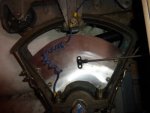
Here's one for you, our installation by previous owner with simple 4mm plate bolted to quadrant, still well attached after 20 years or so. Linear drive mounts to welded on bracket underneath the plate, RPS on top.
 

Attachments

  • P1000722a.jpg
    P1000722a.jpg
    29 KB · Views: 48
Exactly. The hobbyist hardware is more than capable of doing the job, the important part is the control algorithms running on it. A simple PID-based controller is easy enough to implement and will provide adequate steering in most conditions if skilfully tuned, especially if there's a system for varying the PID values with speed.

The modern proprietary pilots go well beyond this, taking motion and acceleration into account as well as just heading. I was watching mine steering downwind in a small swell a couple of weeks ago, and it was turning the wheel as the stern lifted to each wave just as a helmsman would do, before the bow had started to move at all. A pilot that only reacts to a heading input cannot anticipate like this, it has to wait until the boat is already off-course and then bring it back.

There's no reason the open-source pilots can't get there in time, if a few people with the right skills and access to testing choose to work on them, but I suspect they aren't there yet.

Pete

What brand/model AP are you using?
 
I’m going to buy a new autopilot, may well get it from Raymarine but I’m not sure which one.
I have a Najad 343 roughly 7 tons.
Which one would you all suggest out of
Raymarine Wheelpilot EV-100 or Raymarine Autopilot EV-200 Linear drive?
There is a large difference in price.

My sailing area is a offshore but not ocean passage making yet. It may well never be ocean passage but seems silly to buy the cheaper if it cannot cope.

Any experiences.?

Many thanks in advance for you input.
Warren

A general comment fom someone who values his a/ pilot and has had most types on board over the years.

Electronics exposed to the elements will fail and when most unexpected.

Below decks, acting on the quadrant ( assuming you have one) is optimal

Hydraulic is not cheap but works for years and alone has the power to maintain a course in tough weather.

You will have noted how often deep sea sailors report failed a/pilot gear. Anything with a screw operated ram is of limited durability.

Cockpit setups acting on the wheel are for weekend trips. If you believe you will trade up vessels in the medium term fit this type.

Like radar, a/pilots are not cheap to install and do use power. You may have to add a battery if using your pilot for hours on end. This will prove one of your best investments. Brand is not critical but mine is Simrad hydraulic.

PWG
 
Hydraulic is not cheap but works for years and alone has the power to maintain a course in tough weather.

Alone? I've lost count of the number of boats with leaking hydraulic systems. OTOH, Raymarine electric linear drives post (IIRC 1996) with the updated gears, rarely fail. Ours has done thousands of miles in winds at times gusting F9 and has performed faultlessly.
 
Top