Where to connect Inverter Earth/Ground cable

I only spoke about GI's in the last 2 items what are you comments on the first 4 items.

The position of the GI is very important to the effective of a protective earth and the reliability of the earthing of a mains circuitry

Don't evade the points I made

The GI is not part of an inverter installation.

I already covered the correct installation of the Earth connection.
 
So your way is the only way and you don't seem to wish to discuss an alternative view point.

The Earth has to be connected to the Earth, there is a clue in the name, there is no "alternative view point".

Take your pick of how you achieve the connection, i offered several suggestions, some dependent on the boat.
 
  • Like
Reactions: pvb
The Earth has to be connected to the Earth, there is a clue in the name, there is no "alternative view point".

Take your pick of how you achieve the connection, i offered several suggestions, some dependent on the boat.

So the incoming protective earth wire is connected to the "Earth" at the supply transformer and providing the neutral and case of the inverter is connected to the incoming protective earth all should be OK
 
Try reading what i said, i know it's a novel idea,but just this once, give it a try.


I do read a lot and wats more I analysis what I read including conflating information. I have also had some of my studies and documents peer reviewed.

Your comment says to me that you are always right and not interested in anyone else point of view and start to get hostile when any one challenges you.
 
I do read a lot and wats more I analysis what I read including conflating information. I have also had some of my studies and documents peer reviewed.

Your comment says to me that you are always right and not interested in anyone else point of view and start to get hostile when any one challenges you.

This thread is a prefect example of how you start an argument from nothing Roger.

The OP asked:

Where do you think I should be connecting the earth cable to?

I replied:

Basically, anything that's in contact with the water, the 12v negative may not be. If you don't have a metal hull or a grounding plate, (most of us don't have either) a hull anode works well.

You have then waffled about galvanic isolators, which have nothing to do with an inverter Earth, inverters don't need a GI. Then you come out with nonsense like:

So the incoming protective earth wire is connected to the "Earth" at the supply transformer and providing the neutral and case of the inverter is connected to the incoming protective earth all should be OK

That's just pure rubbish and totally irrelevant to the thread. Marina Earth is not connected to a supply transformer, it's made locally. How is it good enough to connect the inverter to the "incoming protective earth" ? What happens when you leave the marina and use the inverter at sea ?

The OP has his answer and i think everyone else reading this thread can see it for what it is, so i'm off, i have better things to do than keep responding to troll posts.
 
My main question is how do connecting an inverter metal case or the negative to the sea make it safer when the basic structure is an insulator i.e GRP

How would a connecting to the sea shut down the inverter if a fault occurred, in particular an internal short in the inverter where the live shorts to the metal case of the inverter

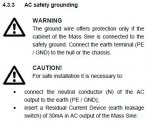
Normally a leakage of current to the ground(earth) either via the earthing cable of through the ground (earth) would trip the RCD

Don't tell me you already have because you haven't need fault condition current path analysis.
 
I have read all the posts but I just have a simple question and hopefully a simple answer, first the installation:

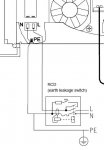
I am installing a Mastervolt 800W inverter. Instructions states that the 240v neutral output needs to be connected to earth to the inverter chassis, which I have done. QUESTION: Do I connect (earth) the inverter chassis to, eg. the engine block? (See pics).
The earth would then be provided through continuity of the prop shaft to water! BTW, I am installing a RCD. Should clarify that the inverter output is stand-alone will only be used for TV and video player and will not be connected to the shore power panel.
Inverter earthing.JPGInverter output wiring.JPG
 
I have read all the posts but I just have a simple question and hopefully a simple answer, first the installation:

I can give you a very simple answer, for your installation alone (before one of our resident inverter "experts" comes along to correct me (again) :

The neutral and "Earth" must be bonded at the inverter, as you rightly say, you then need to connect the "Earth" to Earth/Ground, in you case, the water that the boat sits in. How you make the connection to the water is an individual choice, depending on the construction of the boat. If the only way is to connect it to the block, as you describe, then that is acceptable.

As an aside, current regulations dictate that shore power installations should also have the Earth connection made to the water, as well as the usual shoreside based Earth connection. Doing so would mean installing a galvanic isolator or an isolation transformer too. You are not obliged to comply with this regulation on an older boat, the reg is not retrospective.
 
I have read all the posts but I just have a simple question and hopefully a simple answer, first the installation:

I am installing a Mastervolt 800W inverter. Instructions states that the 240v neutral output needs to be connected to earth to the inverter chassis, which I have done. QUESTION: Do I connect (earth) the inverter chassis to, eg. the engine block? (See pics).
The earth would then be provided through continuity of the prop shaft to water! BTW, I am installing a RCD. Should clarify that the inverter output is stand-alone will only be used for TV and video player and will not be connected to the shore power panel.

The inverter earth terminal ( PE/GND) should be connected to boat's own internal PE system , Use the same connection point to which the incoming shorepower PE is connected . (The DC negative and the engine block may be connected to the same point)
This connection together with earthing of the inverter neutral ensures that the rcd gives the safety protection it is fitted to provide
It may be that a bolt on the engine block acts as this central grounding point but is worth remembering that the connection through oil filled bearings to the pop shaft is less than perfect. One forum member recently reported a variable and at times significant resistance between engine block and gearbox output shaft/prop shaft

The regulations also require that there is a connection between the infernal PE system and the water . This may be by direct connection to the hull of metal hulled vessels or via an external grounding plate or the shaft and propeller in the case of non conducting hulls.
Tranona recently told us that his new boat , which has a sail drive rather than shaft driven propeller, has a hull anode fitted exclusively for this purpose rather than the traditional bronze grounding plate
 
I can give you a very simple answer, for your installation alone (before one of our resident inverter "experts" comes along to correct me (again) :

The neutral and "Earth" must be bonded at the inverter, as you rightly say, you then need to connect the "Earth" to Earth/Ground, in you case, the water that the boat sits in. How you make the connection to the water is an individual choice, depending on the construction of the boat. If the only way is to connect it to the block, as you describe, then that is acceptable.

As an aside, current regulations dictate that shore power installations should also have the Earth connection made to the water, as well as the usual shoreside based Earth connection. Doing so would mean installing a galvanic isolator or an isolation transformer too. You are not obliged to comply with this regulation on an older boat, the reg is not retrospective.
Thanks @PaulRainbow for your reassuring reply. I have checked the boat (20 year old) AC drawings and there is a combined 16A MCB/30mA RCD double pole circuit breaker fitted to the distribution panel. There does not appear to AC earth bonding to the water side. Therefore according to your reply, I do not require a galvanic isolator. I have now connected and powered up the inverter and all appears to be working. The test button on the inverter RCD output trips as should. :);).
Could you please confirm if the RJ12 coms cable between the Mass sine inverter and C-4-RI remote panel is a 6 pin crossover cable?
 
The inverter earth terminal ( PE/GND) should be connected to boat's own internal PE system , Use the same connection point to which the incoming shorepower PE is connected . (The DC negative and the engine block may be connected to the same point)
This connection together with earthing of the inverter neutral ensures that the rcd gives the safety protection it is fitted to provide
It may be that a bolt on the engine block acts as this central grounding point but is worth remembering that the connection through oil filled bearings to the pop shaft is less than perfect. One forum member recently reported a variable and at times significant resistance between engine block and gearbox output shaft/prop shaft

The regulations also require that there is a connection between the infernal PE system and the water . This may be by direct connection to the hull of metal hulled vessels or via an external grounding plate or the shaft and propeller in the case of non conducting hulls.
Tranona recently told us that his new boat , which has a sail drive rather than shaft driven propeller, has a hull anode fitted exclusively for this purpose rather than the traditional bronze grounding plate

He did indeed tell us this, yet when i suggested this in another thread you abused and insulted me, as usual. Now you've found that it's a recognised method, adopted by a major boat manufacturer, you're recommending it, laughable.

FYI, as i stated in post #30, regulations in this respect are not retrospective, ( you have been unable to find your usual illegal pirate copy of the current regs, so you're guessing what they are anyway) so the OP is not obliged to follow them if he chooses not to do so.
 
Last edited:
Thanks @PaulRainbow for your reassuring reply. I have checked the boat (20 year old) AC drawings and there is a combined 16A MCB/30mA RCD double pole circuit breaker fitted to the distribution panel. There does not appear to AC earth bonding to the water side. Therefore according to your reply, I do not require a galvanic isolator. I have now connected and powered up the inverter and all appears to be working. The test button on the inverter RCD output trips as should. :);).
Could you please confirm if the RJ12 coms cable between the Mass sine inverter and C-4-RI remote panel is a 6 pin crossover cable?

At 20 yrs old it pre-dates the current requirement to make the Earth connection from shore power to the water. It also doesn't matter to the inverter, which does need that connection to be made.

It's worth noting that the RCD test button only tests the RCD, not the connection to any sockets, so it's worth buying a cheap RCD test "plug" to make sure it all works from your sockets, i dare say it will be fine.

The RJ12 cable has pins 1 and 6 crossed.
 
Last edited:
Thanks all for the knowledgeable advice and suggestions regarding the inverter earthing ?. I now am satisfied that I have safely installed my inverter ;). Have ordered the cross over cable for the remote panel.
 
Top