
Where do you mount your liferaft?

Mistroma - might I ask that you post back here your findings? Interesting to see if there is consensus with the servicing agents! I used Suffolk Marine Safety.

BTW - Attached is a picture from the Plastimo catalog showing the cradle with the line exiting from the top. I initially thought that the toggle should be underneath to prevent water ingress..... until advised otherwise.
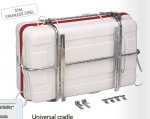
plastimo-cradle.jpg
 
Last edited:
Back in the days when we had life rafts in the UK ( they are only for billionaires here) we fitted ours vertically in a pushpit mounted cradle. Launching would require a push to the open side once the 'gate' on the frame was opened. I did add a quick releasable webbing strap for extra safety ( and a multi tool/knife in a holster right by it.) This was on a Jeanneau Sun Legende 41 with a Plasimo 6 person cannister raft..

Sadly over here in money talks bullshit walks country a raft costs 3 or more times EU prices and servicing costs even more than that. So in company with most, our dinghy is the chosen option, in our case a 3.1 metre RIB Carried in davits on the stern. I do not expect to be caught in 'Perfect Storm' seas, nor would wish to be so in a life raft and for sinking following a collision or whatever or for a fire on board incident, the RIB and it's ability to actually go somewhere actively is a reasonable, even better, option. But hereabouts the waters are warm and on our longest crossing we are likely no more than 40 miles from dry land ( 2hrs in the RIB If the motor is on, bit more if rowed:nonchalance:) plus our grab bag contains 2 handheld VHFs, with spare batteries and our smartphones with NAV PROGRAMS And GPS)
 
Last edited:
Mistroma - might I ask that you post back here your findings? Interesting to see if there is consensus with the servicing agents! I used Suffolk Marine Safety.

BTW - Attached is a picture from the Plastimo catalog showing the cradle with the line exiting from the top. I initially thought that the toggle should be underneath to prevent water ingress..... until advised otherwise.
View attachment 55706

I did email Ocean Safety three times asking if orientation was important. I emailed them on 4th February and again on 19th February and had no response whatsoever. I'm waiting for a response to my 3rd email and will post their reply, or lack of one. Perhaps I'm using the wrong email address (info@oceansafety.com).
 
Does the team think that the pushpit on a Jeanneau 45 is strong enough to mount my 4 man liferaft canister, in a cradle, without any reinforcement, to allow for a fast deployment?

I have my 4 man liferaft mounted on the pushpit of my UFO 34 which is 1" diameter stainless. I'd be surprised if the J45 pushpit wasn't strong enough to mount one at the same weight, but how big a liferaft were you thinking of Peter ?

Boo2
 
I did email Ocean Safety three times asking if orientation was important. I emailed them on 4th February and again on 19th February and had no response whatsoever. I'm waiting for a response to my 3rd email and will post their reply, or lack of one. Perhaps I'm using the wrong email address (info@oceansafety.com).

A while ago I emailed them about servicing a Jon Buoy and never got a reply. Possibly they haven't quite grasped the 21st century yet?

Pete
 
I have my 4 man liferaft mounted on the pushpit of my UFO 34 which is 1" diameter stainless. I'd be surprised if the J45 pushpit wasn't strong enough to mount one at the same weight, but how big a liferaft were you thinking of Peter ?

Boo2

Sorry, perhaps I should just have PM'd instead of posting the update.

Earlier posts have already covered store it below, mount on deck or my pushpit is fine so OP won't have a problem.

My 38kg 4 man Ocean safety is certainly too much for the pushpit on my 42DS and requires a strut. The 45DS is fairly similar and pretty certain the OP was planning to mount a bracket on the pushpit and install a similar strut.

It isn't a matter of the 42DS overall deck moulding being weak, just that the curves around the inboard pushpit mount prevent much reinforcement. It is pretty easy to flex the pushpit around that area. My memory of a friend's 45DS made me think that design was very similar.
 
Last edited:
>I did not consider the pushpit on my 42DS to be strong enough to support a 4 man Ocean Safety liferaft.

I am surprised about that when we chartered we sailed every type of AWB from 32 feet to 50 feet and the Jeanneau had the best quality build. Unless that has changed a 4 peson liferaft shouldn't cause a problem on the stern rail of a 42 foot boat. It might be worth checking that with Jeanneau.
 
>I did not consider the pushpit on my 42DS to be strong enough to support a 4 man Ocean Safety liferaft.

I am surprised about that when we chartered we sailed every type of AWB from 32 feet to 50 feet and the Jeanneau had the best quality build. Unless that has changed a 4 peson liferaft shouldn't cause a problem on the stern rail of a 42 foot boat. It might be worth checking that with Jeanneau.

Our 1988 Jeanneau sun Legende had a revised pushpit with radar pole and windgen pole and solar panel goalpost included. we had a 6 person Plastimo cannister raft in a vertically mounted cradle mounted on that pushpit. The raft could be launched by one person simply by opening the latched strap and giving the raft a push sideways towards the centreline. for extra security I added a webbing strap with S/S buckle but mounted a multitool with knife blade right by it just in case. In those days we frequently sailed in rough waters and upwind offshore in full Channel gales, with no problems at all. On our current French built Beneteau boat the pushpit has davits for our 10ft RIB.9.9hp motor and this has an extra support strap from each davit arm to the swim platform (as advised by the davit makers). We no longer carry a liferaft as our sailing now is more sedate and we are never more than 40 miles or so from nearest dry land. Our most likely abandon ship scenario would be for fire or collision /sinking rather than the Perfect Storm and the RIB will manage well enough and at 20kts we can be on dry land walking pretty quickly or can just tootle around waiting for aid. We have a handheld VHF plus our phones in the grab bag in the RIB long with a flare gun ( +12 cartridges) and GPS nav programs/charts on the phones. Liferafts in the USA are hugely costly and servicing them more so still so few carry them especially for the kind of cruising we do nowadays. If back in European waters I would not hesitate to mount a raft in a pushpit cradle, anywhere else makes launching hard especially for one person, a likely scenario when you are always a two up crew like us and one crew could even be injured/incapacitated.
 
>I did not consider the pushpit on my 42DS to be strong enough to support a 4 man Ocean Safety liferaft.

I am surprised about that when we chartered we sailed every type of AWB from 32 feet to 50 feet and the Jeanneau had the best quality build. Unless that has changed a 4 peson liferaft shouldn't cause a problem on the stern rail of a 42 foot boat. It might be worth checking that with Jeanneau.

Did you charter a 42DS? I spend about 6-7 months each year living on my 42DS and prefer installations to last and not cause problems later.

It isn't a simply a problem with my boat so no need to contact Jeanneau. I said before that it was the design, not the build quality. It's due to the curves in the topsides and the positioning of the inner upright at a raised corner beside the walkthrough section and the stern. There isn't any space for a fore & aft backing plate and the pushpit is quite tall. I can flex the upright by heaving backwards and forwards but not side to side. I had no doubt at all that hanging a 38kg liferaft from the top rail was a bad idea. The problem is easily solved by adding a simple strut to transfer the load to the hull underneath. I thought that it was feasible that the 45DS might possibly have a similar issue.
 
Was in an aft locker but very bulky (10 man), so had a cradle built just forward of the main hatch to free up cockpit locker space. We also have a 3m inflated rib upside down on the foredeck and would also use that. In either situation - pretty much waiting for the boat to sink under us, except for a fire.

I wouldn't replace the liferaft but we got it with the boat and it was mandatory (amongst dozens of other things connected to boat "safety" ) for it to be serviced as part of registering the boat in Croatia. About the only really good use of a liferaft I can think of to save lives is inflating it inside the cabin to stop the boat from sinking.
 
30kg, 38kg - that sort of weight seems a hell of a lot when you try and lift it. But the average male is probably 80-90kg and will happily step up on a pushpit rail to reach something, putting all of it on one small contact area.

Just a thought?
 
30kg, 38kg - that sort of weight seems a hell of a lot when you try and lift it. But the average male is probably 80-90kg and will happily step up on a pushpit rail to reach something, putting all of it on one small contact area.

He probably won't sit on the top rail and swing back and forth, back and forth, back and forth, for hour after hour of wave motion, though.

Obviously no reasonable stern rail is going to immediately collapse when you hang a raft on it, but there are definitely combinations where the wrenching movement will do damage over time. Our stern rail leaks through the deck fittings, probably for exactly this reason due to a 6-man charter raft hanging off it for years.

Pete
 
He probably won't sit on the top rail and swing back and forth, back and forth, back and forth, for hour after hour of wave motion, though.

Obviously no reasonable stern rail is going to immediately collapse when you hang a raft on it, but there are definitely combinations where the wrenching movement will do damage over time. Our stern rail leaks through the deck fittings, probably for exactly this reason due to a 6-man charter raft hanging off it for years.

Pete

Absolutely correct, it's the bouncing around I worried about. No problem at all with a 38kg static load. I can stand on our pushpit and the inner upright beside our liferaft actually braces the wind gen. support. But the wind gen support transfers load in a direction where the pushpit is very strong. Unfortunately, the liferaft exerts a load at 90 degrees to that direction.

I'm certain that some boats will be fine and not suggesting that all pushpits are too weak for the job. Just pointing out that statements to effect that "it's fine on my boat and will therefore be OK for OP" won't always be valid (unless they do actually have a 45DS with a 38kg liferaft on pushpit). :D
 
>Did you charter a 42DS? I spend about 6-7 months each year living on my 42DS and prefer installations to last and not cause problems later.

>It isn't a simply a problem with my boat so no need to contact Jeanneau. I said before that it was the design, not the build quality. It's due to the curves in the topsides and the positioning of the inner upright at a raised corner beside the walkthrough section and the stern. There isn't any space for a fore & aft backing plate and the pushpit is quite tall. I can flex the upright by heaving backwards and forwards but not side to side. I had no doubt at all that hanging a 38kg liferaft from the top rail was a bad idea. The problem is easily solved by adding a simple strut to transfer the load to the hull underneath. I thought that it was feasible that the 45DS might possibly have a similar issue.

No we didn't charter a 45DS they were not in any charter fleets we used thus I hadn't realise the difficulty of fitting a liferaft on the stern beause of its design, that's very unusal. The the great majortiy of long distance cruising boats we saw had the liferaft on the stern rail, as we did, because it's very easy to deploy.
 
Mistroma - might I ask that you post back here your findings? Interesting to see if there is consensus with the servicing agents! I used Suffolk Marine Safety.

BTW - Attached is a picture from the Plastimo catalog showing the cradle with the line exiting from the top. I initially thought that the toggle should be underneath to prevent water ingress..... until advised otherwise.
View attachment 55706

I did email Ocean Safety three times asking if orientation was important. I emailed them on 4th February and again on 19th February and had no response whatsoever. I'm waiting for a response to my 3rd email and will post their reply, or lack of one. Perhaps I'm using the wrong email address (info@oceansafety.com).

I asked for a read receipt with the 3rd email and managed too get the name an address of the person who had read it. I emailed that person directly after waiting in vain for another 11 days. I pointed out that this was my 4th attempt and this seemed to prompt a response as it was forwarded to their training manager.

I had an email back to confirm the situation wrt orientation in the cradle. It appears that, as I suspected, the dealer's comment reported earlier in the thread was not correct.

Extract from Ocean Safety's email
The stowage of your liferaft as described in your email is perfectly acceptable i.e. with the painter line exiting on the lower long edge of the container. This is normal practice and the fact that the liferaft will be “above” the cylinder and operating head is of no consequence.

When rafts are packed at manufacture or by manufacturer approved service technicians they will be folded in such a way that ensures that the painter line and operating wire have a clear exit route if pulled. The weight of raft on the cylinder in a leisure liferaft will have no effect on the cylinder itself.

Furthermore we regard it as undesirable to store the raft the other way up as suggested by a third party. It is not difficult to imagine the cylinder lying on top of the raft possibly causing damage to the raft as a result of the motion of the boat over time.

You are also correct in your assumption that the raft will not slide down inside the raft when packed. It is likely to expand a little if anything leading to a nice tight fit within the container.
 
Do you not think that with all the emails flying about many must get missed
I, for one, regularly ignore time wasting emails, but am quite happy to talk to someone on the phone with a sensible query ( I am not suggesting your query is not)
Would not a phone call would have been sensible once the first one missed a response
 
Do you not think that with all the emails flying about many must get missed
I, for one, regularly ignore time wasting emails, but am quite happy to talk to someone on the phone with a sensible query ( I am not suggesting your query is not)
Would not a phone call would have been sensible once the first one missed a response

One perhaps but after that they shouldn't all get missed. What's the point of having a contact address if it isn't monitored. I would have phoned if it had been very urgent and required an immediate answer.

To be honest I was curious about how bad the system would be at their end. I made a point of setting long reminder times to allow for annual leave, illness and all sorts of things. This allowed plenty of time for someone to answer.

Dealing be email is fairly efficient and my reminders are automated so minimal effort for me to send repeat emails. It has the advantage of having a history and I also get to collect useful contact information for little effort. I have added the direct email addresses to my Ocean Safety contact list for future use.

I am well aware that some people see email requests as time wasting and ignore them so that they can chat on the phone. I rarely use these companies more than once as I'm usually outside the UK and rely on email much more than a phone. :D
 
Certainly it seems bizarre to me to regard an email - which you can read, think about, and respond to all at your own convenience - as probably timewasting, and a phone call - which demands your undivided attention, without warning, whenever the caller sees fit - as by default not. Old people's habits, I guess :-p

Pete
 
Top