When not to wear a lifejacket?

It is extremely important that you choose a properly fitting life jacket.
Jackets that are too big will cause the flotation device to push up around your face, which could be dangerous.
Jackets that are too small will not be able to keep your body afloat.
Make sure your life jacket is U.S. Coast Guard-approved.
Double check that your jacket is appropriate for your favorite boating activities.
Take the time to ensure a proper fit.
Life jackets meant for adults do not work for children. If you are boating with children, make sure they are wearing properly fitted, child-sized life jackets.
On recreational vessels underway, children under 13 years old must wear a Coast Guard approved life jacket unless they are below decks or in an enclosed cabin.
www.mcintoshmarine.com
 
Last edited:
It is extremely important that you choose a properly fitting life jacket.
Jackets that are too big will cause the flotation device to push up around your face, which could be dangerous.
Jackets that are too small will not be able to keep your body afloat.
Make sure your life jacket is U.S. Coast Guard-approved.
Double check that your jacket is appropriate for your favorite boating activities.
Take the time to ensure a proper fit.
Life jackets meant for adults do not work for children. If you are boating with children, make sure they are wearing properly fitted, child-sized life jackets.
On recreational vessels underway, children under 13 years old must wear a Coast Guard approved life jacket unless they are below decks or in an enclosed cabin.


I say Chap we are not all living in USA. We do not have your regulation (thank Gard).
 
SamandFliss_zps8e0a13be.jpg


My son and his GF enjoying theirselves on our recent holiday. We met lots of Americans who didn't bother with LJs so I assume they travel outside US waters to enjoy themselves as well. Some of them were so drunk getting back in their dinghies you actually wondered if they would make it down the dock. They did, and there was never never before or since any incidents of people falling in. My son has worked out there for 12 months and the only things that end up in the water are wallets and watches.
 
When i am not on the boat is the time to not wear a life jacket. It doesn't matter what the boat size is. It's related to our safety and i always wear wneh i am on the boat.
 
When i am not on the boat is the time to not wear a life jacket. It doesn't matter what the boat size is. It's related to our safety and i always wear wneh i am on the boat.

so you dont wear it on the marina where you are likely to fall in and you do on the boat where you are not. You must find in difficult to take a dump wearing a lifejacket, too, so hats off to you for managing that. Sleeping is difficult too.

Your risk assessment process is flawed. You should be concerned about your safety.
 
Don't wear your life jacket when you're going to sleep........:disgust:
Boaters enjoy the feel of sun and spray. So it’s tempting to boat without wearing a life jacket – especially on nice days. But modern life jackets are available in a wide variety of shapes, colors, and sizes. Many are thin and flexible. Some are built right into fishing vests or hunter coats. Others are inflatable — as compact as a scarf or fanny pack until they hit water, when they automatically fill with air.
mcintoshmarine.com
 
Last edited:
I am not sure I want an inflatable lifejacket to be built in to my "Fanny Pack".

I think "Fanny Pack" is assumed to have a different connotation this side of the Atlantic.
 
There are really three basic categories of jackets/PFD's as far as the Coast Guard is concerned,
Type I are for offshore environments and heavy seas. These jackets will turn you face up if you're unconscious, but are very bulky and not suited for any activity that requires lots of movement.

Type II jackets are slightly less bulky and can usually turn an unconscious person face up, but not always. They generally are less comfortable than a vest and so are not very well suited to sports activities.

Type III jackets are called "floatation aids" and are what you often see people using when water skiing, wakeboarding and doing other water sports. These vests are more comfortable than the first two types, and so I'll focus on this type.
Within the Type III category there were really three main options that I looked into. First there are what I refer to as the "recreational vests". These are generally very inexpensive and are popular with boaters and fishermen. They use a lighter foam compound which makes them very light, but due to their "blocky" construction they can be somewhat uncomfortable.

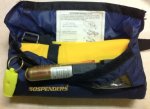
Here is an example of an inflatable life jacket, they can only be inflated automatically once per "charge". There is a compressed air cartridge that is included with the vest, but must be replaced if you inflate the vest. They also have a tube that allows you to manually inflate the vest if the vest won't fully inflate or needs additional air. Notice the signal whistle attached to the life jacket pouch, another Coast Guard regulation.
inflatable-Life-Jacket-open.jpg
 
An interesting thread, both for and against.

To add grist to the mill, here's an MOB incident that happened to us and which underlined the necessity to us of wearing an LJ. The incident involved a reasonably large yacht in calm and sunny conditions.

http://www.playdeau.com/man-overboard/

A very salutory tale, Piers.

I couldn't help laughing at the gallows humour of: "...the MOB was temporarily safe unless the yacht began moving forward. Telling him not to go away, I ran to Play d’eau’s warp locker, chose one and fed it around him in the same way..."

But seriously there are lots of lessons to be learned there, as you say.
 
An interesting thread, both for and against.

To add grist to the mill, here's an MOB incident that happened to us and which underlined the necessity to us of wearing an LJ. The incident involved a reasonably large yacht in calm and sunny conditions.

http://www.playdeau.com/man-overboard/

Piers and Lin
Play d'eau
Fleming 55

Piers, a very interesting blog post but I was slightly confused when I read it (in a bit of a rush). Was the current pushing the boat toward the pontoon or away from it?

Pete
 
We wear life jackets when outside but take them off when in the saloon, keep them close to hand though. I usually don't get to wear mine on most trips as I just drive:).
 
Piers, a very interesting blog post but I was slightly confused when I read it (in a bit of a rush). Was the current pushing the boat toward the pontoon or away from it?

Pete

He was mooring with the tide behind him, and it was also pushing him off the pontoon. Hence, I wanted the stern line first. But by being passed the brest line, the stern was forced out by the tide and the bow was forced into and hard against the pontoon. Has this explained it better?

Piers
 
Top