When does petrol become stale petrol?

Plastic cans are fine, so long as they are properly sealed and kept out of strong sunlight.
Any vented tank or container will allow the fuel to degrade much faster.
All petrol contains various additives these days, I don't think it's wise to keep it longer than necessary.

I've certainly seen a few engines transformed from non-runner to runner by fresh fuel, although I usually at least clean the spark plug if someone's been trying to start a motor with duff fuel.

It would be interesting to do some experimentation. It may be that plastic petrol cans allow some of the lighter fractions to escape, or possibly combine in some way with the plastic.
 
Yamaha 2.5 outboard let me down a couple of years ago, it conked out and wouldn't re-start. The engineer said it was because of old fuel, in this case from the previous season. Since then I've used an additive in the fuel and don't keep it over the winter, and the tank is drained for winterising. No further problems.
 
It would be interesting to do some experimentation. It may be that plastic petrol cans allow some of the lighter fractions to escape, or possibly combine in some way with the plastic.

My reason for suggesting that metal cans should be used rather than plastic is that polythene is to some extent permeable to oxygen.
Whether this is sufficient to cause problems with long term gasoline storage I don't know.
Likewise I dont know if the same applies to other plastics used for fuel tanks
 
. . . . if you have a sensitive or problem motor it is better to buy SUPER unleaded petrol which will keep it's starting properties much longer than premium unleaded.

+1. This was the advice given to me a few years ago by a small engine specialist (outboards large and small, hand carried equipment, etc.). Since following the advice and only using Super Unleaded in my outboard I've had no trouble.
 
My reason for suggesting that metal cans should be used rather than plastic is that polythene is to some extent permeable to oxygen.
Whether this is sufficient to cause problems with long term gasoline storage I don't know.
Likewise I dont know if the same applies to other plastics used for fuel tanks

Many years ago I was given some Duralec, new stuff to me at the time, decanted into a polythene bag. Within a week it was one hard lump. It's counter-intuitive that the relatively complex molecules involved can diffuse through such a membrane where simple old H2O won't, but no doubt a chemist could offer some insight...
 
+1. This was the advice given to me a few years ago by a small engine specialist (outboards large and small, hand carried equipment, etc.). Since following the advice and only using Super Unleaded in my outboard I've had no trouble.

There may be a reason for that, although what I suggest is pure supposition: super-unleaded is 'super' because it has a higher octane rating. High-octane fuels have fewer volatile fractions (basically, they're harder to burn, so more resistant to self-ignition, which is why putting them in a low-compression engine is pointless). Less volatile fractions have less interest in scarpering through a membrane (even a thick one such as a plastic fuel 'can').

That said, I have my doubts that octane rating has much influence on the willingness of petrol to burn. I wouldn't care to douse myself in any of it.
 
I think we all know that trying to get an outboard (or anything for that matter) is extremely difficult if it has old petrol in it, but I wonder, how long it takes for petrol to become "stale petrol". I remember that you could put your mower away for a season with a full tank, and it would start the next virtually straight away.
I switched the fuel supply off and ran my Yammy F2.5 dry after last use, but it still has 1/2 a tank of fuel in it. Is a winter lay over with that fuel still ok or should I tip it out and use fresh next season? I hear so many say, "well it was working last year before I put it away".


As PVB says you'll get lots of conflicting advice, and you did, so here's some more.... :D

My outboard engineer has 30 odd years in the trade, consulted by the majors on outboard design issues etc etc, and he tells me that fuel can go off within the space of a season...

I'm risk averse - the engine needs to be relied on and I'm a mechanical numpty - the stuff is only just over a quid a litre - I swap my fuel every two or three months - put the old in the car, and carry on... others won't, but I don't see the point in risking it...
 
My Yamaha 5 must have a charmed life; the last time I topped up the metal petrol tank was last year (5Lt) previously it was 2004 - still runs.
 
Well we suffer out here in the Caribbean. First thing is our petrol tends to have 10% ethanol added, not always but sometimes. Secondly the temperature rarely drops below 70 f and mostly it is 75 - 80 f. If there is oil mixed in with the fuel then it has a can life of 3 months older than that and starting suffers. No oil and it seems to last a bit longer.

I avoid buying petrol with ethanol in it if I can but sometimes there is only one petrol station in the island. eg Carriacou which has one petrol station and 200 rum shops. I told you it was tough out here.
 
My reason for suggesting that metal cans should be used rather than plastic is that polythene is to some extent permeable to oxygen.
Whether this is sufficient to cause problems with long term gasoline storage I don't know.
Likewise I dont know if the same applies to other plastics used for fuel tanks

The only experiences I have of metal fuel cans seem to involve particles of rust.
I think oxygen passing through HDPE can be significant, but I just take the view that long term storage of petrol has very little merit anyway.
A year or so in a normal plastic can seems fine.
Motorbikes with unvented tanks seem fine.
Any thing with a vented tank can be trouble IME.
Half a litre or so of old fuel in 5 litres of new does not seem to hurt.
A Yamaha 40 disposes of any leftover 2 stroke fuel at a fair old rate.
 
IMGP0376.JPGIMGP0379.JPG
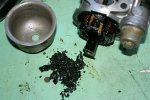
Pictured above is the carb from a generator that had the fuel left on for a couple of years unused. My experience is that something in modern petrol condenses on to the metal of cotainers (carbs, fuel tanks etc). It is a hard shelac type stuff and was also coated inside the tanks of two motorcycles that had been idle for about five years with half full tanks. This has not happened with the unused petrol bought for the generator in a plastic can as the can is clean inside.
 
Last edited:
How can any engine which burns fuel be supplied from an unvented tank ...... the closest to an unvented tank would be a tank with a one-way valve but this would still be a vented tank and I've never heard of one-way valves being used on road vehicles. :confused:

Richard

Indeed I mean a one-way valve.
It means the space above the fuel is air and petrol vapour, but the fuel vapour is not escaping. There is no free flow of air or vapour.
A half full tank say ten litres of 'air space' that's less than 3g of oxygen if my GCE chemistry hasn't gone off?
(mol of O2 is 32g, mol at STP is 22.4litres, air is 20% O2?, so 10l of air is less half a mol of gas, tenth of a mol of O2).
So less likely to corrupt 10 litres of petrol.
Likewise there's no more water getting in, and no volatile parts of the petrol leaving.
All of my bikes currently are 1990 onward fuel injected and have non-return breathers on the tanks. As standard.
My garage does not smell of petrol, but the shed where the strimmer lives does.
I thought modern cars had similar but I've never had the tank and everything out of one to really be sure?
AIUI, fumes from an open tank would fail Californian emissions rules these days? I'm not totally sure about that TBH.
But maybe it's part of the picture of why it's acceptable to 99% of people that modern fuel goes stale if exposed to air?
 
Indeed I mean a one-way valve.
It means the space above the fuel is air and petrol vapour, but the fuel vapour is not escaping. There is no free flow of air or vapour.
A half full tank say ten litres of 'air space' that's less than 3g of oxygen if my GCE chemistry hasn't gone off?
(mol of O2 is 32g, mol at STP is 22.4litres, air is 20% O2?, so 10l of air is less half a mol of gas, tenth of a mol of O2).
So less likely to corrupt 10 litres of petrol.
Likewise there's no more water getting in, and no volatile parts of the petrol leaving.
All of my bikes currently are 1990 onward fuel injected and have non-return breathers on the tanks. As standard.
My garage does not smell of petrol, but the shed where the strimmer lives does.
I thought modern cars had similar but I've never had the tank and everything out of one to really be sure?
AIUI, fumes from an open tank would fail Californian emissions rules these days? I'm not totally sure about that TBH.
But maybe it's part of the picture of why it's acceptable to 99% of people that modern fuel goes stale if exposed to air?

Apologies ..... you're right. I'd forgotten that modern cars and bikes are indeed fitted with one-way valves for emissions purposes. I spent too much time working on old bangers!

Richard
 
Top