When does legal title change?

I perfectly see what you mean, and I would also sleep like a baby, IF the BoS were a bulletproof document - as when the sale is notarised for instance, which I guess is the case with real estate properties.
It is down here, at least - as it is also for registered boats actually, hence my doubt.
But considering that AFAIK the BoS is just a piece of paper printed from a PDF and signed by the seller+buyer, wouldn't it be possible for the seller to sign another one (or a dozen of them for that matter) with other buyers?
I understand that this would be a fraud of course, and I have zero reasons to think that BB should fear that, but I'm just wondering what would happen if the register would receive multiple registration requests for the same boat...:confused:
All agreed, except in UK land sales are not notarised in the sense of continental european notarisation. Land sales are actually very close indeed to (part 1 reg) boat sales in UK. Remember part 1 is for huge big ships; we leisure boat users of it are imposters(!). Only difference is that a charge/mortgage over land is unenforceable against a 3rd party if it is not registered, unlike a mortgage over a boat (qv)

If multiple BoS were received by registry (a fraud, obviously, as you say) then they would need to determine which one was executed first. In the context of BB's question his would be first so that isn't a problem

In the "sideshow" sentence of my post that you quote above, please don't take me too literally. I was just making the (important) point about what a BoS is compared with your name entered on the register. I would of course always recommend getting your name on the register asap, not sitting on the BoS or TR1 for 5 years. But in Uk people routinely hand over £10m or £100m or whatever in return for a TR1 (which is the BoS for land, in UK, also a freely downloadable pdf) without their name being on the land register

EDIT: the Uk land registry is these days well computerised with transfers done by internet, unlike the archaic ship registry where everything is paper/pen/envelopes/postage stamps. The ship registry really needs to come out of the 19th century but seem to have no intention imho
 
Last edited:
Aha, all understood - though with some surprise re. the TR1 thing.

Just to further play devil's advocate, though...
In the context of BB's question his [BoS] would be first
...how can he positively know it is? :rolleyes:

I'll get my coat... :D
 
Aha, all understood - though with some surprise re. the TR1 thing.

Just to further play devil's advocate, though...

...how can he positively know it is? :rolleyes:

I'll get my coat... :D
He can't. Nor can anyone else buying a boat or land, but (a) it's not relevant to the question because it is part of the background risk in all transactions and is evidently a low risk, (b) the perpetrator needs to think the scam is worth it because he is looking at 5 years in jail and is hardly going to escape very far given that the money will be bank traceable, and if he is THAT good at evading the banking system what is he doing running frauds based on plywood smashed up boats that BB is describing giving him <£50k illegal profit yet the same amount of jail time. I think I'd want £25m for such a jail risk and even then I'd think twice.

Let's get back to worrying about VAT invoices :encouragement:
 
I think I'd want £25m for such a jail risk and even then I'd think twice.
Ermm... as much as £25m would definitely be a life changing amount (for me, anyway), I would think twice simply because I don't fancy the idea of screwing some honest folks, rather than for the jail risk as such...
 
Ermm... as much as £25m would definitely be a life changing amount (for me, anyway), I would think twice simply because I don't fancy the idea of screwing some honest folks, rather than for the jail risk as such...
Yep sure. I wasn't trying to convey that I would defraud people for £25m. We're wandering down an aimless side road here!
 
I don't think you need it Nick. Plenty of us are happy to hand over a few million quid in return for a TR1 - no-one waits for the Land Registry to enter us as owners on the Land Register. The BoS is the same thing: it gives you an entitlement to have your name on the register, and that's all you need. The actual entry of you name on the register is oddly a sideshow compared with the right to have that happen

Ha! Ironic that I've been reading this thread as light relief from a day which has otherwise been spent quibbling about whether we or they assume the liability risk for the gap twixt transfer of equitable and legal titles on a land deal. Talk about a busman's holiday.

Not that this helps answer the question, of course. :D
 
Rather weirdly, I really reading that the point at which you agree to buy and the owner agrees to sell to you is when title changes (provided it isn't subject to anything, like a survey for instance).

So if you go and look at a boat, offer the owner £xx and agree to meet him a fortnight later to exchange cash for paperwork, technically the boat is yours and is your responsibility at that point - not at the point of hand-over of cash/paperwork/keys.

Always struck me as odd, but that is (so I'm lead to believe) the legal status of it.

So at the very least, make sure you have insurance in place!


Legal title can exist in registered and unregistered form. With most possessions, a TV say, which isn't registered, legal title passes when the thing is handed over. With registered property (Part 1 boats, planes, shares, registered loan notes, land etc in the UK) it occurs when the registrar enters the name of the new owner in the register

There are some incorrect statements above. Ari's 1st and 2nd sentences in #8 are very not correct. Prv's last sentence in #4 (it's either cheque handover or cheque clearance) isn't correct because it is neither of those. The quoted MSF4705 above in #2 isn't perfectly correct because it is when the entry is made in the register which will be a few minutes before the certificate is issued.

Funnily enough I was reading an old boat mag this evening (I promise I haven't spent the last few days scouring them for an appropriate article! :D )

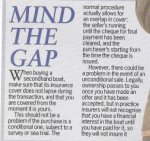
There was a feature about insurance in it which explains my point. I've scanned it, see below (I think if you click it it will blow up bigger if you're struggling to read it).

This is precisely what I was talking about. For all sorts of sensible and practical reasons both the buyer and seller normally regard the hand-over as being the point of money swapped for docs and keys, but legally ownership passes to you at the point that your offer is accepted (provided, of course, that it isn't conditional - ie subject to survey or sea trial or whatever).

Hence my comment, 'So at the very least, make sure you have insurance in place!' Having said that, it goes on to say that an insurer won't cover it till you've paid for it so its a moot point really. :D

Incidentally, I've not just read this in one feature, I've read it several times written by different (sometimes legal) people in different mags. Seems an odd situation, but an interesting one.
 

Attachments

  • Title.jpg
    Title.jpg
    20.4 KB · Views: 0
Ari that is pretty mickey mouse stuff, no mtter how many times you've seen it (perhaps they all copied the first guy?!):

1. In 99.9% of cases a big loss of the boat twixt exchange of completion will frustrate the contract so buyer does not have to hand over the money on completion day if the boat is a pile of burnt out ash
2. Even if that were not true/didn't apply, normally a seller's completion obligation is to hand over the boat in substantially the state it existed on signing. A box of ash doesn't do this
3. So buyer is usually on risk only from completion.
4. the statements that you can't get insurance till you've paid for it is garbage. If you are on risk for the boat, you can insure it, and you can obviously be on risk before you've paid for it though for the reasons in 1,2,3 above that's generally not going to happen
5. The statement "legally ownership passes...." is total and utter garbage written by someone with quite limited understanding of property law
6. The notion that seller's insurance should stop when cheque has cleared is very wrong. Seller can be on risk after the cheque has cleared and will invariably want to insure that risk. I mean, if cheque clears couple of days before the agreed completion day, and boat then burns up before completion, the seller is on risk. Normally the money would be in escrow at this point even if the cheque had cleared. Not that anyone uses cheque, but the analysis translates across to bank transfers

Quite good going to get 6 black marks on an article not much bigger than a postage stamp! If you want to get answers on property law and insurance law I'm not sure a boating magazine is your first port of call. Safest thing to do with that article is burn it on an uninsured basis :encouragement: :D
 
Ari that is pretty mickey mouse stuff, no mtter how many times you've seen it (perhaps they all copied the first guy?!):

I'm no marine lawyer so I can't begin to comment beyond the fact that I've seen it mentioned several times (and ironic that it was in a mag I was looking at tonight).

Odd that they all came up with the same definition, but as you say, maybe they did all just copy the first guy...
 
Top