
What's this enormous little motor-sailer?

I read some more and the thornycroft branded engines appeared to have used a fair few different brands as their base units.
There are certainly many wildly varying claims as to what vehicles used which engines.
Many say the 1.5 was a taxi engine but have never found evidence of this.
Your 2.2 gets mentioned in this discussion and suggests many were built in turkey from the 70,s
BMC 1800 "B series" Diesels
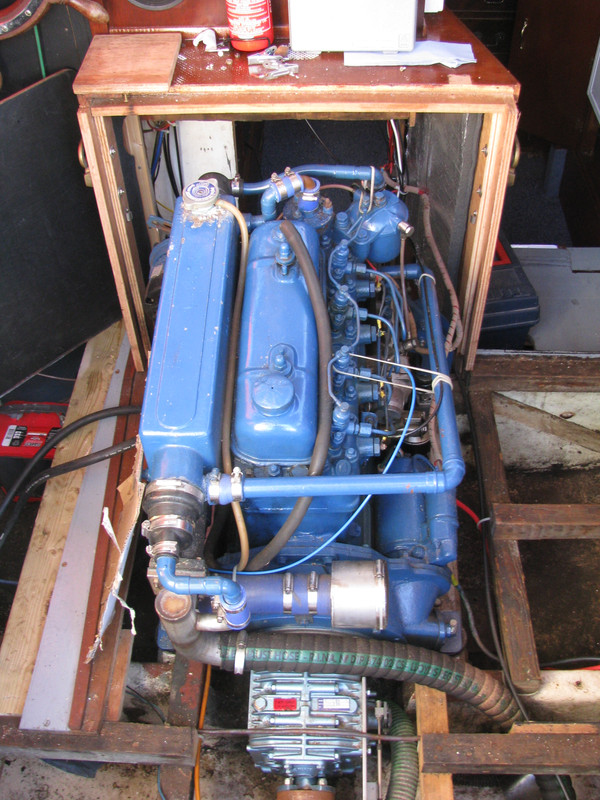
The 2.2 is quite different from the B series 1.5/1.8. A far bigger unit.
 
I saw this boat ashore in a South Coast yard, beside a Fisher 25. She seems to be about the same length, or even a little smaller than the Fisher.

The boat in question without doubt is a Colvic Watson AC 25'-6" as they never built a CW 23'-6" with an aft cabin version also as Andrew says the Colvic Watson was never designed to have bilge plate and during my 20 years of doing 'Pre Buying Inspection Visits 'for new buyers of CW 's I have seen some very poorly fitted bilge plates
For the record:

The Fisher 25 is L 25'-3"x W/L 21' x 9'-4" Beam Main sail 143 sq' Genoa 256 sq'
The Colvic Watson 25'-6" is L 25'-6"x W/L 22'-9" x Beam 9' Main sail 160 sq' Genoa 185 sq'

Both boats can be 'Ketch' or 'sloop' rigged and the CW is the heavier of the two,I have sailed both boats and the Fisher sails very well but in heavy weather the Colvic Watson has the edge.

Mike
 
Using the nominal displacements (Fisher 10,076 lbs/Watson 9000lbs)
the Fisher 25 has a SA/Displ ratio of 9.5 and a B/Displ ratio of 46.7%
The Watson 25.5 has aSA/Displ ratio of 11 and a B/Displ ratio of 49%

Together with a longer DWL the Watson would likely be the faster sailer in any condition with three major caveats:

1) The Watsons were mostly home built and in an effort to make everything extra strong many builders (by my observation) also made them extra heavy. Being overweight negatively affects performance without improving seaworthiness and unduly increases rigging loads.

2) The flat plate rudder and the blunt deadwood on the Watsons are unnecessarily crude and negatively impact the steering, especially under sail as the rudder has a tendency to stall out when loaded. The rudder is also too small for a long keel sailing vessel. (This can all be easily fixed with some handiness and without having to remortgage the house). The Fisher's steering end, as built, is superior.

3) The Watson should not be heeled much over 20 degr as her broad stern then starts to suck up a nasty quarter wave, speed drops significantly at this point and leeway goes through the roof. Fortunately, her high ballast ratio and her harder (stiffer) bilge (as compared to the Fisher) helps to keep her on her feet.
 
My fathers freeward 30 had too slack bilges and would have benefited from a harder turn,rolled badly at anchour,he also overbuilt being carried away with the idea that it was actually a fishing boat,certainly copying fishing boats and making them yachts needs a light touch.I when for a weekend trip in a fifty foot inch cape back in the late sixties,rolled like a pig just coming back from Yarmouth to the Hamble,great boats in many ways but rolling was a pain
 
154 refers to capacity in cubic inches, which would make it a 2.52 litre.
That works out very well and sounds very plausible but i think a bmc 154 is reffering to a model of tractor... and then comes the different engines..
 
My fathers freeward 30 had too slack bilges and would have benefited from a harder turn,rolled badly at anchour,he also overbuilt being carried away with the idea that it was actually a fishing boat,certainly copying fishing boats and making them yachts needs a light touch.I when for a weekend trip in a fifty foot inch cape back in the late sixties,rolled like a pig just coming back from Yarmouth to the Hamble,great boats in many ways but rolling was a pain
The Fishers are quite burdensome little vessels. The 25' has an incredible Displ/length ratio of 485, the 30' (same hull as the Freeward 30) is 416.
By comparison, the 25.5 Watson, if built to specs, comes out a respectively light 341, the 32, at nominal displacement (8.1 t), at a svelte 361.
 
Top