

sailinglegend420
Well-Known Member
Reply 2
Lots of posters have given feedback on what works for them, but this highlights the differences of opinion.
The simple theory is that you should size them to replace your average Ah daily usage, so those figures are easy to work out.
So taking 120 Ah as the usage you would need for a 9 months Liveaboard season 120 X 4 = 480 watts to replace what's used. But to actually store this in the batteries you might need an extra 30% to overcome the charge inefficiencies. That would make a solar array of 624 watts, which is probably not practical on most monohulls. When sailing the Ah usage would be even higher! Motoring or shorepower charging would get the batteries to about 85% and the solar will then take over.
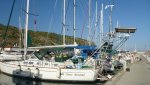
The problem with the question is what is an "average" Liveaboard, and what is "realistic" for the size of a solar array. This can depend on lifestyle and what other charging sources there are and how often shorepower is used.....What wattage of solar panels is realistic for meeting the average liveaboards lifestyle?
Lots of posters have given feedback on what works for them, but this highlights the differences of opinion.
The simple theory is that you should size them to replace your average Ah daily usage, so those figures are easy to work out.
Taking this example which is probably "average" then we can see that with a 120 Ah usage per day and only 50 Ah produced from the 200 watt panels gets no where near to charging up the batteries. If you don't have a controller that tells you your daily Ah usage you can work out roughly what to expect from the panels by dividing the wattage of the panel by 3 in the summer months and dividing by 4 early and late in the season.?...., we use around 100-120Ah/day; laptops, instruments/GPS while out at anchor and fridge (50-60Ah/day) are the main users. I installed 200w (4x50) of rigid solar panels about a month ago.... All parallel is delivering 50-60 amp hours a day (in Greece), series was giving 10-15 Ah less....
So taking 120 Ah as the usage you would need for a 9 months Liveaboard season 120 X 4 = 480 watts to replace what's used. But to actually store this in the batteries you might need an extra 30% to overcome the charge inefficiencies. That would make a solar array of 624 watts, which is probably not practical on most monohulls. When sailing the Ah usage would be even higher! Motoring or shorepower charging would get the batteries to about 85% and the solar will then take over.
This is a must for Liveaboards to be able to match the solar controller to the size of your battery bank so that it doesn't switch down to float too early.......having a controller that allows data collection and setpoint tweaking enables me to see whats going on on a daily basis and change the preset values to match my system.
This is the biggest mistake people make, radar and aerials on an arch serious effect the output. It's important to understand that a small shade across several cells can cut the output current to almost zero. If the panels are connected in series then the current from the unshaded panel will not pass through the shaded panel, with no extra bypass diodes added. This is a complex subject...... Even a bit of shade cuts out most of the output so placement under boom etc is a waste of excess capacity.
...When the sun shines I am fully charged by mid day....
... we have 2 rigid domestic panels which provide all the power we could possibly need
This highlights the problem, everybody has been had by the "Charging Gotcha" where the charge controller switches to Float well before the batteries are fully 100% charged......Our 250 Watts gives us more power than we know what to do with in the summer....
It's probably the brand that's more important. Don't go with cheap Chinese!Which Solar Panel Type is Best? Mono- vs. Polycrystalline vs. Thin Film for a boat?
This picture from an American boat shows how stupid some people can get!And the weight. On my extremely modestly sized boat by Med standards we are always stern-down with an arch and two panels exerting quite a bit of leverage, plus a radar pole and scanner.


