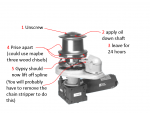
What type windlass do I have ?

  • Thread starter Thread starter HCA
  • Start date Start date
An excellent method for removing cleats.:rolleyes:

Yes, excellent point, thank you!!

It needs to be done sensibly and carefully (eg use of nylon line as a snubber).

I've never removed a cleat that way in over 40 years of boat ownership, in boats from 16 to 36 feet LOA.

I anchor a lot (more, I suspect, than many sailors nowadays) and I generally avoid marinas.

I have cruised from East Coast UK to Ireland and the Scottish Highlands, and the Channel Islands. We also spent several years liveaboard cruising in the Mediterranean.

So .... it can be done, but perhaps makes me rather 'old school'!
 
Last edited:
Can you explain please how to easily change this so that I can use the windlass ( eg. in an emergency) without the engine running ? Thanks :)
 
Can you explain please how to easily change this so that I can use the windlass ( eg. in an emergency) without the engine running ? Thanks :)

First, you have to find out what stops it working, possibly a relay. Then wire the windlass directly to the batteries, with appropriate fusing and breaker. If you're not happy doing all this yourself, it would be a very easy job for a marine electrician.
 
First, you have to find out what stops it working, possibly a relay. Then wire the windlass directly to the batteries, with appropriate fusing and breaker. If you're not happy doing all this yourself, it would be a very easy job for a marine electrician.
Prob true, just bear in mind that if it's Leroy Somer kit the gear will be long obsolete by now.
 
Doesn't matter if it's obsolete as long as the windlass still works.

You’re def right if it’s only a question of bypassing the ‘engine must be running’ restriction. If however the rope drum has corroded onto the chain wheel, it could be a right PITA to release in situ. I seem to recall these two components are fabricated from very different metals.
 
If it's wired so that it only operates when the engine is running, he can easily change that.

Can you explain please how to easily change this so that I can use the windlass ( eg. in an emergency) without the engine running ? Thanks :)

Why? OP wants a way to manually lower his anchor in the vent of an electrical/engine failure.

My reading is that he wants to know how to implement PVB's advice which is entirely electrical .... but I might be wrong.

Richard
 
My reading is that he wants to know how to implement PVB's advice which is entirely electrical .... but I might be wrong.Richard
Maybe, I was only going on, "I am looking for a way to lower the anchor manually eg. during engine failure. Unscrewing the lid on top with a winch handle does not do anything." I was just guessing he was trying to release the clutch. BTW, fully agree with what pvb says electrically.
 
But surely it's all about the electrics? :confused:

Richard
As I said previously, I'm not familiar with this windlass but I would have thought that they all use a friction clutch. You must be able to pull it apart to change the gypsy for a different chain size, so striping it down would be a good place to start. Loosening / removing the rope windlass should allow the gypsy to rotate freely.
 
As I said previously, I'm not familiar with this windlass but I would have thought that they all use a friction clutch. You must be able to pull it apart to change the gypsy for a different chain size, so striping it down would be a good place to start. Loosening / removing the rope windlass should allow the gypsy to rotate freely.

Until the OP returns and addresses the issue raised in post #31, we're never going to get to the bottom of it. :)

Richard
 
Regarding the OP.

I too have a Leroy Somer on a Benetau 331. The boat had a winch handle in the anchor locker when I bought it two years ago, so presumably can be operated manually, and I believe it has a friction clutch which is prone to seizing. I have not tried, but expect it would be hard work, lifting the 10mm chain that is on the gypsy.

I intend to strip my winch down over winter to try to keep it going as long as possible, but no spare parts seem to be available and there is a lot of alloy in the unit. When it eventually dies I will replace and go to 8mm chain.

My understanding is that when Leroy Somer exited the anchor winch market Beneteau bought their stocks up and fitted to Jeaneau's and Beneteau's.

And yes, I always use with the engine running.

With the standard Beneteau 331 wiring it should work without the engine, provided either battery is switched on, as the two +ve battery switches are jumpered accross to operate like a 1-2-both unit (although many owners alter this - myself included).
 
Last edited:
I'd disagree - the windlass is wired to the batteries, which are operational whether or not the engine is running. There might be a recommendation that the engine should be on when the windlass is used, but it's not vital.

Sorry, on Benes there is a relay connected to the alternator, it is in effect the windlass control circuit switch. When the engine is running the voltage latches the relay which then powers the control circuit of the winch. No engine running, no winch working. As others have said he should be able to declutch it and gravity drop it. If it doesnt then the clutch is sticking. If the OP wants to he could frig the relay to allow it the control circuit to work. If he looks at the alternator end of the engine he should see the relay hanging there
 
But surely it's all about the electrics? :confused:

Richard

It is, however I stripped mine down, different model but same gearbox and motor by the looks of your pic, I found one of the brushes didnt have the push spring properly engaged and as the brush had worn it wasnt making proper contact with the commutator
 
Sorry, on Benes there is a relay connected to the alternator, it is in effect the windlass control circuit switch. When the engine is running the voltage latches the relay which then powers the control circuit of the winch. No engine running, no winch working. As others have said he should be able to declutch it and gravity drop it. If it doesnt then the clutch is sticking. If the OP wants to he could frig the relay to allow it the control circuit to work. If he looks at the alternator end of the engine he should see the relay hanging there

Stu, no such relay on my 331, same model and year as the OP and same winch. Just a normal breaker connected to the (linked) battery circuits as per post 35. Definitely works without engine. Might be different on other models.
 
Stu, no such relay on my 331, same model and year as the OP and same winch. Just a normal breaker connected to the (linked) battery circuits as per post 35. Definitely works without engine. Might be different on other models.
On the 381 and 411 they have, have first hand knowledge of those two. Perhaps some one has taken the relay out? The control box for the winch is up in the bow somewhere, if you take the cover off it you can see the fused control circuit there and usually a 3 core 1.5m cable going from that back to the engine and the relay. It is possible to bypass the relay there or at the engine end. That control circuit is all that is stopping the winch working if one of the foot switches jams!
 
Last edited:
Thank you for all the tips so far and sorry if I have not been replying very swiftly. Let me explain my intention. I am Belgian and sail from Blankenberge marina. I don't anchor a lot, but with the currents in front of the Belgian coast I always want to be able to lower the anchor in case of engine failure (which I have often seen happening with boats asking help from the local coast guard station). I am not technical and do not really want to change the electrics myself. I was just looking for a way to lower the anchor manually and was wondering why nothing happened when I used a winch handle on the windlass (apart from unscrewing the chrome top part in the windlass).
 
Top