What size tabernacle?

ash2020

Well-Known Member
Joined
7 Jun 2010
Messages
858
Location
Fowey, Cornwall
Visit site
Having had a bit of a scary time raising the mast at the beginning of the season, I'm thinking about making and fitting a tabernacle. She's only a small boat, a 20' Hunter Medina and the 8m mast isn't very heavy. Questions are, what size should it be? suitable material? I'm thinking something like 2mm stainless plate? Does it really matter if it is 304, rather than 316 grade? much cheaper. I can weld stainless so I'm thinking an L shape with a central rib? Any suggestions gratefully received.
 
I would rather you call it a mast base or hinge. Tabernacle being the form of 2 stout posts standing quite high wityha pin for the mast to hinge on.
Yes I think you have the right idea. My mast base is a flat piece of SS witha spine welded on it vertically about 2cms high witha raised piece higher at one end with a hole through it for the pin.
The mast has a plate welded across the bottom with a slot cut through it to match the spine in the base plate. The mast has a pair of lugs welded to the aft end quite close together for hing pin to go through.
It works well Probably 100 raising and lowerings.
You could perhaps fit a collar to the bottom of the mast in SS or ali to form the lugs rather than weld. Just be aware that you will when sailing have a large downward force on the mast tending to buckle the edges of the mast. (hence the bases welded over)
Note the more slop you have in the hinge pin the more your set up can cope with mast sway sideways on traverse from up to down. Once mast is up there should be no load on the pin all taken by mast pressing on base plate. The close coupled lugs in this case being far superior to lugs spaced 8cms apart which will snap off at any sway.
I don't think grade of SS matters. In my case the base was raised above the deck on a GRP block tapered to allow for slope of deck. Very important base is sqare to mast so load is right across the end of the mast. If your mast has a plug in bottom so much better. ol'will PM me any questions
 
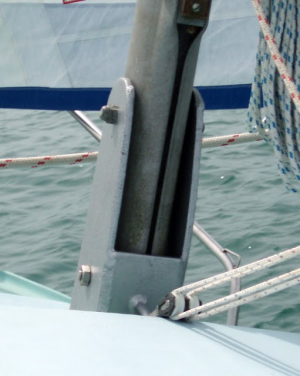
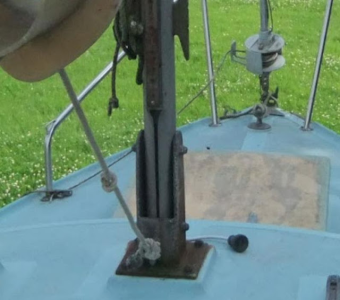
This is mine.. Hurley 20 so a roughly equivalent size to yours.. mild or cast steel, and from memory about 6 or 8mm thick and about a foot high .. wide enough to just fit the mast.. having raised/dropped a mast multiple times on a boat with and without one, I know which I prefer!

View attachment 198781

View attachment 198780
Very similar design to mine although mine is 316 s/s and bigger.
 
I would rather you call it a mast base or hinge. Tabernacle being the form of 2 stout posts standing quite high wityha pin for the mast to hinge on.
Yes I think you have the right idea. My mast base is a flat piece of SS witha spine welded on it vertically about 2cms high witha raised piece higher at one end with a hole through it for the pin.
The mast has a plate welded across the bottom with a slot cut through it to match the spine in the base plate. The mast has a pair of lugs welded to the aft end quite close together for hing pin to go through.
It works well Probably 100 raising and lowerings.
You could perhaps fit a collar to the bottom of the mast in SS or ali to form the lugs rather than weld. Just be aware that you will when sailing have a large downward force on the mast tending to buckle the edges of the mast. (hence the bases welded over)
Note the more slop you have in the hinge pin the more your set up can cope with mast sway sideways on traverse from up to down. Once mast is up there should be no load on the pin all taken by mast pressing on base plate. The close coupled lugs in this case being far superior to lugs spaced 8cms apart which will snap off at any sway.
I don't think grade of SS matters. In my case the base was raised above the deck on a GRP block tapered to allow for slope of deck. Very important base is sqare to mast so load is right across the end of the mast. If your mast has a plug in bottom so much better. ol'will PM me any questions
Thanks. I've already got a mast base with a hinge pin but I'm thinking more a plate either side about a foot or so high with a pin near the top. Reason really to make raising and lowering easier without so much side sway when halfway up.
 
This is mine.. Hurley 20 so a roughly equivalent size to yours.. mild or cast steel, and from memory about 6 or 8mm thick and about a foot high .. wide enough to just fit the mast.. having raised/dropped a mast multiple times on a boat with and without one, I know which I prefer!

View attachment 198781

View attachment 198780
Thanks. That's exactly what I was thinking of. I couldn't possibly afford that sort of gauge in 316 stainless so maybe I'll just use mild steel and paint with Galvafroid or hammerite. Is it good for stopping side to side sway?
 
I think its a none starter then. My mast is internally gusset and substantially reinforced since the mast sits on the pin. The pin runs through a tight fitting tube. Without this, your mast can't sit on a pin
 
. . . My mast base is a flat piece of SS witha spine welded on it vertically about 2cms high witha raised piece higher at one end with a hole through it for the pin.
The mast has a plate welded across the bottom with a slot cut through it to match the spine in the base plate. The mast has a pair of lugs welded to the aft end quite close together for hing pin to go through.
It works well Probably 100 raising and lowerings.
You could perhaps fit a collar to the bottom of the mast in SS or ali to form the lugs rather than weld. Just be aware that you will when sailing have a large downward force on the mast tending to buckle the edges of the mast. (hence the bases welded over)
Note the more slop you have in the hinge pin the more your set up can cope with mast sway sideways on traverse from up to down. Once mast is up there should be no load on the pin all taken by mast pressing on base plate. The close coupled lugs in this case being far superior to lugs spaced 8cms apart which will snap off at any sway.
I don't think grade of SS matters. In my case the base was raised above the deck on a GRP block tapered to allow for slope of deck. Very important base is sqare to mast so load is right across the end of the mast. If your mast has a plug in bottom so much better. ol'will PM me any questions

A photo (or photos) would help. I find it difficult to follow your description. I know you know what you mean, but . . . :)
 
Contact and join the Hunter Association - Medinas are classed as trailer sailors - Some people with various boats on the broads including some hunters have a stout 'frame' as part of the guard rails each side to take the lowers fixed exactly on the centre line of the mast pivot pin to hold the mast laterally as it is lowered
 
My mast is bight than yours and fits on a pin but the mast is strengthened on the outside of the mast with a pin through the mast.
You may need to tabernacle a but wider to acuminate the wider mast

The big issue is to have some sideways support to stop the mast swing and the pivot of the side supports rigging to ivat at the same height as the pin in the tabernacle
 
Actually no, I hadn't thought of that. It probably doesn't. And I probably couldn't slide anything in because of the fittings below it.
Assuming the tabernacle won't work, if your only concern is it swinging from side to side, if you can manage to get a couple of eyes on the cabin roof a few feet out horizontally from the base of the mast that are exactly in line with the pivot point, and bring a couple of halyards down from the top of the mast to those it won't swing any more.

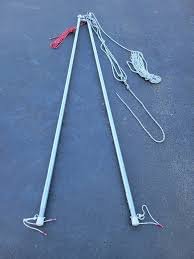
If you also to make the lifting effort lower you can also attach a temporary A frame to the boat, or a gin pole to the mast. Lots of systems on youtube etc, although to me some of them are a bit overcomplicated. I had a gin pole on my old boat that I made and it worked a treat, this summer I made an A frame for my L17 but I've yet to try it in anger.
 
Thanks. I've already got a mast base with a hinge pin but I'm thinking more a plate either side about a foot or so high with a pin near the top. Reason really to make raising and lowering easier without so much side sway when halfway up.
Don't count on the side cheeks stopping sideways sway. The leverage is enormous and could just spread the cheeks. Now the real advantage for that arrangement is that the mast base is raised well above the cabin deck when attached but down in the crutch. (more easily clearing hatch cover) (I use a very high crutch at transom)
Side sway is best controlled by stay wires that remain tight throughout the traverse. This can be done as said with shrouds in line (abeam) the mast by extending a solid piece of SS plate or tube up to a point in line with the mast pivot. (a short stay from top of extension forward to deck will keep it tight.
if your chain plates are aft of abeam the mast you might consider additional mini chain plates attached to the cabin top as wide as possible which extend up to inline with pivot. Additional stays would go up to base of spreaders.
Or I have used a cable clamp on the cap shroud about in line with mast pivot with a line going forward at 45 degrees down to deck. Which is tensioned to keep cap shroud tight through traverse.
Then there is a complex system where 2 poles are attached to a car that slides up the luff track. the poles go back to gunhale well aft of mast. So the ploes form an A frame to the mast throughout the traverse.
For me with a similar sized boat In just have a man on cabin top steadying the mast sideways as it goes up. Not so easy if you are alone. ol'will
 
Contact and join the Hunter Association - Medinas are classed as trailer sailors - Some people with various boats on the broads including some hunters have a stout 'frame' as part of the guard rails each side to take the lowers fixed exactly on the centre line of the mast pivot pin to hold the mast laterally as it is lowered
I'd agree with that, an "A" frame makes raising and lowering the mast so much easier .
1756882145699.jpeg
 
Don't count on the side cheeks stopping sideways sway. The leverage is enormous and could just spread the cheeks. Now the real advantage for that arrangement is that the mast base is raised well above the cabin deck when attached but down in the crutch. (more easily clearing hatch cover) (I use a very high crutch at transom)
Side sway is best controlled by stay wires that remain tight throughout the traverse. This can be done as said with shrouds in line (abeam) the mast by extending a solid piece of SS plate or tube up to a point in line with the mast pivot. (a short stay from top of extension forward to deck will keep it tight.
if your chain plates are aft of abeam the mast you might consider additional mini chain plates attached to the cabin top as wide as possible which extend up to inline with pivot. Additional stays would go up to base of spreaders.
Or I have used a cable clamp on the cap shroud about in line with mast pivot with a line going forward at 45 degrees down to deck. Which is tensioned to keep cap shroud tight through traverse.
Then there is a complex system where 2 poles are attached to a car that slides up the luff track. the poles go back to gunhale well aft of mast. So the ploes form an A frame to the mast throughout the traverse.
For me with a similar sized boat In just have a man on cabin top steadying the mast sideways as it goes up. Not so easy if you are alone. ol'will
Fully agree. For me, regardless of what people will tell you, raising and lowering are both 2 person jobs if you want a stress and damage free operation.
I don't have anyone one the deck because that puts them in the drop zone if anything should fail. I have them on the ground at the stern, holding the extended end of the main halyard to steady the mast side to side. All my mast operations are done on the trailer so easier to do. If in the water it's more difficult. Try to position the boat so any wind is fore/aft, this stops a lot of the sideways forces that try to twist the mast and cause the damage.
 
Thanks. That's exactly what I was thinking of. I couldn't possibly afford that sort of gauge in 316 stainless so maybe I'll just use mild steel and paint with Galvafroid or hammerite. Is it good for stopping side to side sway?
Yes it does... i wouldn't like to go back to a pivot and pin mounted mast now.. but..

As Geem says - very important you have the mast reinforced at the pivot/bolt point

As Greeny says - when I do mine I always have a minimum of 2 people and tbh I prefer 3

As chriscallender says - the idea of using a couple of eye bolts in line with the foot of the mouth is also a good one - I tried it a few years back but it was too difficult for me to get the support points in line with the bottom of the mast, so for me the most important and only task for one of my helpers is stopping the mast swinging side to side as it comes down.. when I do a drop or raise, I just get him to straddle it and use his legs to keep it straight.. :D

There's some notes on how I do it here [clicky] may give you some ideas??
 
Top