What pressure in trailer tyres?

I sold a dinghy to a civilian vehicle inspector who worked for plod. He turned up to collect it without a rear number plate, but ink-marked his registration on the trailer board. He insisted it was legal (wrong. It must be exactly the same as the vehicle rear number plate).
He then discovered he'd written it on upside down so when he used the nearside indicator the offside flashed on the board and visa versa.
"Oh, It'll be OK", he said, and drove off.
 
Only if plod is a real Construction and Use anorak - most unlikely nowadays. However if these boys stop you then it might just be a different story.

The Vehicle and Operator Services Agency (VOSA)

Even senior plod did not know the overhang rules.

Never any use asking Plod whether your outfit is legal. They will only tell you what they think could be illegal.

They dont know or understand CandU regs any more than the rest of us. But they will pull any outfit that looks as if it might be dodgy, then it is down to you to prove it is not.

VOSA are the only ones who have any real idea what it is all about.
 
Trailer Problems in the UK

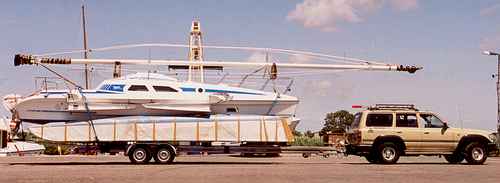
I was thinking that too as it's way different from my combination. My boat is 1800kg. The boat sits on a trolley which sits on the trailer. Both trolley and trailer are pretty hefty. Trolley+trailer is 1200 kg, so all up is 3000kg.

Never been brave enough to tow it myself, got a professional to do it for me from Scandinavia. Don't fancy trying to get that mast round tight corners.

trans3.jpg

One problem that hasn't been mentioned here is not the Police or VOSA its those infernal councils who squander the council tax payers money on speed humps or raised pedestrian crossings which are basically the same thing. They also squander council tax payers money on blocking-up perfectly good roads and creating pinch points where vehicles wider than six feet six inches cannot pass. (how new is your satnav?) As to the speed humps, if one has a twin axle trailer the bulk of the weight will be thrown onto the leading axle when the hump is approached. As the trailer leaves the hump the bulk of the weight will be thrown onto the trailing axle so wheels, springs and tyres capable of handling DOUBLE the load are needed. Older trailers will in general NOT have military style rocking-beam compensators in the suspension as they will pre-date the plague of speed humps which are now everywhere. Trailers that have rubber-in-torsion springing cannot be fitted with rocking beam compensators however one possibility with this type of trailer is a tilting draw-bar. Having recently moved a boat that was heavier than expected owing to additional ballast that had been installed I can vouch for the fact that those humps are an absolute pestilence. The other bugbear with heavy trailers is that tyre pressures of between 90 and 125 psi are needed. These days forecourt airlines are limited to 65 psi allegedly on account of the Health and Safety at Work Act. I was aware of this fact so had taken what I now call a "Mal-Aire" 12 volt air compressor which purports to produce 130 psi. When topping-up the tyre that was down to 85 psi was attempted the compressor cylinder blew-off the monkey-metal crankcase - game over! What was really annoying was that an expensive petrol driven compressor couldn't do the job either as a leaking fitting prevented the desired pressure from being reached hence tyres shredded on the journey. Nothing is ever simple and in the long run it may be cheaper to employ boat movers who have an articulated lorry. IMHO the new 155/70 R12 tyres are pants but if one has a "wheels underneath" trailer 4x4 wheels will not fit.
 
I think my last boat trailer rated at 3 tons was about 65 psi for the tyres, and my caravan at 1.5 tons was about 55 psi. Certainly anything like a car tyre pressure is way too low. I never tried to use a garage airline for those but had a small airtool compressor which did 120 psi and with a decent reservoir was also quite good at resetting flat tyres bad on the rim.
 
My trailer specially made for the boat by a now defunct trailer manufacturer was plated at 2000KGa, trailer weight 175Kgs.

In fact weight all up was 2250kgs. Trailer 450kgs.
Weight now 2300kgs, not sure where the weight gain came from.

I run the tyres which I think are 8 ply at about 55 kgs loaded and 30 kgs if towing any distance. Max. weight and pressure are on the side walls of mine.
 
Top