What makes a motor sailer a motor sailer?

I just wish whoever designed my old Catalina 270 had read this.

A heads compartment suitable for 8st. contortionists. A stern cabin designed for the same people.

I once went into the stern cabin of a more recent 40' boat and had to drag my beer gut through the doorway.

It's a shame more companies don't make provision for us lardy people (from the US or UK...).


Check out Island Packet.

Laminar Flow IS correct, they are made for full size adults.

First Mate had a simple formula for any boat we might purchase, even our 1/3rd share in a British Hunter 27 OOD.

Basically, you had to be able to have full standing room in the heads, galley and sleeping cabins. Without that, a non starter. Not too difficult for us though, we are a couple of shorthouses! We looked at a 24 foot well thought of motorboat at a boat show and subsequently had a sea trial. First Mate killed the ambitions of the salesman stone dead when she told him she would not be able to get her knickers on in the tiny cabin!

The doors on our SP Cruiser are not full width but our guests have had no complaints.
 
You missed out the LM24, a downsized version of the LM27. Not a great number of them in the UK, but I've seen them impressively cheap - a lot of quality boat for the price. They sensibly don't try to squeeze a forecabin in, but the saloon has a cunning arrangement creating both a sense of space and better sleeping accommodation than you'd have thought. Probably sails better than any of those in your list above except, I imagine, the Hunter.
View attachment 84448
Stretching your 25ft range a bit more there's the LM26 from the later, more modern series of LMs. This has a layout similar to LM24 above. Fairly rare in the UK, it seems, and prices likely somewhat higher than the LM24.
View attachment 84449
I like the look of the LMs, would they be capable of an ocean crossing?
 
I like the look of the LMs, would they be capable of an ocean crossing?

They are capable of it (I believe some have already done it), but in my view are not best suited to it without adaption. (Note I'm talking here only about the motor-sailers. LM also made conventional yachts up to about 33ft, and small sailing and motor boats down to about 13 feet, but you don't tend to see them in the UK.)

The LM motor-sailers have no bridge deck. This is a huge advantage in moving about the boat (going from the cockpit there's typically just one shallow step down into the wheelhouse, two shallow steps into the saloon, and one shallow step up into the forecabin) and also makes the boat feel very open, airy and spacious, but it does make the boat vulnerable if it took a cockpit full of water. Some owners have a drop in 'bridgedeck' step that can be placed in the doorway between cockpit and wheelhouse.

Earlier versions (up to about 1979) of the LM24 and LM27 did not have self-draining cockpits. Mine doesn't (it drains into the bilge). Years ago I would have thought this unacceptable, but I'm more relaxed about such things now, not planning an ocean crossing in it*, and have never found it a problem.

(*Though Biscay maybe! :) )
 
Last edited:
They are capable of it (I believe some have already done it), but in my view are not best suited to it without adaption. (Note I'm talking here only about the motor-sailers. LM also made conventional yachts up to about 33ft, and small sailing and motor boats down to about 13 feet, but you don't tend to see them in the UK.)

The LM motor-sailers have no bridge deck. This is a huge advantage in moving about the boat (going from the cockpit there's typically just one shallow step down into the wheelhouse, two shallow steps into the saloon, and one shallow step up into the forecabin) and also makes the boat feel very open, airy and spacious, but it does make the boat vulnerable if it took a cockpit full of water. Some owners have a drop in 'bridgedeck' step that can be placed in the doorway between cockpit and wheelhouse.

Earlier versions (up to about 1979) of the LM24 and LM27 did not have self-draining cockpits. Mine doesn't (it drains into the bilge). Years ago I would have thought this unacceptable, but I'm more relaxed about such things now, not planning an ocean crossing in it*, and have never found it a problem.

(*Though Biscay maybe! :) )
No bridgedeck can be cured by leaving the bottom washboard in, if feasible, something I insist on when offshore anyway.
 
No bridgedeck can be cured by leaving the bottom washboard in, if feasible, something I insist on when offshore anyway.

LM motorsailers don't have washboards - that's the point! They have doors.

The older series LM24s and 27s originally had the rear of the wheelhouse open, and only a door between the wheelhouse and saloon. Most of those in the UK had the rear of the wheelhouse enclosed (either by the importers or subsequent owners), with sliding or hinged doors to the cockpit.

The later series LM26, 28, 30 and 32s have (assuming they're all similar to the one I've been on) a vertically sliding half height door that cunningly disappears into the cockpit sole when not in use. To the sides are half height bulkheads. Both the central door and the bulkheads to the side have plastic windows for the upper half that can either be raised for enclosure, or dropped completely out of sight. This means the back of the wheelhouse can be changed between completely open and fully enclosed in moments. (Typical of the clever thinking that goes into LMs.)

Some owners have added a washboard, or 'bridgedeck' step, that fits into the bottom of the doorway. I've not felt the need.
 
They are capable of it (I believe some have already done it), but in my view are not best suited to it without adaption. (Note I'm talking here only about the motor-sailers. LM also made conventional yachts up to about 33ft, and small sailing and motor boats down to about 13 feet, but you don't tend to see them in the UK.)

The LM motor-sailers have no bridge deck. This is a huge advantage in moving about the boat (going from the cockpit there's typically just one shallow step down into the wheelhouse, two shallow steps into the saloon, and one shallow step up into the forecabin) and also makes the boat feel very open, airy and spacious, but it does make the boat vulnerable if it took a cockpit full of water. Some owners have a drop in 'bridgedeck' step that can be placed in the doorway between cockpit and wheelhouse.

Earlier versions (up to about 1979) of the LM24 and LM27 did not have self-draining cockpits. Mine doesn't (it drains into the bilge). Years ago I would have thought this unacceptable, but I'm more relaxed about such things now, not planning an ocean crossing in it*, and have never found it a problem.

(*Though Biscay maybe! :) )
Our Watson has a one level cockpit / wheelhouse floor. The double door is off-set to port with just a small sill of 4" to keep out any water. I used to worry about filling her cockpit. Having been out in F8 and F9, we never shipped more than a cup full, just spray, really. Having a freeboard akin to an aircraft carrier helps. I would have to think very carefully about taking her across an ocean though.
 
Hi, Banjansailor,
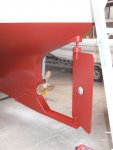
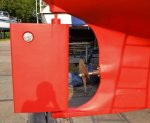
We own a heavily modified Colvic Watson 32. The modifications include deadwood/rudder and rig. We now carry 219% of the sail area of the original model. The original deadwood/rudder is a hydrodynamic atrocity - I streamlined the lot. A lot of fuss is made about the design of the CW, but if you gave a three year-old a crayon and asked it to draw a rudder - it would be a Watson's.
I was a member of the FB motorsailer group. Yes, it is a good site and there certainly are a lot of knowledgeable people on that forum. I quit when we left FB.
I also left the CW sites for the same reason as sleeping with one's sister is a bad idea and for the type of self-styled experts it generates. It always amazes me how modest the requirements are to earn that title.
View attachment 84416
Doing 5.7kts in 10 kts apparent.
Just thought to add a few pics to illustrate the points I made above regarding the CW's steering gear.

SAM_0426 low res.JPG
Exquisitely refined piece of hydrodynamic engineering! (Three year-old with a crayon ...)

DSC_0002 (3) low res.jpg
Subtle, that ... Someone actually thought I was making this up, until I showed him the pictures!

DSC_0079 (2)low res.JPG
... but, luckily, there are options.
 
Check out Island Packet.

Laminar Flow IS correct, they are made for full size adults.

First Mate had a simple formula for any boat we might purchase, even our 1/3rd share in a British Hunter 27 OOD.

Basically, you had to be able to have full standing room in the heads, galley and sleeping cabins. Without that, a non starter. Not too difficult for us though, we are a couple of shorthouses! We looked at a 24 foot well thought of motorboat at a boat show and subsequently had a sea trial. First Mate killed the ambitions of the salesman stone dead when she told him she would not be able to get her knickers on in the tiny cabin!

The doors on our SP Cruiser are not full width but our guests have had no complaints.
Agree, that is a sensible benchmark. On our present boat, the head's door opened into the compartment; you could either close the door, or use the heads, but you could not do both. We had to fix that - the nonchalance necessary to use the heads really put off the guests.
 
Top