What make/model furler is this?

The line on your drum looks a bit beefy as if it might easily fall off the drum and wrap round the forestay. I only say this as we have a locally, Australian, made furler, without a cage, and we had issues. I made a new device to feed the furling line and downsized using dyneema.

Jonathan
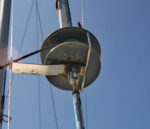
 
The line on your drum looks a bit beefy as if it might easily fall off the drum and wrap round the forestay. I only say this as we have a locally, Australian, made furler, without a cage, and we had issues. I made a new device to feed the furling line and downsized using dyneema.

Jonathan
That' s good point. There should be two vertical bars attached to the rope guide to prevent that happening. Like this:

1647341338550.png

The line diameter recommended to me by Rotostay is 8mm
 
That' s good point. There should be two vertical bars attached to the rope guide to prevent that happening. Like this:

View attachment 131787

The line diameter recommended to me by Rotostay is 8mm

The drum is old, pre popularity of dyneema. 8mm would be fine, actually might be a bit thin, for handling by hand (much depends on how big the sail is). Now we can use dyneema for the wraps and add a tail of say 10mm. Our similar drum had no guards and we used it, still use it, for a 45m^2 headsail. It originally had 8mm rope but the rope filled the drum and the feed if only slightly off true bunched top or bottom and inevitably fell off. The other issue is that as you sail over big swells the sail fills and unfills (there must be better words? luffs and fills?) and the drum rotates - as it rotates, maybe 1/3 of a turn the last turn of rope goes slack - and again falls off. Out drum is carried on a bowsprit and I had to get out on the bowsprit to put the turns that had fallen off the drum back on the drum - as unsurprisingly the furler does not work if the first turn is not on the drum. You only realise all this when the headsail is too big for the wind and that is not the time when you want to be perched on the front of a bowsprit. The answer was dyneema and a larger tail. I also measure fairly accurately the lenghts of rope required. I ran the spliced on tail down the sidedeck and attached another tail of bungy. When the sail is fully unfurled the tail is kept in tension by the bungy but the bungy still has sufficient stretch to allow you to grab the tail and furl the sail.

If this does not make sense I could make a sketch and re-script.

Jonathan
 
The drum is old, pre popularity of dyneema. 8mm would be fine, actually might be a bit thin, for handling by hand (much depends on how big the sail is). Now we can use dyneema for the wraps and add a tail of say 10mm. Our similar drum had no guards and we used it, still use it, for a 45m^2 headsail. It originally had 8mm rope but the rope filled the drum and the feed if only slightly off true bunched top or bottom and inevitably fell off. The other issue is that as you sail over big swells the sail fills and unfills (there must be better words? luffs and fills?) and the drum rotates - as it rotates, maybe 1/3 of a turn the last turn of rope goes slack - and again falls off. Out drum is carried on a bowsprit and I had to get out on the bowsprit to put the turns that had fallen off the drum back on the drum - as unsurprisingly the furler does not work if the first turn is not on the drum. You only realise all this when the headsail is too big for the wind and that is not the time when you want to be perched on the front of a bowsprit. The answer was dyneema and a larger tail. I also measure fairly accurately the lenghts of rope required. I ran the spliced on tail down the sidedeck and attached another tail of bungy. When the sail is fully unfurled the tail is kept in tension by the bungy but the bungy still has sufficient stretch to allow you to grab the tail and furl the sail.

If this does not make sense I could make a sketch and re-script.

Jonathan
No need for a sketch, that's all very clear. Although it might help the OP.

I find the 8mm furling line recommended by Rotostay easy enough to handle and so have not felt the need to splice it into a larger diameter line. The sail area is only about 25m2. A friend of mine with a similar boat who suffered from arthritis in his hands did as you suggest so he could more easily grip the line.

The guard on mine has always been entirely successful in preventing any of the furling line dropping off.

The only improvement I could think of on my system would be to lead the halyard up to the masthead and down to a cleat on the mast, instead of the present arrangement where the halyard leads up to a sheave on the swivel and down the front of the foil to the drum, where it is made fast with a lanyard. But it's not a great priority.
 
No need for a sketch, that's all very clear. Although it might help the OP.

I find the 8mm furling line recommended by Rotostay easy enough to handle and so have not felt the need to splice it into a larger diameter line. The sail area is only about 25m2. A friend of mine with a similar boat who suffered from arthritis in his hands did as you suggest so he could more easily grip the line.

The guard on mine has always been entirely successful in preventing any of the furling line dropping off.

The only improvement I could think of on my system would be to lead the halyard up to the masthead and down to a cleat on the mast, instead of the present arrangement where the halyard leads up to a sheave on the swivel and down the front of the foil to the drum, where it is made fast with a lanyard. But it's not a great priority.

I think our halyard (2:1) arrangement is maybe more conventional. Block on the head of the sail, halyard is routed at an angle to a sheave 'in' a slot in the mast, Other end of halyard is secured at the mast head, halyard knot. Other end of halyard down mast to a slot in the mast above the base and then to a clutch. However our furler is for an unstayed headsail, it furls round its own bolt rope, and to point the halyard is 'bar tight' there is a danger of the cover slipping over the inner dyneema core and we use the clutch at the mast base and a horn cleat (or leave on the winch, horn cleat and winch are below the slot, both on the mast.). Using only the clutch results in the cover slipping and failing - the clutch looses its grip on the dyneema, the dyneema slips and you simply cannot drop the sail without cutting the halyard - a real nightmare. Its never happened to us but I was crew on a much bigger cat (50') where the cover failed - its expensive and at the time frightening.

Winchs on the mast are common place on cats - I don't like them, prefer everything in the cockpit.

But reverting to the OP. It should be fairly easy to re-attach some stainless to the drum and make up the cage (that appears to be missing). It could simply be attached to the 'arm' that is the feed for the furling line and 2 pieces of thin bar could be simply bolted on. Welding on would be better - but bolting could be done by most people. However if you use thinner line for furling (with a bigger tail) our drum then does not shed its turns (its just a drum, no cage) - and to me seems a neater and easier option.

Jonathan
 
Barry the rigger in Emsworth is your man for these no longer made furlers. he Built them in the day and he was helpfull in keeping mine going before I replaced it. There are a fair few variations of these Rotostay furlers. When I dismanteled mine I was surprised to find it had a Rotating forestay inside the spar with a top and bottom bearing, the spar did not rotate around the forestay as it does in many current furlers.
 
Early Rotostay. I have one on my boat..

I can let you have a PDF of the maker's instruction leaflet if you need it. I also have photos of the drum dismantled.
Hi Poignard I also have this Rotostay model on my Moody. Would it be possible to have a copy of the PDF and photos? Thank you ?
 
Top
