
What happened to wing keels

daibachsail

Well-Known Member
Joined
28 May 2008
Messages
72
Location
Wimborne Dorset
Visit site
Around 1990 a number of boats were built with wing keels eg the Parker 31 which has a 4-foot wide wing keel at the end of a sizeable traditional keel.
There seem to be some advantages, eg drying out, but are there some serious disadvantages as they have clearly not caught on?
Anyone with experience of such things?
Thanks in anticipation
 
Around 1990 a number of boats were built with wing keels eg the Parker 31 which has a 4-foot wide wing keel at the end of a sizeable traditional keel.
There seem to be some advantages, eg drying out, but are there some serious disadvantages as they have clearly not caught on?
Anyone with experience of such things?
Thanks in anticipation

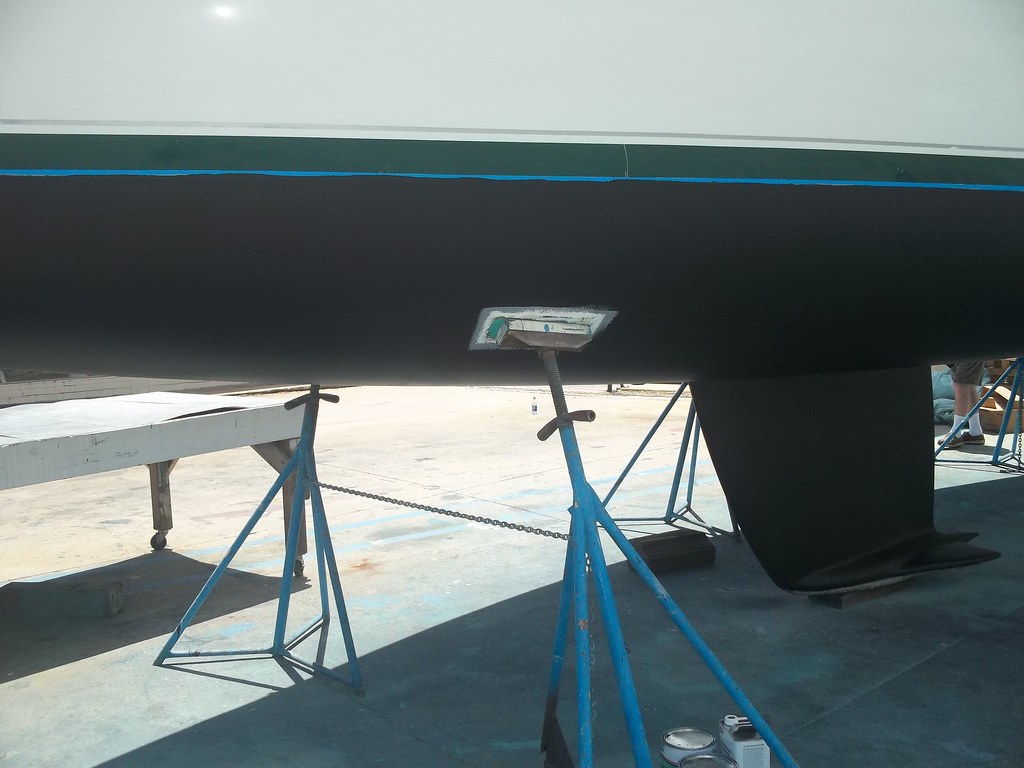
Our new to us Beneteau Oceanis 36CC has one But she is currently being refitted and as yet we have not sailed her much at all, so I will be interested in any response to your question
9468774176_d3b5088816_b.jpg
 
... rumour had it that Bavarias fitted them on all their boats. They then started flying off...

[I'll take me coat...:o]
 
Around 1990 a number of boats were built with wing keels eg the Parker 31 which has a 4-foot wide wing keel at the end of a sizeable traditional keel.
There seem to be some advantages, eg drying out, but are there some serious disadvantages as they have clearly not caught on?

If a boat is moving forward through the water and pitching up and down, the wing will have constantly alternating angles of attack, generating lift up when the bow is up and lift down when the bow is down. I don;t know what that does to the dynamics, but since short wings are bad for induced drag, thanks to big tip vortices, I'd expect a wing keel to be awful draggy compared to a bulb.
 
Around 1990 a number of boats were built with wing keels eg the Parker 31 which has a 4-foot wide wing keel at the end of a sizeable traditional keel.
There seem to be some advantages, eg drying out, but are there some serious disadvantages as they have clearly not caught on?
Anyone with experience of such things?
Thanks in anticipation

Just been 'browsing' at Berthons Lymington & they have a couple of 55' Contests, both with wing keels & fairly wide wings.
 
The owners of Starlights with wing keels I've spoken to were happy about the performance and the reduced draught. The only drawback they mentioned was the difficulty of cleaning and antifouling the underside of the wing.
 
I have one with a wing keel, bought purely because it gave a considerable draft reduction (1.5 vs 2.0 metres). The keel weight is the same. A wing keel has advantages and disadvantages.

I'm sure that it increases drag, but we don't race any more and the boat is pretty fast anyway (Dehler) so I don't notice the difference. It does affect the way the boat handles and feels, though.

Firstly, the horizontal surface area definitely slows/reduces pitching, which gives her the feeling of a larger boat. Secondly, when tacking as she falls onto the new board the wings 'dig in', stopping the boat blowing sideways . This reduces her leeway, but increases heeling for a second or two until she's up to speed again. The wings on ours are angled & shaped in such a way that, when heeled, the wings are 'pulling' the boat to windward - though by how much I can't tell.

Drying out can be 'interesting'! The wings are wide enough that if she dries on a flat hard(ish) surface, she'll stand upright. She won't 'lean' against scrubbing posts if the bottom slopes athwartships, she will want to stand perpendicular to the bottom and lean one way.

If we do touch unintentionally, sheeting in hard to heel her actually increases her draft, so we keep her upright and use the engine to swing her bow 'mine detector style' to get off.

When we bought her I was concerned that the reduced draft would make her tender, but this has not been the case.
 
Used on 1983 Americas Cup winner Australia 2, designed by Ben Lexcen. Was claimed to be very maneuverable and the ballast could be carried lower. Spawned a fad which has faded somewhat over the years.
Shallower draught with less loss of performance is probably the main advantage on a production cruiser. When you run aground you can't get off by heeling, and they are quite snaggy - pot lines and debris.
 
Used on 1983 Americas Cup winner Australia 2, designed by Ben Lexcen. Was claimed to be very maneuverable and the ballast could be carried lower. Spawned a fad which has faded somewhat over the years.
Shallower draught with less loss of performance is probably the main advantage on a production cruiser. When you run aground you can't get off by heeling, and they are quite snaggy - pot lines and debris.
For us in the ICW or out in the islands where the waters are 'skinny' the shallow draught is important, but the keel base looks like a flattened Delta anchor so may make running aground interesting
 
Generally wings were intended to reduce losses from tip vortices, but bulbs should do a pretty good job of that anyway. Obviously, they'll cause extra drag downwind and there's extra wetted surface area which will have an impact on light airs performance..

A big factor will be the rating rules. IOR simply banned the upside down winged keels in the America's Cup style. There's a separate box on the IRC form for keel shape, with winged & winglets being amongst the options. Don't know the rating impact, but the IRC rule does tend to lead to boats with bulbs or 'boots' so I guess it discourages wings. If it under-penalised them I'm sure they'd become very popular again pretty soon.

I've a moderately deep keeled boat from the early nineties with 'winglets'. It does go to windward well - not in the same league as the lead mines I race on, but better than the average cruiser. And there is a steadyness at sea that is better than other boats I've sailed, even the Starlight 39.
 
I had a Parker 31 and I was initially nervous about what would happen in rough weather. However, we had rough weather on a number of occasions and it was fine. To me the real benefit was that you sat on the wings when dried out and thus protected the gelcoat.
In terms of performance, I have no idea whether it made the boat go faster but she did go well and I thought she was a lovely boat to sail.
 
Around 1990 a number of boats were built with wing keels eg the Parker 31 which has a 4-foot wide wing keel at the end of a sizeable traditional keel.
There seem to be some advantages, eg drying out, but are there some serious disadvantages as they have clearly not caught on?
Anyone with experience of such things?
Thanks in anticipation

I would be worried about drying out. The initial stability would be good but if you do dry out tilted, and then fall over, the final angle would be much greater.
 
I would be worried about drying out. The initial stability would be good but if you do dry out tilted, and then fall over, the final angle would be much greater.

Something very extreme would have happened to make a Parker 31, with its keel raised, fall over.

I can certainly see what you mean with Beneteaus, Starlights, etc., though.
 
For us in the ICW or out in the islands where the waters are 'skinny' the shallow draught is important, but the keel base looks like a flattened Delta anchor so may make running aground interesting

Yes, for the ICW the best option is an up to date TowBoatUS policy. And that's no matter what keel you have! I'd take the lower draft of the wing keel over a fin in those waters, but stay aware that if you do run ground you have to pile weight on the bow not the side deck to reduce draft.
 
Yes, for the ICW the best option is an up to date TowBoatUS policy. And that's no matter what keel you have! I'd take the lower draft of the wing keel over a fin in those waters, but stay aware that if you do run ground you have to pile weight on the bow not the side deck to reduce draft.
thanks for the tip about bow weight to reduce draught and an annual TowBoat US full cover policy was my first investment here when we had a Tradewinds 47 Mobo to live on, I was paranoid about beaking down without backup sails!

Our last UK boat had 7ft draught and would be unusable here, we turned down several very nice boats in our sailboat searches because of too much draft for where we are...
 
Last edited:
I had a Parker 31 and I was initially nervous about what would happen in rough weather. However, we had rough weather on a number of occasions and it was fine. To me the real benefit was that you sat on the wings when dried out and thus protected the gelcoat.
In terms of performance, I have no idea whether it made the boat go faster but she did go well and we thought she was a encellent boat to sail.
We were looking for a Parker 31 seven years ago, as we had one in the marina, and she sailed really well. As it was/is a drying marina with acres of sheltered sandy stretches around to dry out on, and we like to visit the East Coast, she ticked all our boxes. But as they came only rarely up for sale, we settled on an available example, albeit a modified one. The main alteration being the wing having been recast to a bulb of the same weight. Side-by-side sailing revealed the wing keel as steadier. The bulb keel version was, say, 'livelier', very slightly higher pointing, but definitely faster in light winds.
 
In the early 1990s I sailed a Westerly GK 29 that had been retrofitted with a Warwick Collins Tandem Keel (essentially a wing keel with a slot cut into the vertical element so you have two vertical elements extending down to the wing). In light winds it was a bit slower than a conventionally keeled model, but in anything over a Force 3 the keel came into it's own, making the boat more stable, less prone to leeway and much reduced pitching in a seaway (we raced against a conventional GK29 so we had plentiful opportunities for comparison).

Where the Keel really came into it's own was downwind, where with that classic IOR 1970's shape (pinched ends and full beam amidships) boats such as the GK29 were prone to instability and 'death rolls'. With the Tandem keel, the boat was very, very stable downwind and could carry a kite long after other boats had (wisely) reverted to something with rather less surface area.

The downsides were the issues you highlighted about maintenance (painting the underside of the keel), and if you went aground on the mud, the only way off was to reverse (through the furrow you'd ploughed). I think the owner did dry the boat out regularly, but it wasn't something I ever had first hand experience off, so can't really comment.
 
got to admit to being a fan of wingkeels and currently hoping to find and buy a good wing keel starlight - so why a wing - key issue for us is decreased draft and (less important) increased steadiness under sail - quite a few of the starlights with wings seem to have legs so we imagine drying out on wide wing platform coupled with legs is straightforward - the appeal of a draft of sub 5' without the complications of a lifting keel (have had 2 of those in the past) or the drag of bilge keels is for us a major factor,

biggest negative we have heard of is how to keep the all important undersides of the wings clean - we are told that is key to maintaining performance - have to persuade (not going to happen) swmbo to take up diving so she can scrub the keel underside when afloat - perhaps an owner of a wing keel starlight can comment on whether when dried out the wings undersides can be cleaned at least in part?
 
Top