
What do you think this spring is made from?

Tim Good

Well-Known Member
Joined
26 Feb 2010
Messages
2,888
Location
Bristol
Visit site
This spring is for poling out two headsails. In each end a male pole fitting screws. Then each pole is attached to the spring and to the clews of the sails. I.e. A Twizzle Rig.

On a passage back from the Azores it got bent. As per picture. I want to get another made. There are plenty of specialist spring companies but they need to know the exact material. Is it likely to be 316 stainless or some other alloy?
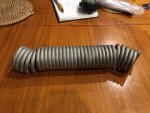

CF40E972-2DB7-4DE7-8100-0D2563A118F1.jpeg
 
By the surface finish and the fact that it is a spring, I would hazard a guess at music wire. Used to be specified under BS5216 when I was using the stuff.
 
What could it be if not stainless? It doesn’t appear to rust at all.


Thats a good question.

I use quite a lot of stainless rod, mainly drawn rod and it quite a different colour.

The magnetic test would give some indication.

BTW stainless steel does rust if not polished and even then can have spots of rust on the surface. Thats why its call stain less not stain free.
 
There are many grades of stainless steel. I would guess that this is a martensitic grade to give it sufficient hardness for a spring together with reasonable corrosion resistance. I guess that 420 is the most probable but it would require heat treatment. Try a simple hardness test: cut it with a hacksaw. If it cuts easily it is probably softer than about 400 Vickers, so probably oil quench at 960, temper at 700 C. If it is pretty hard work with the saw tending to skid , probably oil quench at 960, temper at 400 C.

Martensitic SS would be attracted to a magnet. Knife blades are often made from it.
 
There are many grades of stainless steel. I would guess that this is a martensitic grade to give it sufficient hardness for a spring together with reasonable corrosion resistance. I guess that 420 is the most probable but it would require heat treatment. Try a simple hardness test: cut it with a hacksaw. If it cuts easily it is probably softer than about 400 Vickers, so probably oil quench at 960, temper at 700 C. If it is pretty hard work with the saw tending to skid , probably oil quench at 960, temper at 400 C.

Martensitic SS would be attracted to a magnet. Knife blades are often made from it.
Can always trust you for a solid answer, VYV!

Do you think the spring I have actually got can be repaired or once they bent out of shape like that do you think that’s it?
 
There are many grades of stainless steel. I would guess that this is a martensitic grade to give it sufficient hardness for a spring together with reasonable corrosion resistance. I guess that 420 is the most probable but it would require heat treatment. Try a simple hardness test: cut it with a hacksaw. If it cuts easily it is probably softer than about 400 Vickers, so probably oil quench at 960, temper at 700 C. If it is pretty hard work with the saw tending to skid , probably oil quench at 960,
That could be fun ?
 
Genuine question. Would a stainless spring of that wire thickness work harden in use ?
All metals work harden, as far as I know. but 'work' in this context means plastic deformation, not the normal elastic deformation that springs are designed to accommodate.

Why anyone would select an expensive and specialised alloy like Nitinol for a job like this would need some justification.
 
It bent when you used it.
Why do you want another one the same?

Because the system is flawed. My poles appear too long for the sails and the inner forestay meant too much tension on the downhaul. Throw in some tough weather on the tail of storm Ellen and you get a bent spring. I feel it is fine if used correctly.
 
Top