What do I need to install gas supply to cooker?

steve yates

Well-Known Member
Joined
16 Oct 2014
Messages
4,105
Location
Benfleet, Essex/Keswick, Cumbria
Visit site
I have removed the old cooker and gas system from my bradwell 18, I use propane. The cooker was a deathtrap and it turns out the flexible hose from the regulator was stamped 1990. So I'm feeling lucky.
I've just removed the copper pipe too that runs along the quarter berth and into the old cooker, it was looking green, and going by the atae of the rest if it, I just want rid of the lot and a shiny new system on.
I've bought new flexi hose, and ss jubille clips, apart from the copper piping itself, is there anything else I need to consider? Olives, special fittings, anything like that?

I've also seen the bubble detectors which seem like a great idea. DO they indicate of there is a leak anywhere in the system?

Before anyone says get a gas engineer, its a super simple set up, well within even my very limited capabilities, as long as there is nothing major that I dont even realise I do not know, if you know what I mean.

Thanks.
 
My recommendation would be to keep it as simple as possible, with as few joints as you can get away with. My boat - as built - has regulator, hose, copper pipe, hose, cooker and that is it. Every time you add a bubble tester, or a solenoid, or a bypass for the solenoid for flat battery days, or a stop valve by the cooker, or any other device or gadget, you are adding potential points of failure.
 
I strongly suggest you study Chapter 7 of the BSS Essential Guide ... Strictly speaking it only applies to inland waterways but there is no other comparable guide to refer you to.

http://www.marinesurveys.net/BoatSafety/Guideline-chap7LPG.pdf

You presumably have a gas bottle locker ... does it match the requirements of the BSS regarding gas tightness and drain.
You will need a regulator to match your gas ( propane) and your new cooker .. That may mean a dual fuel (30mb) marine regulator
Unless you have a bottle mounted regulator you will need a high pressure "pig tail hose" to connect the bottle and regulator. A bottle mounted regulator will need a LP hose to connect it to the copper pipe work.

You will then need copper pipe, pipe support clips, a local isolation cock ( not strictly necessary with only a single gas appliance but a good idea) , compression fittings to link it all up.
and a low pressure hose connection to the cooker. For LPG copper olives are recommended rather than brass ones
It may be necessary to protect/ prevent chafe if the pipe passes through any bulkheads. Bulkhead fittings are only needed if passing through watertight bulkheads but half of a drilled through bulkhead fitting makes a neat way of getting a copper pipe out of the gas locker without introducing additional joints

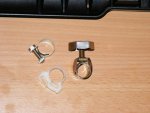
Worm drive hose clips are acceptable on LP hoses but not on HP hoses. "Ear clips" can be used on HP hose if you are not using a professionally made up pig tail. I prefer "mini hose clamps" on the LP hose LP hoses need "Fulham" nozzles to connect to regulator maybe to local isolation cock and cooker. There are different designed nozzles for HP hose ( I'd recommend these as well if you use HP hose for the LP system as its easier to get the hose onto them)

A bubble leak detector is not a bad idea. It enables you to carry out a leakage test of the low pressure system every time you turn the gas on at the bottle. if you wish.

Be sure you know how to make a compression joint properly regarding correct tightening of the nuts and without jointing compound and especially tape.

Know how to carry out the leakage tests on your new system or get it professionally tested
( the old Corgi tests were put on the old WOA forum many years ago ... maybe you can still find them although of course they may have been revised by now.)

Fit an LPG alarm. and a CO alarm. Not a good idea to use a combined CO and LPG alarm like they sell for caravans IMO. Two reasons. Firstly they need sensors in different locations and secondly the CO alarms , being chemical devices, have a limited life span.
 
Last edited:
I've got the same job to do at some point so this is all useful. What does the forum think of PVC coated copper tube to reduce the risk of abrasion/corrosion? Does it just hide possible signs of damage?
 
I presume your cooker is gimballed, If not you can get away with your new regulator on a flexible tube to facilitate changing and a run of copper to the cooker. If you want the bubble tester it can be installed in the gas locker at the joint between the rubber and the copper. We have one but since my wife is obsessive about turning the gas off at the regulator when not in use, it is rarely used. We do have a tap at the junction of the copper with the flexible tube at the cooker but she prefers to turn it off outside. We do not use armoured hose, we are subject to the BSS but their inspector does not encourage it. If the copper leads through a locker or other vulnerable place you can surround it with a bit of loose fitting clear pvc hose. As the Duck says the less joints the better but you can install tester or taps where you are changing from flexible to copper. Have a reasonable length of flexible at the bottle so that you do not put strain on the joints when changing the bottle. Calor 4.5 or 7kg, refills are almost as cheap as the pathetic little Camping gaz ones but confined to UK, If you have height in your locker the 7kg. used to do us a whole season.
As well as Calor in S'oton , Hamilton gas Products in Bangor are very helpful and competively priced, both serve boats and caravans, have good websites, if you pose your question to them they will send you a kit,
 
I think there should be a stop valve 'indoors' close to the cooker, and it should be in 'plain view' not tucked away in a locker.
The importatn thin is that the run of pipe sghould be easy to inspect for corrosion or damage, yet protected from corrosion and damage. Those requirements often conflict.
Pipe and hose are cheap. If running them a slightly different route makes them a little longer, but gives easy inspection , protection and even easier replacement, that should be considered.
Beware of dissimilar metal corrosion.
 
I've got the same job to do at some point so this is all useful. What does the forum think of PVC coated copper tube to reduce the risk of abrasion/corrosion? Does it just hide possible signs of damage?

My LPG car uses plastic covered copper pipe all the way from fuel tank to vapouriser. I can't see any reason not to use it for low pressure propane gas in a boat.

I think there should be a stop valve 'indoors' close to the cooker, and it should be in 'plain view' not tucked away in a locker.

I can't see the point. It introduces three points of failure (two connections and the valve itself) and all you get in return is duplicated functionality of turning the regulator off. If there are multiple appliances then sure, a stop valve for some of them might be worthwhile but for a single appliance system it's just complication.

I think we also need to remember that the OP is asking about an 18' long boat.
 
I think there should be a stop valve 'indoors' close to the cooker, and it should be in 'plain view' not tucked away in a locker.

Not necessary for a single appliance system. We have a bubble leak detector in the gas locker, straight after the bottle mounted regulator but it won't detect a leak in the pipe before it or regulator. Our gas is turned on for months at a time, only turned off if we're leaving the boat for a few days. Gas detector head mounted high in bilge below cooker.
 
My LPG car uses plastic covered copper pipe all the way from fuel tank to vapouriser. I can't see any reason not to use it for low pressure propane gas in a boat.
I can't see the point. It introduces three points of failure (two connections and the valve itself) and all you get in return is duplicated functionality of turning the regulator off. If there are multiple appliances then sure, a stop valve for some of them might be worthwhile but for a single appliance system it's just complication.
I think we also need to remember that the OP is asking about an 18' long boat.
There no reason, that I am aware of, not to use plastic covered copper pipe but if it is run where it does not come in contact with bilge water it should not be necessary. Mechanical damage from abrasion. chafe or fatigue should not be issues either if properly routed and supported.

Local isolation cocks are only required if there is more than one appliance on the system. It does however make a convenient anchor for the end of the copper pipe and you have to have some sort of fitting to connect the cooker hose to anyway. I do have an isolation valve . The copper pipe attaches to it with a compression joint and it has a Fulham nozzle for the hose . The alternative would be a hose nozzle directly on the pipe so no change in the number of joints ... just the possibility of the gas cock itself developing a leak.
 
There no reason, that I am aware of, not to use plastic covered copper pipe but if it is run where it does not come in contact with bilge water it should not be necessary. Mechanical damage from abrasion. chafe or fatigue should not be issues either if properly routed and supported.
I think it's used on LPG lines on cars because they are often quite exposed to potential damage, and a liquid leak at full tank pressure could be ... character forming.

Local isolation cocks are only required if there is more than one appliance on the system. It does however make a convenient anchor for the end of the copper pipe and you have to have some sort of fitting to connect the cooker hose to anyway. I do have an isolation valve . The copper pipe attaches to it with a compression joint and it has a Fulham nozzle for the hose . The alternative would be a hose nozzle directly on the pipe so no change in the number of joints ... just the possibility of the gas cock itself developing a leak.

My LP hoses at both ends are clamped directly to the pipe (with proper clamps!) with the pipe ends supported immediately adjacent by P-brackets.
 
My LP hoses at both ends are clamped directly to the pipe (with proper clamps!) with the pipe ends supported immediately adjacent by P-brackets.
I use proper hose nozzles.
I use the "mini hose clamps" rather than worm drive Jubilee type. I think I may have one of the plastic snapper clips on one joint but on the bottle mounted regulator connection I have one of the hand tightened stainless steel ones so that I can easily undo it to change the bottle.

DSCF0056.JPG
 
Thanks all, the run comes from the lazarrette into the quarterberth and along there to the galley, it's all open and visible.
The new cooker is gimballed Quandry, the old one was bolted down and the copper pipe attached to it directly, but for a moving cooker I will add an additional bit of flexi hose there I think. Good idea to put the bubble detector between the flexi from the regulator and the copper pipe.
I'm not sure about a tap at the cooker end, I always turn on and off at the regulator, with a piece of red webbing that hangs out of the lazzarette to indicate the gas is on. Seems safer than just stopping it form entering the cooker but still able to flow from the bottle??
I use a 4.5kg propane bottle, mainly cos she was used in winter.
The gas bottle is just in the lazarette, no gas locker. I can't see any practical way of venting through the hull in such a small boat.
I will be bonding in a frame and tie downs to keep the bottle still though, and doing the same for the remote petrol fuel tank in the same locker.
 
Thanks all, the run comes from the lazarrette into the quarterberth and along there to the galley, it's all open and visible.
The new cooker is gimballed Quandry, the old one was bolted down and the copper pipe attached to it directly, but for a moving cooker I will add an additional bit of flexi hose there I think. Good idea to put the bubble detector between the flexi from the regulator and the copper pipe.
I'm not sure about a tap at the cooker end, I always turn on and off at the regulator, with a piece of red webbing that hangs out of the lazzarette to indicate the gas is on. Seems safer than just stopping it form entering the cooker but still able to flow from the bottle??
I use a 4.5kg propane bottle, mainly cos she was used in winter.
The gas bottle is just in the lazarette, no gas locker. I can't see any practical way of venting through the hull in such a small boat.
I will be bonding in a frame and tie downs to keep the bottle still though, and doing the same for the remote petrol fuel tank in the same locker.

So long as you have no plands on using the boat on any of the inland waterways you could be OK, since you won't be required to have a Boat Safety inspection, which with the proposed set up you wouldn't get a 'pass'.
 
The gas bottle is just in the lazarette, no gas locker. I can't see any practical way of venting through the hull in such a small boat.
Add-on gas lockers used to be available when propane became explosive back in about 1989. The ones I saw were basically GRP buckets with flanges, lids and drains, sized to fit a Camping Gaz bottle. You cut a circular hole in a cockpit seat and dropped it into the space below. I was going to use one if I had got round to fitting a new stove to my Jouster before selling her. The only downside was that the lockers were remarkably expensive.

Gas lockers are still readily available, as you have probably found out, but they all seem to be side-entry for motorhomes and caravans or else large ones for existing lockers on boats.
 
Thanks all,
I'm not sure about a tap at the cooker end,

The gas bottle is just in the lazarette, no gas locker. I can't see any practical way of venting through the hull in such a small boat.

The gas cock local to the cooker is not essential. It s my choice to have one.

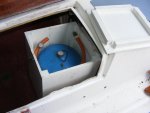
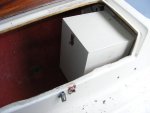
Very unsatifactory not to have a gas bottle locker IMO. My gas cylinder was originally just on a bracket come shelf in the cockpit locker but I made a locker for it. The drain does not have to be at the very bottom ... this is mentioned in the BSS chapter 7. Mine is several inches up from the bottom.

DSCF1340.jpgDSCF1339.jpg
 
But what difference does it make if the gas locker is venting into the same locker it sits in? Without the drain overboard component, surely a gas locker is useless?
It should have an overboard drain.... and be sealed to above the level of all the HP components ... See the BSS chapter 7, as previously advised, for all the details
If the locker is in the lazerette it should be easy, even on a small boat, to drain it through the transom.

How are you venting and filling your built in petrol tank.. presumably for an outboard ?.......... That's a problem I have not solved so it sits in the cockpit when in use.
 
Shut off valve near the cooker:
I can't see the point. It introduces three points of failure (two connections and the valve itself) and all you get in return is duplicated functionality of turning the regulator off. If there are multiple appliances then sure, a stop valve for some of them might be worthwhile but for a single appliance system it's just complication.
...
The BSS, for all its limitations, such as thinking gas behaves as a liquid not a gas, requires a shut off valve to be readily accessible.
I can't see that the cylinder valve, located in a locker within a locker fulfills that.

A readily accessible shut off valve comes in handy in several scenarios I've heard of happening, broken flexible hose, flare up due to regulator failure for instance. We always turn ours off whenever the cooker is not alight.

A gas bottle locker is non negotiable, anyone installing a gas system without one frankly needs a slap.
It must, in my view, be sealed from the accommodation, very strongly preferable that it opens to the deck or even transom.
 
It should have an overboard drain.... and be sealed to above the level of all the HP components ... See the BSS chapter 7, as previously advised, for all the details
If the locker is in the lazerette it should be easy, even on a small boat, to drain it through the transom.

How are you venting and filling your built in petrol tank.. presumably for an outboard ?.......... That's a problem I have not solved so it sits in the cockpit when in use.
It just sits in the lazarette all the time, and I top it up with a funnel from the green petrol cans. It has developed a leak before and drained all the fuel out into the lockers, but there is a massive amount of space there for a small boat, so the fumes aren't concentrated in a small ara.

As for the gas, I dont see how it can be sealed in when the lazarette, goes round the corner into the cockpit locker, and there is a gap between the deck and the top into the quarter berth. Leaking gas will sink, so a vent overboard mans a hole in the transom at the waterline, I'm then more likely to sink than blow up. There is so much volume in the lockers the bottle would be empty and the gas would still not reach a vent hole.
I get a gas locker is a good thing, but venting it into my lazarette seems a pointless exercise, probably be safer to keep it in the locker!
Venting onto deck via a hose from a gas locker might be possible, and a workable solution I would be interested in, but will it dissipate there or hang about the cockpit then into the cabin round the washboards?
 
Last edited:
Top