What cartridge for prefilters, 10 or 30 microns

MapisM

Well-Known Member
Joined
11 Mar 2002
Messages
20,658
Visit site
The title says it all, really.
I just noticed that prefilter cartridges are available in two versions (for both Racor and Separ), and I'm wondering if there's a consensus on which one is better.
Fwiw, my understanding is that 30 microns is the "default" version, but if the pros of 10 microns outweigh the cons, I might as well go for it.
I suppose that 10 microns is bound to give a better filtration at the expense of a somewhat higher risk of getting clogged, but I have no first hand experience on the differences.
Prices are exactly the same, btw.
Thanks in advance for your views/experiences!
 
You're making me wonder how many folks know that... I sure don't! :o
They are OEM filters for MAN engines, if that tells you something.
 
I,am on 30 for the racor 900 ,s which also have water in fuel sensors / alarms ( WIF ) . Clear bowls easily visible as well with a drain cock at the bottom .
There’s a pair of OEM metal cartridges in series on the engines I think they are 2 micron .

I replace them every year in May before the season starts in earnest.
Inspecting the bowl frequently diuring the season has thus far shown nothing abnormal.
Inspecting the removed 30 micron paper element before chucking it has thus far shown nothing abnormal.
I also have drain bungs at the bottom corner of the main tanks below the fuel out cock .Again nothing abnormal detected .
Tanks are contoured to the hull V on the bottom surface so make a natural lower apex .

Been using Starbrite diesel additive somthing like €25 at every fill up .Reckons to dissolve any water into the fuel .In otherword eliminates the fuel water barrier where the bug(s) proliferate.Its not a anti microbial.

Being none common rail was a conscious decision in the buying process ,in terms of the consequences of 8hit or water getting throughout to the injector tips .

Your none CR injector pump and tips are a lot more resilient compared to CR regarding fuel hygiene .

Stop worrying :encouragement:
 
I had Racor's on my TAMD63P's with 30 micron and thought I would try 10 micron one year to see if the additional pressure drop impacted perfromance due to what I assumed, but never checked, might be a higher pressure drop across the finer filter, I didn't notice any drop in performance.

But, one did become challenged on one occasion whilst en-route to another marina, so if fitted, I would recommend more frequent checks/servicing. The secondary filters on the engine were 2 micron, I just thought it was worth a try, more filtration the better sort of thing. I did revert back to the 30 micron in the end.
 
The engine mounted filters are fine, probably 10 micron or less.

If you were sieving earth for your vegetable plot and you wanted a fine tilth you would start with a coarse sieve say 20mm to remove lumps and stones, then a 10mm and finally a 5mm, to get fine soil. If you used a 5mm sieve first it would be laborious and just block up.

In the same way the normal practice is to use a large filter say 30 micron as a rock stopper as a Fi Mary filter and then the engine mounted filter catches the rest.

I have a pair of Volvo Penta 63 P’s with the large Volvo Penta Racor filters, elements about 7 inch high with 30 micron filters. I like the larger surface area in case of a contamination problem at sea they will collect at least twice the amount of crud as the smaller ones before blocking.
 
I like the larger surface area in case of a contamination problem at sea they will collect at least twice the amount of crud as the smaller ones before blocking.
If you don't mind me playing devil's advocate, isn't that akin to saying that they let twice the amount of crud reach the engine mounted filters, which in turn are more likely to get blocked themselves?
And even if it might depend on the installation to some extent, in my boat I'd rather deal with the replacement of a cartridge on prefilters (which are very conveniently placed just under the e/r hatch), rather than with engine mounted filters...
 
thought I would try 10 micron one year to see if the additional pressure drop impacted perfromance due to what I assumed, but never checked, might be a higher pressure drop across the finer filter, I didn't notice any drop in performance.
Good point. I didn't think about the potential effects on engine performance.
Otoh, my prefilters seem way oversized on paper (rated for 1080 l/h vs. a max fuel burn of 180 l/h !!!), so I'd be surprised if the pressure drop should have any meaningful effect also on my boat.
I'm tempted to follow your train of thought and give the 10 micron things a try...
 
That is why you have a finer engine mounted filter to catch the fine stuff. Your primary is to catch the large stuff the rocks.

image: http://www.ybw.com/forums/images/ybw/misc/quote_icon.png
quote_icon.png
Originally Posted by Banditimage: [url]http://www.ybw.com/forums/images/ybw/buttons/viewpost-right.png
viewpost-right.png
[/URL]
I like the larger surface area in case of a contamination problem at sea they will collect at least twice the amount of crud as the smaller ones before blocking.


"If you don't mind me playing devil's advocate, isn't that akin to saying that they let twice the amount of crud reach the engine mounted filters, which in turn are more likely to get blocked themselves?
And even if it might depend on the installation to some extent, in my boat I'd rather deal with the replacement of a cartridge on prefilters (which are very conveniently placed just under the e/r hatch), rather than with engine mounted filters...
Read more at http://www.ybw.com/forums/showthrea...efilters-10-or-30-microns#hTtpYkTbHhHCyZPr.99

My filter is 30 micron but double the area, so collects twice the ammount of rocks before blocking.
 
FWIW the Racor prefilters for my MAN engines are 30 microns. After the Racors, the fuel goes through another MAN prefilter which I believe is 20 microns and then finally the fuel goes through the fine filters on the engine (dont know the micron rating but I'm guessing 10 microns)

I just dont see the point of fitting 10 micron prefilters because then any filters further downstream are not doing any filtering and effectively the total filtering capacity is reduced. I'm guessing that the Racor 10 micron filters are only used when the Racor is the only filter in the system but I may be wrong on that
 
After the Racors, the fuel goes through another MAN prefilter which I believe is 20 microns and then finally the fuel goes through the fine filters on the engine
Microns aside, it's interesting to hear of a triple filtering, I never noticed that in your boat.
Do you know if that's a Ferretti requirement/installation, or did MAN fit an additional filter in CR engines as standard?
I never saw such setup in several mechanic V8 and V12 which I've seen, and neither in a couple of electronic (but pre-CR) V10.
And that includes some Ferrettis (165, 57 and 590).
 
Microns aside, it's interesting to hear of a triple filtering, I never noticed that in your boat.
Do you know if that's a Ferretti requirement/installation, or did MAN fit an additional filter in CR engines as standard?
I never saw such setup in several mechanic V8 and V12 which I've seen, and neither in a couple of electronic (but pre-CR) V10.
And that includes some Ferrettis (165, 57 and 590).

I had never seen it before either. In fact when I first saw it, I assumed it was a retrofit by the first owner. However, when I read the Ferretti manual, the pre filter set up is mentioned in there so I assume its a specific Ferretti thing because, like you, I didnt see it on other MAN V12 engined boats I looked at before I bought the F630

IMG-2241.jpg
 
Doh! It's not like they are hard to see, either. I'm surprised to have never noticed them!
Regardless, actually when I said that I never saw those MAN prefilters on any V12 engines, I meant mechanic ones.
That's the reason why I was envisaging that it might be a common rail-specific installation...
 
On second thought, there is one MAN V12 CR powered boat which I've seen, and it's MYAG's Y80.
By sheer coincidence, I just watched again the video posted by Hurricane here, and the inside of her e/r is visible for a moment.
Same CR engines as yours, just tuned for higher power, IIRC.
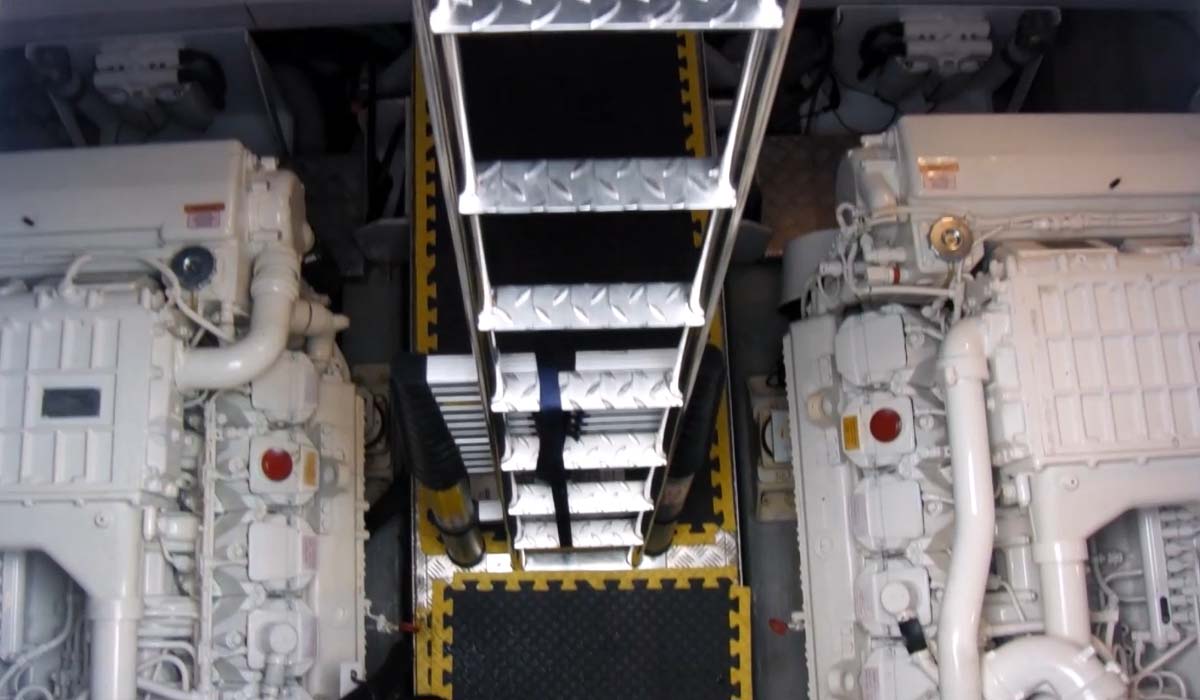
And unless I'm mistaken, in the screenshot below from that video there are two of the same MAN prefilters, visible in front of each engines...
Xe0RUtG2_o.jpg
 
Actually come to think of it there’s a little guaze prefilter inside a glass bowl on my engines ,located under the manual lift pump.
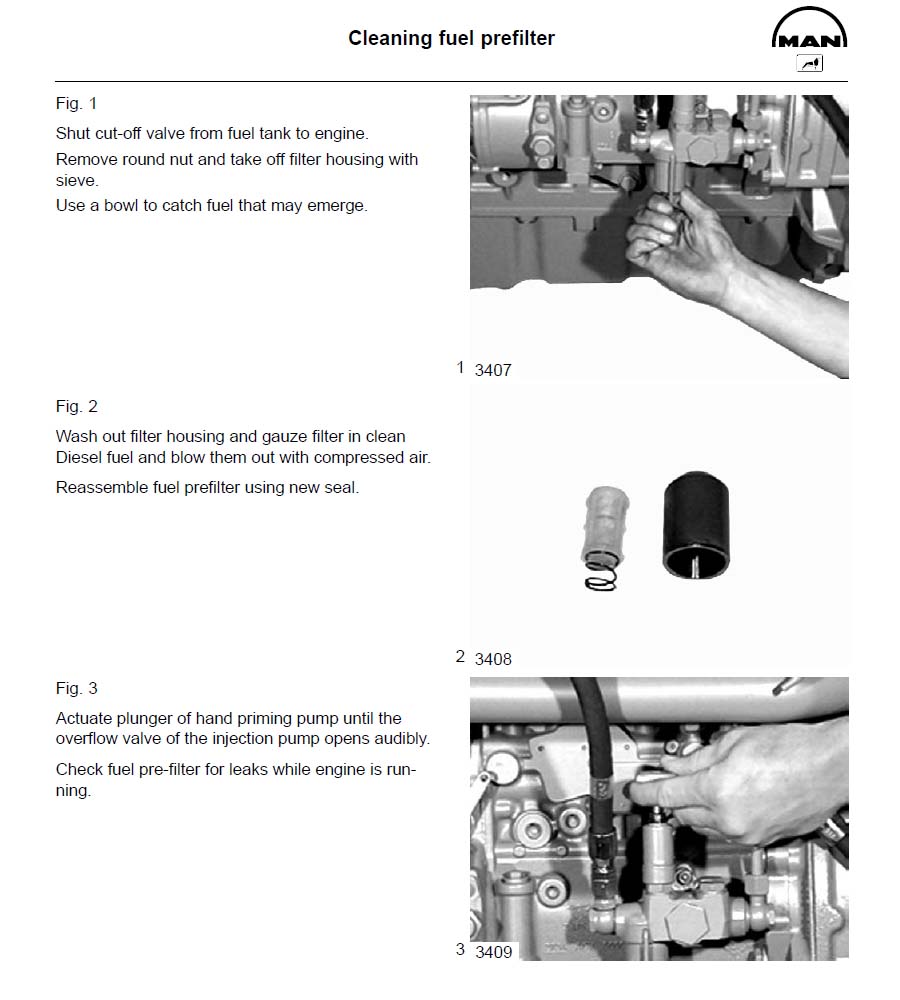
That’s the rockstopper .Service manual says remove and rinse with fresh fuel then refit the same eliment .
It’s about 3 cm dia by say 8 cm long .
I did not include it in my initial explanation as it’s not really replaced/ chucked away in a disposable sense like the other two

Being glass you can see inside it .It sits under the other two replaceable cartridges and fuel goes through it that first before those .
But the builder fitted the centrifugal racors before the engine filters as well .

So technically I guess it’s actually quadruple system for each engine .The fuel passes through 4 filters on its way to the pump .

30 micron centrifuged racor with visible glass bowls +WIF alarms , fitted by the builder remote from the engine
That rinse able guaze prefilter of unknown size micron wise ? Looks like a gross rock stopper fitted by MAN on the engine.
Two 2 micron ( almost sure of the size - need to ck ? ) spin on cartridges in series fitted on the engine .

If Mikes right then it may be 30 ,20 , 10 , 10
If I,am right it’s 30: 20 , 2 ,2

Either way answering your initial Q it’s makes sense in my view to start large say 30 as opposed to 10 in the racors and grade it down .
Remember eventually as the 30 racor primary fills up with time / fuel vol those 30 micron holes clog first so effectively reducing the micron number down once all the bigger 30 holes are filled with “ rocks “ .Theres somthing in the Parker racor guide about optimum vacuum of up to3 inches of Hg ,

It’s all about management of the vacuum.

If you fit 10 ,s as the primarys like you propose then you ought to fit vac gauges to see if they restrict, there’s a risk now .

See here
https://www.parker.com/literature/R...Passage_Maker_Troubleshooter_Jan-Feb_2015.pdf
 
Last edited:
Play d'eau used to have 30 micron in the Racor pre-filters, 10 for the fine filter. After talking with Parker Hannifin technical, the recommendation was to use 10 for both. Two key points were made. There'd be no degradation in the Racor fuel throughput, and it's easier to chane a Racor ar sea than a hot fine filter.

That was years ago, and I've used 10 micron ever since. No problems.
 
Actually come to think of it there’s a little guaze prefilter inside a glass bowl on my engines ,located under the manual lift pump.
Thanks PF for the PMM article link.

Besides, you made me curious ref. the above gauze prefilter, because I don't think there's such thing on my engines.
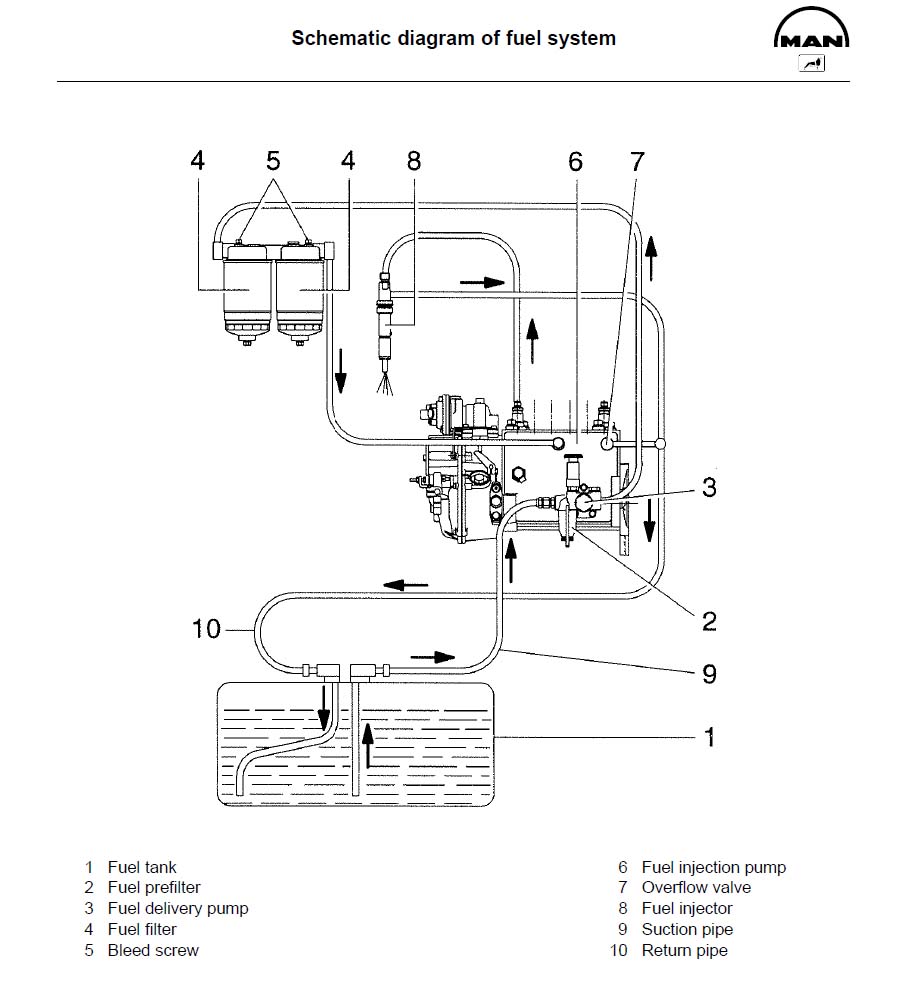
So, I had a look at the D2876 manual. I suppose that the thing you are referring to is #2 in the diagram below, described as "fuel prefilter", right?
And if so, are you sure that the glass bowl wasn't retrofitted? Just look at the second pic: it doesn't look like glass at all, and for good reasons, imho...

z16uIAmd_o.jpg

ajpoYPip_o.jpg
 
Play d'eau used to have 30 micron in the Racor pre-filters, 10 for the fine filter. After talking with Parker Hannifin technical, the recommendation was to use 10 for both. Two key points were made. There'd be no degradation in the Racor fuel throughput, and it's easier to chane a Racor ar sea than a hot fine filter.

That was years ago, and I've used 10 micron ever since. No problems.
Both points make sense, I reckon. And good to hear of such long and positive experience.
Just one thing, do you possibly remember if that recommendation was generic, or specifically based on your engines/boat?
I am just wondering if the prefilter throughput couldn't be more critical on gas guzzlers - aka planing boats... :rolleyes:
 
Both points make sense, I reckon. And good to hear of such long and positive experience.
Just one thing, do you possibly remember if that recommendation was generic, or specifically based on your engines/boat?
I am just wondering if the prefilter throughput couldn't be more critical on gas guzzlers - aka planing boats... :rolleyes:

Good question. I was assured that the throughput was the same for both filters. However, I would doublecheck for your engines, just in case. There must be a webpage with the relevant data, somewhere.
 
@ MapisM post #17 - yep fig 2 is it .

Those manuals are semi generic one size fits all pictures wise .
Tell me about it ? :)
Eg the first time I tackled an oil change .Spent hrs poring over the “ manual “
Easily found the pump and with the help of a mate removed 32 L and he filled 4/5 L containers I disposed of it .
Lined up the fresh oil in handy 5 L cans - - could we find the filler ? = nope
Where do you put the oil in ?
Got the manual out - paper Vs , went online ( same Vs ) hmmm the filler cap supposed to be just below the pump a kinda funnel thing just above the sump pan - looks perfectly normal in the “ manual “ (s) .
Some frustrated 30/40 mins later I,am thinking need to phone a friend / call an engineer and take a sounding stupid for the team so to speak .
We looked everywhere except on the very top .
The second rocker box cover has a discreet filler cap painted the same gold colour camouflaged.
NOT shown in the so called “ manual “

So back to your Q my “ prefilter “ are glass - real glass and I don’t think aftermarket.

Perhaps for American Coast guard or some other market there may be local variations in bits and bats like filler cap positions and material of the “ prefilter “ housing etc etc ?
 
Top