What are these Electrical Things ??

I have a Quick Genius windlass. I think it’s a ‘G 600’. Original with the boat. Ten years old.
Since I acquired the boat (this year) I’ve been looking for an overload reset for the windlass. So far I haven’t needed it fortunately. I guess it’s only protracted by this fuse ?
 
One of my concerns is that, according to the windlass manual, it should be protected with a 40amp circuit breaker. Yet this fuse is labelled “63 Amps”.
Do you think these fuses are a cheap solution on a production boat ?
 
I have a Quick Genius windlass. I think it’s a ‘G 600’. Original with the boat. Ten years old.
Since I acquired the boat (this year) I’ve been looking for an overload reset for the windlass. So far I haven’t needed it fortunately. I guess it’s only protracted by this fuse ?
The overload reset would be the recommended thermal circuit breaker.
One of my concerns is that, according to the windlass manual, it should be protected with a 40amp circuit breaker. Yet this fuse is labelled “63 Amps”.
Do you think these fuses are a cheap solution on a production boat ?
That's what i have been saying all along, circuit breaker.

No doubt they fitted an over rated fuse to stop them blowing if you overload the windlass a little, or use it for an extended period of time. That, at the expense of providing overload/overheat protection for the windlass.

Yes, used as a cheap excuse for protection. Very bad practice by Bavaria here.
 
Fuses will blow if there is a short and eventually if there is an overload. A thermal circuit breaker will trip if there is a short, but it will also trip if the circuit is overloaded, even slightly overloaded for an extended period. Prolonged use of a windlass (snagged anchor etc) can overheat the motor, causing damage, a thermal circuit breaker, correctly rated, will prevent this and can be reset in a second if it does happen.

No need for both, a thermal circuit breaker is the correct solution.
Fuses aren’t occasionally able to break a circuit, in a fault condition like short circuit. A circuit breaker will. Agree there are variations on the theme. But that’s the basics.
 
Fuses aren’t occasionally able to break a circuit, in a fault condition like short circuit. A circuit breaker will. Agree there are variations on the theme. But that’s the basics.
Sorry, but a correctly rated fuse should always blow in a short circuit scenario, that is what they are there for. A basic circuit breaker does the same thing. The thermal circuit breaker that i have mentioned in this thread does everything a fuse will do and a little more.
 
Sorry, but a correctly rated fuse should always blow in a short circuit scenario, that is what they are there for. A basic circuit breaker does the same thing. The thermal circuit breaker that i have mentioned in this thread does everything a fuse will do and a little more.
Not one for an argument really…probably best we leave it. But a fuse is for an overload condition. Things like an overloaded motor causing a higher than designed current in the system. Not to say they don’t eventually blow in a fault condition like a short circuit…but not generally their modus operandi really. I’ve been a 33kv Sap off and on for a fair while…just passing on the professional man’s angle, should it help
 
I assume we're all quite certain there isn't a breaker further downstream? I'd expect fuses near the battery for large circuits even if there's a breaker in the electric cupboard
 
Well, if there is a circuit breaker somewhere , it’s very well hidden, which kind of defeats the object !
Thanks all for contributions. Very interesting.
This confirms what I’ve come to understand as a newbie to boat ownership…..nothing (except that you will definitely run aground sooner or later) is certain or clear cut !
 
Well, if there is a circuit breaker somewhere , it’s very well hidden, which kind of defeats the object !
Thanks all for contributions. Very interesting.
This confirms what I’ve come to understand as a newbie to boat ownership…..nothing (except that you will definitely run aground sooner or later) is certain or clear cut !
No, there is not - see post#10. The fuse will blow if the motor seizes as mine did. Could not work out why the replacement motor did not work as there is no indication the fuse has blown, hence the replacement with a 70A circuit breaker as required by Lewmar and provided with a kit if you bought the windlass retail.

Bavaria used to fit Lofrans windlasses until they got into financial trouble then switched to a mixture of Quick and Lewmar. The Lofrans had a circuit breaker, fairly low rated from memory as it flipped fairly often but readily accessible just in front of the chart table. Around the same time they changed their wiring and switch panels using those big fuses as standard on all models making it easier to for them to add options and switch suppliers.

If it is any consolation, Bavaria systems are generally much more straightforward than some other mass producers and even more so than semi custom builders, some of whom because of the nature of the smaller volumes can tend to make things up as they go along.
 
Well, if there is a circuit breaker somewhere , it’s very well hidden, which kind of defeats the object !
Thanks all for contributions. Very interesting.
This confirms what I’ve come to understand as a newbie to boat ownership…..nothing (except that you will definitely run aground sooner or later) is certain or clear cut !
But in this case, it is clear cut, the answer is in the manual for the windlass.
 
No, there is not - see post#10. The fuse will blow if the motor seizes as mine did. Could not work out why the replacement motor did not work as there is no indication the fuse has blown, …
Current models of this fuse have a little indicator - you can see it in one of the pics posted previously, a pair of little red prongs. When the fuse is blown these sort of spring loose - the indication is very obvious once you've seen one blown. I know because I recently started using my inverter-charger properly and this can draw more than 100A.

EgEfUHl.jpg

When I bought my boat the master fuse must've been the original fitted by the dutch yard when it was built 25 years ago, and I believe some problems with the inverter were due to corrosion on the contacts - after replacing the fuse and holder the inverter no longer showed the "low battery" warning error when under load.
 
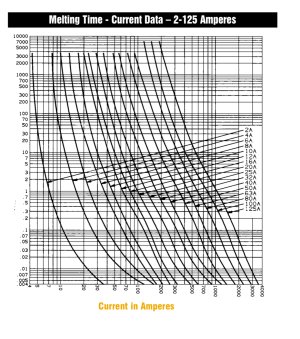
Fuses are pretty normally on large inductive loads or high inrush currents. Breakers get very expensive on large loads and most motors have internal overheats. The main purpose of a fuse is to protect the cable from over heat due to excessive power and thus a fire. Fuses are rated differently so have curves. Say a 10 amp fuse will pull 10 amps all day but for for say 10 seconds and 100 amps for 2 seconds and 1000 amps for milli seconds.

In my world commercially mcbs are used or mccb for big loads but there are still loads of fuses out there on big stuff.

Agree breakers are a nice to have but check you purchase one suitable for dc

Typical time and amps curve below.
 

Attachments

  • IMG_8824.jpeg
    IMG_8824.jpeg
    722.3 KB · Views: 4
I think we need some simple basics here. Fuses and circuit breakers basically do the same job. Protect against faults Such as Short circuits. There are variations of both with differing tripping curves depending on application. Circuit breakers come in three varieties, Magnetic, Thermal and Thermal/Magnetic. The Magnetic version will normally have a higher tripping threshold as it depends on the strength of the magnetic field produced by the current to be at a certain level. It is therefore more suitable for fault protection rather than overload. The Thermal unit will trip on a lower current due to the heating of the trip mechanism. So whilst it may take , for example, 90 amps to trip a 30 amp magnetic CB almost instantaneously, a similarly rated thermal device can trip on, again for example, 40 amps, after a time delay determined by the breaker curve As Paul has said it will act as an overload device and you don't need a CB and a fuse. Thermal/magnetic CBs are a combination of both with the tripping curves of the magnetic and thermal units set at appropriate levels for Short circuit and overload conditions. They are quite expensive! Again with any of the above you don't need Both fuses and CBs.
There are also devices called Overload protection relays (OPR). These are different again and are magnetic devices set to trip at, normally, 125% FLC. with a time delay of a few minutes, this can vary. These can be used in conjunction with either fuses or CBs.
All of the above is a simple explanation and is meant as nothing other than that, figures used are examples only.

Edit. I should have added that fuses are Circuit protection devices, as are Magnetic CBs. Not overload protection. If you only have either of these you should have an OPR fitted.
 
Last edited:
Alex, Paul and others. Thanks very much for taking the time. I never knew there was so much to it !

Ultimately, all I want to do is to protect my windlass motor (Quick Genius G600) from overload. At present it looks like the circuit is protected by a NH000 fuse link, labelled ‘63 Amps’. The windlass owners manual says it should be protected by a ‘delayed action thermal-magnetic or hydraulic magnetic circuit breaker rated at 40 Amps’.

From what you guys are saying the present arrangement is inadequate and will not protect the motor from overload. Correct ?

I therefore need to fit a readily available thermal circuit breaker rated at 40 Amps.

Having had a look on YouTube it seems that if I buy a good quality thermal CB, it will trip reliably at 40 Amps and therefore protect the motor and equally not be constantly tripping.

Still not sure about this ‘delayed action thermal-magnetic or hydraulic magnetic circuit breaker’ ?
 
Alex, Paul and others. Thanks very much for taking the time. I never knew there was so much to it !

Ultimately, all I want to do is to protect my windlass motor (Quick Genius G600) from overload. At present it looks like the circuit is protected by a NH000 fuse link, labelled ‘63 Amps’. The windlass owners manual says it should be protected by a ‘delayed action thermal-magnetic or hydraulic magnetic circuit breaker rated at 40 Amps’.

From what you guys are saying the present arrangement is inadequate and will not protect the motor from overload. Correct ?

I therefore need to fit a readily available thermal circuit breaker rated at 40 Amps.

Having had a look on YouTube it seems that if I buy a good quality thermal CB, it will trip reliably at 40 Amps and therefore protect the motor and equally not be constantly tripping.

Still not sure about this ‘delayed action thermal-magnetic or hydraulic magnetic circuit breaker’ ?
I would suggest that you stick with Pauls original suggestion and get a good thermal CB. From a reliable source! You don't need the fuse as well but it won't harm to leave it in circuit. The breaker will trip before the fuse blows, unless you have a real short circuit and then both may go!!
 
Alex, Paul and others. Thanks very much for taking the time. I never knew there was so much to it !

Ultimately, all I want to do is to protect my windlass motor (Quick Genius G600) from overload. At present it looks like the circuit is protected by a NH000 fuse link, labelled ‘63 Amps’. The windlass owners manual says it should be protected by a ‘delayed action thermal-magnetic or hydraulic magnetic circuit breaker rated at 40 Amps’.

From what you guys are saying the present arrangement is inadequate and will not protect the motor from overload. Correct ?

I therefore need to fit a readily available thermal circuit breaker rated at 40 Amps.

Having had a look on YouTube it seems that if I buy a good quality thermal CB, it will trip reliably at 40 Amps and therefore protect the motor and equally not be constantly tripping.

Still not sure about this ‘delayed action thermal-magnetic or hydraulic magnetic circuit breaker’ ?
Quick make/market the breaker that you need.

Out of stock at the moment, but.... Quick Circuit Breaker 40A (10040 / DC)
 
If you've a fuse, ensure that you've an accessible spare for fitting, once you've fault found why it went in the 1st place.
 
Last edited:
@vas
They're NH fuses not T fuses.
https://www.swe-check.com.au/editorials/nh_fuses.php........there's also a good piece about the 'speed' ratings of fuses in general linked through that web page.
In general
Circuit protection especially at low voltage high (potential) currents is a very demanding / awkward task as the potential for very rapid high increases in temperature / fire is always present but to over compensate by poorly rated protection ( as in wrong devices and or values) can easily give rise to nuisance tripping etc. Consult with the OEM's for best practice.
 
If anyone has these NH style fuses and would like some onboard spares I have a large crate of secondhand fuses in the NH range from ~ 60 - 250 amps. PM me with the size e.g. NH00 125a, and I will post a couple out to you of the closest size I have.

I would ask you place a donation to at least cover my postage in the nearest Lifeboat tin.
 
Top