What are the arguments for/against storage on the hard vs in the water in the Med

tudorsailor

Well-Known Member
Joined
12 Jun 2005
Messages
2,756
Location
London
zebahdy.blogspot.co.uk
I am moving my yacht to Dubrovnik. They have a good deal whereby one can keep the yacht out on the hard for the winter. I realise that in the UK, that hauling the boat out is a good idea as the temperature goes below freezing. However this is obviously not a problem in Croatia

So what are the pros and cons?

If the boat is left in the water, I get the engine and generator run every fortnight. When the boat is on the hard obviously one cannot do this. So what do I have to do when the boat is going to be out of the water for 6 months? Do I winterise the engine or is this unnecessary as the boat will not freeze?

How do I stop the engine and genset start batteries from going flat?

Thanks

TudorSailor
 
Cariad is stored on the hard for sometimes as long as 9 or 10 months at a time.

She wont sink, break away from moorings, get banged into, get taken for a joyride or get nicked.

I have a solar array and control system that keeps the batteries 100% charged and conditioned.

My last launch took place an hour and a half after I arrived at the yard. It meant dewinterising on the water but it was much more pleasant than sitting ashore for the weekend!
 
It doesn't freeze in Dubrovnik? Are you in for a shock.

Winterising, despite the name, is mainly not to protect the engine against freezing, but against corrosion. So it'll need doing, by the book.

As to charging -- presumably you'll be leaving the boat unattended -- do you have solar panels? I'd not be inclined to leave a charger running.
 
Last edited:
I leave the boat for 6-7 months over the winter in Turkey on the hard..I make sure that the batteries are fully charged and then completely disconnect them..ie remove the cables from the battery terminals,clean the battery surfaces and that's it. No solar panel or top up charger is needed. When I return in spring,the voltages have only dropped by 0.2 volts at the most.Batteries are now 3 years old and show no signs of drop.They will not go flat,or anywhere near flat unless they have been mistreated.
Make sure the engine has the correct antifreeze ,as this will protect against corrosion as well as any possibility of freezing.
Open the engine compartment and give a good mist of WD40 or similar all over the engine.This helps to disperse any dampness.
 
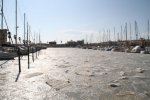
My boat stays in the water all year round. It works out much much cheaper that way. However in the South of France it can get chilly......
 

Attachments

  • PortLeucateGlace4.jpg
    PortLeucateGlace4.jpg
    93.2 KB · Views: 0
Agree with jamesmar.

In addition, I top up the fuel tanks and drain all the fresh water.

I do this, wherever I am, at any time of the year, if I am leaving the boat for more than three months - which is often the case.

The major pro is that the hull will dry out - even over the winter.
 
The fresh water systems of many boats overwintered in Croatia in 2011/2012 froze, doing spectacular damage in some cases. I gave a talk to CA in March on overwintering and was specifically asked to include frost protection.
 
In the northern Adriatic where I keep afloat all year temperatures regularly drop to between -10°C to -20°C during the winter months - further south will be warmer but should not be depended on. I have photos of my boat last winter encased in ice - it was thick enough for someone to walk out on in the marina.

As commented, ashore is better for hull drying and should be out for spring anti-fouling anyway so crane costs will have to be paid whatever. Whether ashore or afloat the engine will need anti-freeze, fresh water tank draining (pumps can split if water remains ... I had to replace one that had residual water in that froze this year) and fuel tank should be left full to minimise condensation.

Annual spring anti-fouling is now always necessary here; the Adriatic is plagued by tube worm infestations. Because I was ashore for repairs last autumn I anti-fouled before re-launching thinking there would be little fouling over the winter. However, my first sail this year I had to anchor and dive to scrape off the huge clumps of tube worm encrustations over the rudder and propeller. Nothing seems to prevent their fouling; they attach to the smallest area and build up on each other's shell until there is a large clump of them.
 
We have lifted the boat for 6 months or so for the past ten years. Peace of mind. We charge up the batteries and make an arrangement either with the yard or a live aboard to plug in the power for a day every month. We seal the boat up no ventilation. This was the case in Portugal, Spain, France, Montenegro and Greece for the past ten years. We always try and find a cradle as we are 22 tonne. We generally remove the head sails but leave the main in the mast, we also have a full winter cover that comes down to the water line. I think its horses for courses. We do use the cheapest anti foul going as she is only in the water for six months.
 
Top