
JumbleDuck
Well-Known Member
Really? I've always just popped them in by hand. I must be stronger than I thought!as you say ,, but , for the uninitiated , a valve spring removal tool is required for refitting the valve collets

Really? I've always just popped them in by hand. I must be stronger than I thought!as you say ,, but , for the uninitiated , a valve spring removal tool is required for refitting the valve collets
did you just pop them down the air intake ??Really? I've always just popped them in by hand. I must be stronger than I thought!
Not sure I understand. Put head on something - normally a socket - to support the valve, push spring down with one hand, place collets with the other.did you just pop them down the air intake ??
never done it on the yanmar but done it plenty on car engines years ago , never liked doing it without the tool , maybe yanmar springs are a bit softer , i dont know ,,, anyway , good to read that you do not consider it to be required , for future referenceNot sure I understand. Put head on something - normally a socket - to support the valve, push spring down with one hand, place collets with the other.
 !!!
!!!
A lot softer than any car engine I've ever worked on.never done it on the yanmar but done it plenty on car engines years ago , never liked doing it without the tool , maybe yanmar springs are a bit softer , i dont know ,,, anyway , good to read that you do not consider it to be required , for future reference
I've just rebuilt a 3GM30F which is pretty much the same as yours but with 3 cylinders. It too had poor compression.with a lot of cursing at the engine manual which does not elaborate on how to remove this precision engineered small circular component from the injector bore, I gave up. I did eventually get the heat shield out, so did sort of get to inspect the inside of the pre combustion chamber. Eventually if it ain't broke why fix mentality, I decided this was not the cause of my engine woes.
My main issue is very poor compression, I'm pinning my hopes that a new gasket for the rocker arm cover will give airtight seal to make negative pressure in crankcase on the compression stroke, this apparently helps the piston rings to seal against the bore during compression.
I had a look at the Toad marine website that coopec mentioned, nice website but I'm still none the wiser about the age, only that built anytime between 1983 and 2009! Not that it matters a great deal, but suppose I was looking into finding a reason to ditch Yanmar and go for a Beta marine engine which I've heard good stuff about!
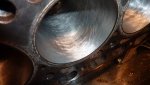 Glazed bore
 reground valve seat
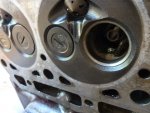 reground vale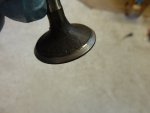
I've done it that way on Herald and DS engines. Mind you, I was too skint to afford a spring compressor then.never done it on the yanmar but done it plenty on car engines years ago , never liked doing it without the tool , maybe yanmar springs are a bit softer , i dont know ,,, anyway , good to read that you do not consider it to be required , for future reference
I had to smash mine to bits to get it out. Luckily the complete set of bits needed wasn't too expensive, especially at US prices.The precombustor chamber (concur on the woeful description in the manual) can alledgedly be hooked out of the injector aperture with a piece of wire. In reality they tend to be stuck in too hard for that. On reassembly they just drop back down the 'ole and are held in place by the injector. istr there is a little lug that matches a groove in the 'ole so it goes back pointing the right way.
If you really wanted to remove it I'd try to unseat it with a wooden drift and a tap with a light hammer from the 'inside' face of the head.
Two of mine blew out while I was turning the engine over for a compression test!I had to smash mine to bits to get it out. Luckily the complete set of bits needed wasn't too expensive, especially at US prices.
You do not need sealant on cylinder head gasket. Correct torquing of bolts in correct order and retorquing after IIRC 50 hours is all that is required.Thanks to everyone who's just responded, especially slowboat35, you've probably made the definitive goto page for anyone with compression issues on Yanmar engines!
Just tried to take pic of bore to ask your opinion, even with my cemera on lowest megapixel setting, ybw forum wont accept due to size (maybe format jpg not accepted) Anyway put some diesel down the bore to check for leak, eventually (2hrs later) had to suck it out again with syringe. Also draining my engine oil so no issues there. The cylinder bore looks ok to me, a very light smearing of soot on the bore. I'm thinking the head gasket could also be leaking, even though the head was last fitted by pro mechanic seems he didnt apply sealant between gasket and head. The gasket is adhered to cylinder side but nothing on head side??
Bounce the valves by tapping the top plate with a light hammer to loosen the collets and do like the video above with a suitable spanner - the springs are not strong.Those guys talking about removing valves, you must be using a G clamp to compress the v spring?? Or some special tool that allows you to compress and get access to collets to release spring pressure.
As i write waiting on machine shop getting back to me with price to service my CHead. If less than £100 think i will let them deal with it.
How do I find out the age of my 1gm10, knowing only the engine number 09713. I don't see anything on the Yanmar website to help
On a side note, can anyone recommend a good Yanmar dealer/ repair shop for servicing and ordering spare parts? Hopefully with shop in Central Scotland?
the valve compression tool actually looks kinda like a big G clampThose guys talking about removing valves, you must be using a G clamp to compress the v spring?? Or some special tool that allows you to compress and get access to collets to release spring pressure.
As i write waiting on machine shop getting back to me with price to service my CHead. If less than £100 think i will let them deal with it.
i am assuming that you have the engine unit on the floor and not in situe in the engine bay ,,, do the cylinders seperate from the block ( lower section ) ? honing ? , i always thot that was a machine job, are you suggesting doing that with the cylinders still bolted on ?? how ?Niall,
If your cyl. head gasket was bleeding compression you'd have fumes in the boat and muck and soot all over one side of the engine and engine bay. It would also sound odd. You'd know about it!
No sealant or grease is used on reassembly according to Yanmar. I take it they assume the wads of $ your gasket costs is enough to seal the pressure in. It bloodywell needs to be! (try parts4engines/repower marine instead)
You've already got the engine dismantled and are half way to solving the problen - ie head off. Don't waste your good efforts so far by trying/hoping that a lazy approach of a half-measure will fix it. With the head off it's daft not to re-lap the valves and if the bores look shiny it's not much extra effort (really, it isn't!) to finish the job and ensure your compression is guaranteed to be restored instead of taking a half-assed gamble...
I know there's always a worry that work you start might you might begin a snowball effect. On this particular route a head job and hone the bore is a self-contained event. You're disrupting nothing else. The tetchy fuel metering and injection pump isnt being touched (I wouldn't dare!) and injectors don't even have to be removed from the head.
Parts required are head gasket, rocker box gasket (sorry - extreme Yanmar ripoff unless you find someone with a gasket making kit - try asking around...) valve stem seals and a set of rings. You may need/want a valve spring compressor and will need a valve lapping kit. Bet ypu can borrow one of those too. No! Fuggit! You pay postage, I'll loan you a piston slipper, grinding paste and the honing tool. As long as I get them back! Tutorials on their use are on youtube aplenty.
This is very basic stuff! You've got the confidence to take the head off, that's by far the hardest thing with the torques involved (getting my head bolts undone required a 24" extension bar on the socket and a fence post wedged in the starter motor aperture to my arse to heave against. 75Ft/lb? To undo them must have taken twice that!
I have never taken a diesel apart before. It's a breath of fresh air - really! There's no timing to screw up! The iron work is identical. Don't be intimidated, it's just a bolted together bit of lump of iron just like any other.
Seriously, my first foray into a diesel rebuild convinced me that they are actually easier (though perhaps grubbier) to work on than a petrol engine as long as you stick to the mechanical as opposed to the 'fuel-draulic' bits.
You'd have the piston out and on the bench in half an hour.
You'll spend barely half hour cleaning the coke off the top of the piston and checking ring/land clearance with a feeler gauge if you are that bothered. An hour packing the bottom of he bore with a protective barrier (cardboard and rags) against carborundum debris and then honing and cleaning the bore, ten minutes more fitting the new rings, ten minutes putting the piston into the slipper and tapping it into the bore, ten minutes fitting the big end cap and torquing the bolts and another ten refitting the sump. Reassembling the rest of the engine with cyninder head already done is a couple of hours max. You'd do all that in an afternoon!
Seriously - it's a doddle! You're almost there already!
And the result is an old engine that suddenly is transformed into an apparently new one!
It'll give your starter motor a nasty surprise! The compression mine now has bears no resemblance to what it used to be.
PM me if you want to borrow the tools.
That's the issue I referred to above - you need to know which way to fit the gasket, and they often don't say. It seemed to work for me when assembled OK, but it's a bit disconcerting.Its probably not a concern for me, Im unlikely to ever reach the Carribean (or maybe, who knows) but are the two small holes in gasket (one elongated the other circular diameter just 6mm enough for circulation round cylinder jacket?