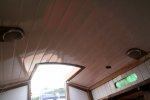
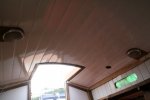
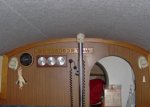
What about these to replace headlining with? and should it breathe?

steve yates

Well-Known Member
Joined
16 Oct 2014
Messages
4,105
Location
Benfleet, Essex/Keswick, Cumbria
Visit site
Went into wickes for something else, and saw tongue and groove type strips of cladding which I thought could make great replacements for the vinyl headlining.

I'm interested in your thoughts on them and if anyone has used them before. There was mdf, spruce and a white pvcu. The pvc was lightest, bendiest (approx £3.50 per 2.5m length) and would be easy to wipe and clean. But it's plastic, so will I just get condensation on it?
The mdf I guess could be painted, ( £4.50 per 2.5m) and the spruce (or varnish the spruce ? ) to protect it and waterproof it, and I assume it will "breathe" and be better for condensation? The spruce is also cheaper, about £2 per 3m.

My first thoughts were to stick some insulating wrap or closed cell foam to the ceiling as insulation, no nails some battens crossways at intervals and then screw the cladding length ways to these battens. Any better ideas? What would be good to stick the insulation up with?

It seems to be potentially much cheaper than new vinyl headling, which I really don't like anyway! I might have to do something different alont the sides and around the windows of course, not sure how good I would be at cutting stuff into there! Any suggestions on that front or has anyone replaced vinyl with wood or similar before?

Luckily, it's going to be a summer job, tho getting the old crap off is still not going to be any fun!

I'd aprreciate any input and tips. Thanks.
 
That is a perfectly feasible idea and others have done similar things. The wood can look good but is maybe a bit dark when varnished so the white PVC is probably better and easier to hide the fastening with the little white caps you can get. The big challenge is finishing around the edges as the coachroof is not square. Also suggest you have a fixed middle strip as you can only instal one way. You can then spile your edge strip to fit the curve and add your main strips towards the middle and cover the gap with a straight strip. Not too well described but you will get it when you draw up the layout of the strips.
 
Hello Steve,
The cladding you can get from wicks is ok but it is a little flimsy and naff. A much better product is https://mbdecor.co.uk/shop/pvc-cladding/7mm-gloss-white/. It is not the same as soffit rubbish. its stronger and has a very good finish. It also comes in double strips. It locks together well. I think it is similar in price. you can get different finishes. they send free samples to compare.

Steveeasy
 
I have no problem with the performance of the t and g sheeting, I built a partly cantilevered bathroom extension which other than tiled areas is completely lined with 6mm. softwood matchboarding, finished in a satin finish bathroom paint, it has done about 10 years now and still does not need repaint so must resist condensation well. My main concern was opening of the joints with the extreme changes in humidity the surface is subjected to but this has not been a problem despite the walls being up to about 4m. long.
However, I would not do your headlining with it, it will take considerable skill to apply to a tapered cambered surface and to trim and edge around fixtures, the edges will need some sort of cover lipping to look neat, access for services over will not be as easy as you might anticipate, it has to be laid when very dry and tightened up, it is fixed using wedges as movement across the grain is high. If it was a wheelhouse or similar with simpler geometry it would be practical but not in a Longbow.
If you do decide to go with this or similar, be sure to design in an easily removable central panel for access to cables etc. Lip or batten edge it so that when you take it down and put it up again 5 times it still looks neat.
If I wuz you; I would use vinyl glued to 4mm. oil tempered hardwood sheets, a central strip and two wide edge strips with joins hidden and supported by painted or varnished battens. The hardboard is cheap, flexible and durable, it is light enough to cut oversize and then mark off in situ to get a good fit, 32 mm wide battens give you up to about 20mm. of tolerance and you will need that. You can fit and trim all the panels and then take them out to clad them with the selected surface finish. If you want to save and do not want to use solvent adhesives to fix vinyl you could clad with a plain colour vinyl bathroom/kitchen wallcovering and adapt your panel width to suit. (Light silver grey with a texture looks trendy.) It will not stand heavy scrubbing like vinyl would and is not stretchy so more care needed in fixing. If surfaces have more than slight concave curves, line them in situ to avoid wrinkles. If you keep it clean particularly around the galley to prevent mildew spots you should be able to get 15 to 20 years out of it by which time you will be lounging in the cockpit of an Oyster.
Our Finngulf, a fairly up-market boat, had headlinings of thin birch ply covered with vinyl, the white panels were supported by two long teak battens dividing it longitudinally into three, similar battens at the edges plus long teak grab rails . The fixings were small slightly raised head stainless steel screws into softwood battens under the grp , the Finns made no effort to hide these but took a lot of care with the positioning and symetry and I thought that it looked functional and good, it was certainly very practical. They lined the inside of the hull with teak faced ply battens with a 6mm, shadow gap between them, again they made no effort to hide the ss screws but instead made a feature of them, slightly sinking the heads below the surface.
Arising from that thought, if you did decide to do the headlining in wood, forget the T&G but instead use plain strips, say 6mm. thick x 69 or to up to 144 wide (finished), carefully positioned starting from the centreline and working outward, 6mm. shadow gap between, much easier to trim and fit and no worries about shrinkage. Painted finish (too big an area to varnish as it would eventually go too dark) Neat wee carefully spaced exposed fixing screws in very straight lines?

PS - if using oil tempered hardboard, you wet it well sheet by sheet and then let it dry naturally to stabilize it before starting.

PPS - stay away from PVC, it will always look like pvc and eventually it gets brittle, the real definition of 'naff'
 
Last edited:
I would fix some wooden battens to the coachroof then make thin play panels and cover them with foam backed vinyl. This is how my Westerly Discus is done. I took the panels down last Summer and recovered them with vinyl from Hawke House. It's stuck on using waterproof PVA and looks very good. I do not get any condensation from above.
 
It's less forgiving of imperfections in the substrate (not a problem with new ply or hardboard panel) or of imperfect gluing, but I think non-foam-backed vinyl looks crisper and more modern - especially if you use something like 3M Dual Lock to minimise the need for capped screws to hold up the panels.
 
It's less forgiving of imperfections in the substrate (not a problem with new ply or hardboard panel) or of imperfect gluing, but I think non-foam-backed vinyl looks crisper and more modern - especially if you use something like 3M Dual Lock to minimise the need for capped screws to hold up the panels.

I don't think it would be a big issue on headlining stuck to panels, because of the air gap, but without the foam condensation is an issue. I have two wardrobes in my aft cabin, one is lined with foam backed vinyl, the other is plain vinyl (i think the previous owner cleaned the failed foam off and re-stuck the vinyl), the one with no foam suffers condensation in the Winter, the one with foam is bone dry.
 
I first saw the UPVC cladding as boat headlining in a catamaran in Ireland about 15 years ago and it looked terrific. The owner insisted that condensation was not a problem and that it wiped over and he was pleased. I did my catamaran main cabin and forecabin with the lightweight UPvc using the 300mm wide sheet (3 t&g's) and the 100mm strips to get the widths right. There is also a H section centre joining strip and a U section edge trim. You do concealed screws or nails within the tongues as you would normal T&G strips.
Mine has been up 10 years now with no yellowing, staining and I get no condensation. I think because it has a 10mm air gap in the structure it insulates quite well.
If you have wires they can go under or inside the hollow sections but you may have to plan the order of fitting so you can take some off to get at the roof itself to access deck fittings etc but it just needs a little thought.
Another plus is the cost. My cabin roof is about 11ft x 8ft and the total materials cost was about £80.
I have done foam backed vinyl, plain vinyl stuck onto ply and PVC T&G is far, far better with one reservation. The plastic will tolerate a good curve across the "boards" as it flexes well at the thin bits but far less curvature along the length.
My forecabin which has no wires or deck fittings above I fitted the cladding permanently using builders instant fixing adhesive.
I have now seen several boats clad in this way and all looked good. Worth considering..
 
With boats, the professional approach to insulation is to use closed cell and to bond it TIGHT to the fiberglass. In this way the air dose not get behind it and there is no condensation. Insulation must always be sealed on the humid side (the cabin side on most boats) or it will become soaked. If the hull is cored this is more forgiving. Carpet, for example, is asking for mold on solid glass hulls. Google Aerocell or Armaflex.

Perhaps this article will help.https://www.practical-sailor.com/issues/44_1/features/Dirt-cheap-Winter-Insulation-for-Liveaboards_12340-1.html
 
I don't think it would be a big issue on headlining stuck to panels, because of the air gap, but without the foam condensation is an issue. I have two wardrobes in my aft cabin, one is lined with foam backed vinyl, the other is plain vinyl (i think the previous owner cleaned the failed foam off and re-stuck the vinyl), the one with no foam suffers condensation in the Winter, the one with foam is bone dry.

I have had no condensation problems with non-foam-backed on ply headlining panels - between which and my GRP deckhead lining there is a small air gap anyway as you say. (For related reasons, I don't place much credence in any suggestion that the foam-backed variety offers significant extra insulation value in that situation.)
 
Some more thoughts
Perhaps I have been unfair to pvc but after a long career in construction I have never got to like the stuff.
I agree that the insulation value of foam back vinyl is negligible and plain is easier to fix and neater.
Counter battens (what the lining is fixed to) normally run across, because of the camber in this direction you need flexibility, narrow (50mm) strips of ply will bend much more freely than timber. If you can not screw them up, fix with a grab adhesive but even so have a couple of lengths of lath to hand to push them into shape and hold them, like props. CT1 is good but needs supported for too long. Unless the void is deep insulation between them is probably not worth the hassle. Fit in two parts with a gap in the centre for cables from the mast. Take care with their positioning, they will not be seen but the fixings to them may be, about 500mm, centres is wide enough spacing. A cordless jigsaw and a good quality (Bahco) fine tooth handsaw would do most of the wood cutting.
The vinyl wall paper notion was a response to your budget control, vinyl is significantly better.
Free air movement is as good as thin insulation in combating condensation.
It is usually much easier to make a feature of exposed joins as to try to hide them, grab rails or hardwood battens can work for this, very big sheets can be hard to fix accurately.
 
Last edited:
Thank you, sounds like it is quite possible then, glad to read co8's post, I was hoping there would be someone who who had actually tried it, tho as quandry says, I need to think carefully about the fiddly bits, as I'm no diy master :) And yes, I need to consider access, for wiring and deck fittings. One good thing is all existing wiring will be stripped out and the whole thing rewired from scratch, so I will get to choose my wiring routes, and can plan the two things together to suit.
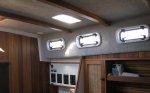
 
Steve

I'm surprised no-one has mentioned carpet headliner? Maybe it wouldn't suit your yacht's style or maybe not suitable for UK climate but I have used "Carpet Headliner" and I think it is great. (I note other YBW Forum commenters think it is good too)

Temp Headlining.JPG

Clive
 
Last edited:
I think that T&G would be difficult to fit neatly given the curved sides and cambered headlining.
On previous boats I replaced the droopy vinyl with ply panels. I stuck 12mm battens to the GRP in a fore & aft direction. The two panels at the side overlapped the central panel. Ply was ordinary (i.e., NOT marine) 3mm plywood that I covered with cheap non-woven carpeting using contact adhesive and wrapping round the edges for around 25mm. One advantage of using that kind of carpeting is that the heads of fillister countersunk screws are virtually invisible in the fibres unless one is looking straight at them from underneath.
This photo is of the Centaur (CR1279) that I had for fourteen years:
BwNo3WN.jpg


p.s. Absolutely no condensation and the air-gap beneath the coachroof gave enough insulation that the cabin was no longer like a Sauna in Summer, nor like a cold-store in Winter. (Malta, central Mediterranean).
 
Last edited:
IMG_6770 (Small).JPGIMG_6770 (Small).JPG

Hi
I used the cladding I suggested(not wicks or soffit stuff) and it was easy to fit. I finished it off with fancy battens and Brass screws. worked well. would I use it again ?. It really depends what your dealing with.

Much better to keep your coachroof original whether that be vinyl or painted. Prefer wood cladding but again it needs to be a good product.

Steveeasy
 
. The two panels at the side overlapped the central panel. Ply was ordinary (i.e., NOT marine) 3mm plywood that I covered with cheap non-woven carpeting using contact adhesive and wrapping round the edges for around 25mm. One advantage of using that kind of carpeting is that the heads of fillister countersunk screws are virtually invisible in the fibres unless one is looking straight at them from underneath.

Puff

That looks great!

Temp headliner1.JPG

I've used "non woven carpet" too so I'm hoping you are right and I can hide some c/s head bolts which will secure my rope jammers otherwise I'll use domed nuts proud of the liner.
I am sure, with care, I can peel off the "carpet", secure the bolts and then replace the "carpet". (Wiring for the main cabin dome light is concealed behind the "carpet" and you can barely notice it)

View attachment 70939

Clive
 
Last edited:
One problem with T&G and ply on boats is that many surfaces are double curved and wood is only tolerant of single curves. I'd love to use T&G to line my forepeak, but I'd have to make each piece a different and varying width for it to fit!
 
Top