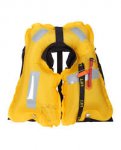
What’s the D ring on a lifejacket for?

fredrussell

Well-Known Member
Joined
24 Mar 2015
Messages
4,159
Visit site
…Or to be more specific, can a person be lifted from the water by a line clipped on to the D ring?
All my LJ’s have a crotch strap, made of 1” webbing, but which secure with a feeble looking plastic ‘rucksack style’ clip (I realise this strap is to stop inflated jacket riding up when inflated). I’m assuming as you lift someone (with winch etc) this clip will break at some point allowing the waist belt will ride up to under armpits. Then what? Keep lifting? Some of my crew are quite overweight and I wonder if the waist belt correctly adjusted for ‘girth’ would be large enough in circumference to slip over their arms/shoulders.
 
Last edited:
Many can be lifted out and at least it is a strong point to hold you clear tof the water. I prefer the metal D ring to the plastic clip option .
 
The D ring is also the point to attach a safety line, the other end of which is clipped to lifelines or a anchor point. This we do when sailing at night.
Some LJs are just that and some also have a harness with a D ring which can be used for lifting. It is pretty uncomfortable for person being lifted. You should do some recovery practice with a few people and try out the various techniques. I organised a couple of these events on the Blackwater. The only real answer being not to go overboard! Anyway, I think that if the LJ comes with a D ring then it should be able to support your weight without the clip beaking otherwise it is scarcely fit for purpose IMO.
 
Don't LJs have a webbing 'lifting becket' higher up, on the front? The 'D'-ring is meant for the tether, and lifting from that point would be quite uncomfortable. Double crotch straps are preferable to a single one, and kinder to a gentleman's anatomy, as well as halving the strain on the plastic clips.
During an "MOB-Day" trial of various methods of extracting a (real volunteer )casualty from the water, at a sailing school to which I once belonged, the crotch-straps never failed once.
Incidentally, the best lifting method was found to be a halyard whose lifting capacity was doubled by judicious use of a snatch block. A 6-1 purchase, with a carabiner at both ends, attached to the end of the boom also proved quite useful. All Glenans cruising boats now carry such a purchase clipped across the pushpit, ready to hand for an MOB rescue.
 
Last edited:
When I look at the harness on the LJ they tend to be a bit Mickey Mouse, compared to a conventional safety harness (we wear climbing harnesses as safety harnesses). The suggestion for using a LJ as your harness seems to imply that you need to be in the water to use the LJ - which means the tether or the jackstays or harness have failed.

The harnesses on our LJ seem to be designed to hold the LJ to the casualty, stop them falling out of the LJ. Ours have a safety loop at the top, back, to which you could attach a lifting strop - but I'm not sure that the casualty would not fall our or be seriously injured when lifted (clothing all sodden). As mentioned the harness for some of our LJs have plastic clip, which can fail under tension, and you never, without exception, see plastic clips on a safety harness as part of the support function..

We wear both harnesses and LJs and clip onto the harness - not the LJ. Each harness and LJ is fitted for the individual and named. We have spares for extra crew, numbered.

Its constantly said - the best policy for MOB is not to go overboard in the first place.

Many MOBs die - they are recovered - but dead.

If you are sailing in home waters your chance of recovery is higher - but if you are short handed, offshore your chances of recovery, alive - very low.

Have reliable jackstays, have hard points, use double tethers, use a reliable harness (or 2)

If you don't believe me - I accept for most its a bit extreme but check the MOB record for the Clipper fleet - and they are fully crewed with well trained crew. It makes very chilling reading

Don't go overboard - there is nothing unmanly about crawling to the bow.

Jonathan
 
Top