wet vac for bilges

I was cleaning various nooks and crannies on board last weekend, but had a lot of trouble with the pump tube blocking. It's not very wide, and the way it's all put together presents several ridges for muck to catch on. I actually had to cut the metal-lined probe pipe (leaving just enough to reach down my extended dipstick tube into the engine sump) as I couldn't clear a blockage in it.

Pete

I've bought a separate hose that doesn't bend anywhere near as much as the pipes/tubes supplied. works a dream for me!
 
I have a Wicks (badged) wet and dry vac which is great. It does trip the mains breaker frequently but perseverance pays. My inverter is not man enough to drive it s, away from shore, it is useless.

These comments have led me to wonder if you can use engine vacuum. There would need to be some means to stop water entering the manifold such as an interceptor drum.

I look forward to some expert views/criticisms/ridicule.

"I look forward to some expert views/criticisms/ridicule." - There hasn't been any.

My bilges are filled with flexible tanks which makes access for drying impossible without a lot of hassle.

I don't like water in the bilges but the run-back from most bilge pumps makes dryness a lost battle. I did buy a 12v electric valve for installation at the pump outlet but haven't tried it yet. I have not seen a commercial pump with such a valve incorporated and the mechanical ones always seem to weep.

I do like the idea of air suction but would prefer it to be "at the touch of a button".

Maybe the 12v wet vacs mentioned are the way to go.
 
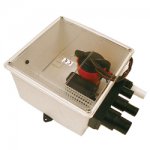
The best way to prevent run back from a bilge pump is to have a dry bilge and a pump that is only there for emergency. the solution to dry bilges is to stop the leaks at source. Water is supposed to remain on the outside of boats or the inside of tanks. I could be wrong, however that has been my philosophy over my years of boating. However, we currently have 2 air conditioner condensate drains and calorifier pressure relief overflow draining into a proprietary shower sump collector tray from which it is then pumped overboard by the inbuilt automatic electric pump. Because there is a long pipe run from that sump to overboard, there is a simple non-return valve in the line but if that valve were to leak the water would merely drain back to the sump tray for the next cycle in any case.
 
The best way to prevent run back from a bilge pump is to have a dry bilge and a pump that is only there for emergency. the solution to dry bilges is to stop the leaks at source.

Have you tried plugging a cloud?

Water is supposed to remain on the outside of boats or the inside of tanks. I could be wrong, however that has been my philosophy over my years of boating. However, we currently have 2 air conditioner condensate drains and calorifier pressure relief overflow draining into a proprietary shower sump collector tray from which it is then pumped overboard by the inbuilt automatic electric pump. Because there is a long pipe run from that sump to overboard, there is a simple non-return valve in the line but if that valve were to leak the water would merely drain back to the sump tray for the next cycle in any case.

My sink gravity drains into a wet locker in the cockpit. It acts as grey water tank. It might not be necessary to pump it dry but it would be nice.

My shower drains into a bilge area that I feel the same about. Non return valves, in my experience, always leak especially in a shower sump.
 
Have you tried plugging a cloud?


My sink gravity drains into a wet locker in the cockpit. It acts as grey water tank. It might not be necessary to pump it dry but it would be nice.

My shower drains into a bilge area that I feel the same about. Non return valves, in my experience, always leak especially in a shower sump.

You misunderstand me.
shower sump I'm talking about is not what youimagine I think. see here

10204204.jpg
a non return valve in the overboard line from here if it leaked would only allow water to trickle back into the sump box.

Clouds? It doesn't rain down below on my boat nor any in I have owned,is yours an open topped dayboat? I have in the past had to trace leaks back to their entry source and eliminate the cause. I cannot understand anyone might wish to drain grey water shower water or any water or waste deliberately into a bilge, eww,yuk.:nonchalance:
 
Last edited:
For sucking up the last bit of water from the bilge sump, I have a 500cc syringe. They're sold for changing gearbox oil and the like.
Mine is all plastic and cost about £12 IIRC.
After that, a j cloth on a stick is handy.
Wet vacs can be dead handy though, used one while investigating a leak on a wooden boat.


Also one way to prevent run-back issues is to fit an ordinary bilge pump with narrower plumbing. Something like 10mm bore, the air will drag the water along. Rubbish for major pumping of course.
 
Firstly with vacuum cleaners there is no substitute for horsepower which means 1000w or more rating. So if you need that suction of air to get the dampness/ water out of the bilges then Op's only option is more generator power or go to a mains supply. Vacuum cleaners are generally a brush type motor which draws more current on start up. However as mentioned before if you block the suction hose the motor speeds up so uses less power. This is contradictory to what we might imagine but is because the cleaners use a centrifugal compressor (pump) which with no airflow stalls (no airflow) and so seems to unload the motor. So yes you might be able to get it to run initially on a generator of marginal power but the start up will still be high current. good luck olewill
 
." I cannot understand anyone might wish to drain grey water shower water or any water or waste deliberately into a bilge, eww,yuk."
Agree absolutely, my friends Elizabethan 29 has this arrangement. The galley sink discharges directly into the deep bilge and is emptied by the bilge pump. Seems to me this is a recipe for SBS (stinky bilge syndrome) with greasy residues sticking to the sides.
 
Top
