Weird yacht terms, an encyclopedia please?

guyd

Well-Known Member
Joined
24 May 2009
Messages
208
Location
Minehead
bossingtonhall.co.uk
Yes - I know Wikipedia exists... - but I wonder if there is a page with diagrams of bits of boats with all the weird names - cunninghams, bull horns, clews, - in a diagrammatic fashion - Ive looked, and all the diagram versions are a bit simplistic (mast, boom, sheet) and unless you know the name (cunningham) how can you look it up?

reasoning - I did my RYA dinghy sailing in the 80's to level 5 (I think - next level was instructor) but dinghies are quite simple - now I have a (just about) yacht, I feel a bit stupid not knowing these terms.
 
You might find this web site possibly useful.

Beginner’s Guide to Boat Terminology - boats.com

Anything else can be found by looking at sailing catalogues, e.g. for mast parts look at Selden. Otherwise photograph the item or give a descrition if you cannot photograph something and post it on here for the correct term. You will also find overtime you will learn the correct terms for many things by reading articles and forums.

I have been sailing since 1965 and still find terms I had never heard of. The most recent was a letterbox spinnaker drop. This involves dropping the spinnaker by passing it from the lee side of the mainsail through the slot of a loose footed mainsail and over the boom, then down the companionway. It is used by some race boats, but I use a similar method as I sail singlehanded, except I do not pass it over the boom.

Being aware of sailing terms is useful but not essential. Learning how to handle your boat is far more important than worrying about using the correct names. If you make a cock up, everyone will realise it and chuckle, but do not worry even us old hands still get it wrong occassionally. ;) ;) ;)
 
Don't worry about correct terms. If you can describe it then someone wiil tell you what it is called. If not just ask on this forum. Re communicating with your crew just point yell or describe. ol'will
 
Whilst it’s great to know all the correct terms just adopt what Michael Green wrote in his book ‘The Art of Coarse Sailing’
The definition of a Coarse Sailor is one who in times of emergency forgets all nautical language and shouts ‘For Gods sake turn left,’
 
I’m in the minority in that I think it’s entirely appropriate to learn and use the correct terms.

RYA booklet to accompany the Comp Crew course is a good start, as has already been mentioned.

As your thirst for knowledge increases, these two books, probably both considered as “coffee table books” in the hands of we recreational sailors, are a wonderful resource.

The Oxford Companion to Ships and the Sea.

Admiralty Manual of Seamanship, Vol 1-3.

They appear on eBay from time to time for pennies and are fascinating to flick through the pages.
 
Like Skylark I think it appropriate to use the correct terms and I think it also enriches ones sailing. After all wouldn't our sailing vocabulary be the poorer without terms like cunningham, slutter, peak halyard, whisker pole, fiddle, gunwale, garboard strake etc etc.
 
I don't think that it is a minority opinion, although most sailors, I suspect, are happy to use the correct terms or at least as many as they can remember properly. I think that confusion tends to arise only when words are used ambiguously, such as 'topsides' when used to mean coachroof. More difficult is 'amidships' which has come to mean centrally both abeam and fore-and-aft. I am happy to used 'Jib', 'genny', and 'foresail' promiscuously without attention to their strict definitions.
 
Why don't you do a Google/image search for the appropriate term?

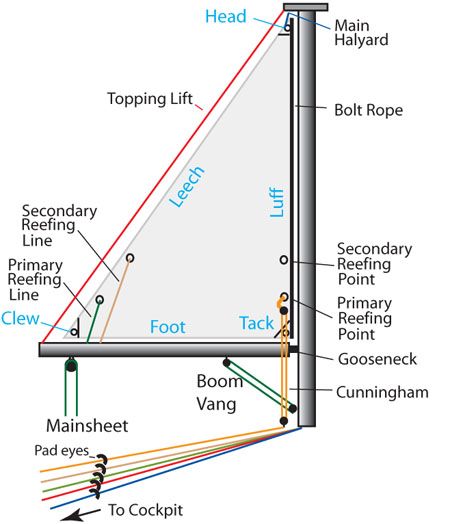
I did a google/image search on "Yacht cunningham" and found this.

ee3920df69d4ad438262925b375773a8.jpg
 
IMHO the proper terms originated naturally as a practical need.
Think of a four masted windjammer: can you figure a seaman receiving the order: "pull the rope!" in the mass of different lines surrounding him. Apt names were born out of necessity.
Our riggings are infinitely simpler but using correct names avoids misunderstandings, (as far as the crew is learned...)
 
The main ones I've heard regularly are called "NOT THAT ONE" - " THE OTHER ONE" in regular use amongst yachties and dinghy sailors'
The application of the plastic name tags at each jammer or cleats/winches helps somewhat and the Traveller and Out-hauls/In-hauls probably make terms more explicable.
Alternative terms for instance, Boom - Vang and Kicking- Strap/Strut, don't describe their function
Old time terms like Hauling-Yards -now Halyards and Sheets/Guys, Whisker Poles, don't help either.
One would have thought that being" Three Sheets to the Wind" meant something quite nautical too!

ianat182
 
Why don't you do a Google/image search for the appropriate term?

I did a google/image search on "Yacht cunningham" and found this.


good diagram, thanks.

Because, if I dont know what its called, how do I know what to search for? ;-) So - there is a loop, just aft of the kicker (or Vang in your diagram) - I have no idea what its for, or what its called....
 
One would have thought that being" Three Sheets to the Wind" meant something quite nautical too!

ianat182

Derived from sailing ships. The 'sheet' in the phrase uses the nautical meaning of a rope that controls the trim of sail. If a sheet is loose, the sail flaps and doesn't provide control for the ship. Having several sheets loose ("to the wind") could cause the ship to rock about drunkenly. Before settling on the standard usage of "three sheets", a scale used to be employed to rate the drunkenness of a person, with "one sheet" meaning slightly inebriated, and "four sheets" meaning unconscious. A better description relates this phrase to a square rigged ship sailing on the wind, on a bowline as they say. With the three windward sheets hauled all the way forward, in or to the wind, the ship will stagger like a drunken sailor as she meets the waves at an angle of 60 degrees to the beam. For loose sheets to have this effect there would have to be six loose sheets, three to windward and three to leeward. Also, unless all the upper sails secured to the yards were also loosed having the course sheets loose would not produce any change in a ship's motion except to reduce its forward speed a bit.
 
Top