weighing my boat, displacement at sea

  • Thread starter Thread starter vas
  • Start date Start date

vas

Well-Known Member
Joined
21 Jun 2011
Messages
8,200
Location
Volos-Athens
Visit site
too hot to work on the boat, so at home I decided to calculate the displacement of MiToS.
Last week I measured with a laser meter thing every metre up to the 6th and then every half a metre sections. So, side length, angle and upright section if available.
Put them all in AutoCAD and created proper full sections at these intervals.
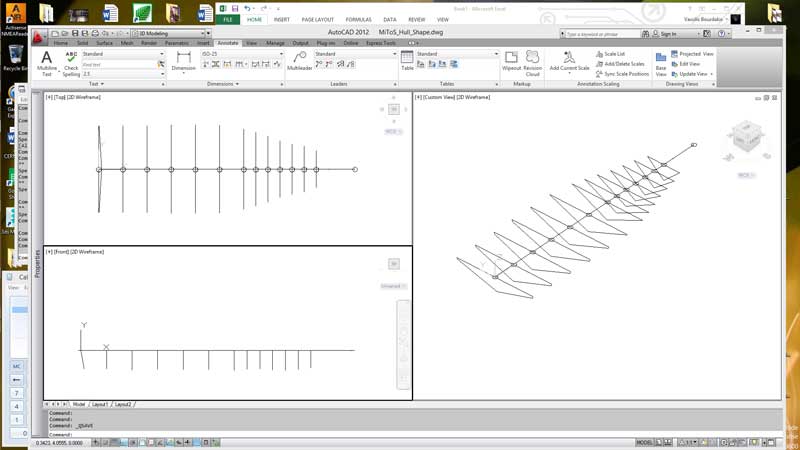
mitos_below_WL_hull_volume.jpg


Shape looks OKish, probably lost a bit on some sections but will probably mean 50-100kg up or down cannot be bothered with that tbh.

On XL did some calcs based on the detailed areas given by AutoCAD, averaging each 1m or 0.5m long section and thus came up with MiToS displacement in salty Med water with 200lt (out of 500lt water) and 250lt out of 1200lt diesel (and an almost empty black water tank which is only 100lt anyway)

the value I came up with is 11,66 CUBIC METRES (and not sqm which was pointed out by MM!)
Am I right in just multiplying it with 1025 to get 11950kg?

Yes, I have no documentation, I've done too many mods, and I'd like to have an idea of how heavy MiToS is.
Am I on right tracks?

cheers

V.


PS. an anchor thread to follow

(just kidding!)
 
Last edited:
Principle is fine. You need to calculate the underwater volume when the boat is floating, so measure the volume of each segment to the actual WL. Reasonably easy (haha) in a hard chine boat with flat sections. Add all the sections up. Once you know the volume (in cubic metres say) then multiply by the density of the sea water where you are (so your 1025Kg / cu metre) and you get the displacement. (ie, the 'weight' of the boat)
 
Interesting exercise Vas. I don't think you are too far wrong, and it sounds about right for your length of boat, apart from the 10 tonnes of epoxy you have applied ��. What did you use to scan? We have GOM scans at work, which give a point cloud array. Looks fantastic in our VR Cave.
 
Then when you've done that work out the grain weight. One of those little "keep someone in a job" things you need from time to time :)

Henry
 
the value I came up with is 11,660sqm
Am I right in just multiplying it with 1025 to get 11950kg?
Ahem... No, in my books.

Leaving aside the salt vs. fresh water which is a red herring, sqm alone are useless.
Btw, 11sqm sounds way underestimated, for MiToS hull footprint.
Or did you actually mean CUBIC meters?
 
Principle is fine. You need to calculate the underwater volume when the boat is floating, so measure the volume of each segment to the actual WL. Reasonably easy (haha) in a hard chine boat with flat sections. Add all the sections up. Once you know the volume (in cubic metres say) then multiply by the density of the sea water where you are (so your 1025Kg / cu metre) and you get the displacement. (ie, the 'weight' of the boat)

Yep, sorry I didn't make my self clear enough. Boat was on the hard last week, jetwashed, with WL clearly visible. So obviously all sections and measurements were done TO THE WL only!

Interesting exercise Vas. I don't think you are too far wrong, and it sounds about right for your length of boat, apart from the 10 tonnes of epoxy you have applied ��. What did you use to scan? We have GOM scans at work, which give a point cloud array. Looks fantastic in our VR Cave.
Paul, obviously not 10tons of epoxy, just a couple of 50kg barrels :p
Tools used were my Leica laser metre and my Sony Xperia Z phone running Clinometer for the hull deadrise (as you call it)

Then when you've done that work out the grain weight. One of those little "keep someone in a job" things you need from time to time :)

Henry
Henry,
thanks for enlightening me on yet another measuring system currently used for gunpowder, nitroglicerine and other interesting and useful substances, I'll pass!
(for the record, I'd never heard of that before so had to google it...)


Ahem... No, in my books.

Leaving aside the salt vs. fresh water which is a red herring, sqm alone are useless.
Btw, 11sqm sounds way underestimated, for MiToS hull footprint.
Or did you actually mean CUBIC meters?

doh!

corrected original post, yes of course I'm talking cubic metres!
now can we focus on the red herring please :p

cheers

V.

PS. all started as I want to order stern lines and suitable springs and I thought it would be a good idea to know the weight as I was under the impression that being ply and iroko and with the DD replaced by much lighter engines, it would be around the 10000 mark
 
An interesting exercise and the only way to check the displacement of a ship but....

To check at the next lift use a modern boat hoist with a hydraulic pressure read out such as a modern Marinetravelift they give weight check when the boat comes clear of the water which is +-5% of the weight.
 
An interesting exercise and the only way to check the displacement of a ship but....

To check at the next lift use a modern boat hoist with a hydraulic pressure read out such as a modern Marinetravelift they give weight check when the boat comes clear of the water which is +-5% of the weight.

not a bad idea if there was such a beast around here. I don't know where in Greece they have a decent travel lift, but I may have to travel 150nm or more (Thessaloniki or Athens), so not really an option ;)

cheers

V.
 
corrected original post, yes of course I'm talking cubic metres!
now can we focus on the red herring please :p
Aha, fine. In hindsight, it was easy to understand that you were actually talking of volume.

Anyway, re. the red herring (:D), I believe that your math is correct.
Water temperature and actual salt level can affect the 1025 which you used as a parameter, but only marginally.
The accuracy mostly depends on the volume estimation, but I can't think of any better way to assess it! :encouragement:
 
Again, an interesting thread from you, vas!

If you are already going through this exercise, are you considering some inclining test in order to determine your stability curve? I have always wondered where the righting moment peaks / stability vanishes on mobos with a flybridge...


BTW - a pity that your next travellift is located in Nea Paramos (Kavala) or Lavrio. Are there so few boats in the Volos area?
 
Aha, fine. In hindsight, it was easy to understand that you were actually talking of volume.

Anyway, re. the red herring (:D), I believe that your math is correct.
Water temperature and actual salt level can affect the 1025 which you used as a parameter, but only marginally.
The accuracy mostly depends on the volume estimation, but I can't think of any better way to assess it! :encouragement:

P., temps from Sept to June had a decent variation, as you can imagine W/L is not clearcut with a sharp pencil, so all these measurements are sort of averages but not more than a couple of persons' weight off the mark I recon, so good enough.
As my late uncle used to say when we were building something that wasn't really spot on: "we're not building an airplane, it's good enough!"

As Archimedes would have said - "Eureka"

how true, and due to being a banana republic I have to use ACAD and a computer to do all these calcs as nearest lift is too far away as Hardmy below states...


Again, an interesting thread from you, vas!

If you are already going through this exercise, are you considering some inclining test in order to determine your stability curve? I have always wondered where the righting moment peaks / stability vanishes on mobos with a flybridge...


BTW - a pity that your next travellift is located in Nea Paramos (Kavala) or Lavrio. Are there so few boats in the Volos area?

you mean there isn't one in the whole of Thessaloniki???

I recon there are 200 craft 99% of them up to 60ft in Volos port and another few hundred around the bay.
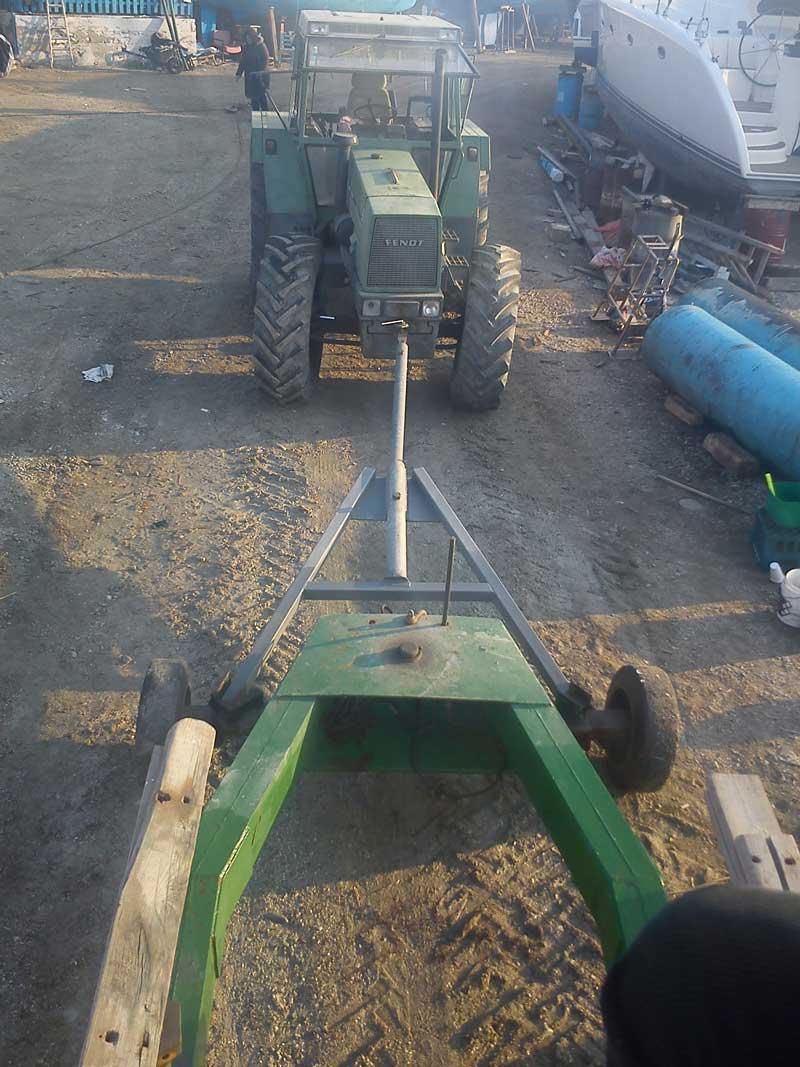
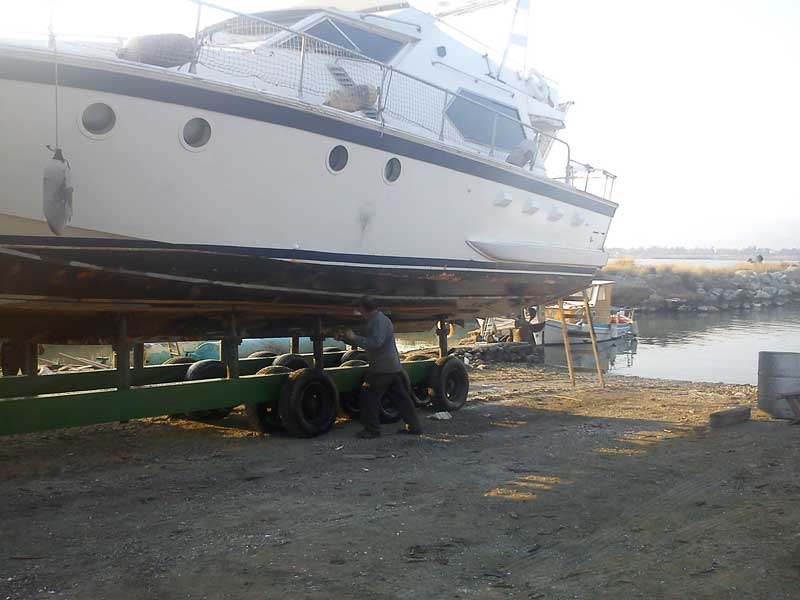
Two main yards with trolleys like this:

movingout_1_Dec11.jpg


movingout_4_Dec11.jpg


Regarding your main Q, I doubt it's an easy job doing that stability curve.
It would be easy to place the 6tanks (4Xdiesel, 2Xwater) and the 100lt black, but then what?
Engine is going to be a pain getting the volume and COG right.
Superstructure, will probably have to do an average of kg/cum or something like that...
Ideally (which looks highly unlikely it will ever happen) I should built a proper 3D model of MiToS. I do have parts in 2D and 3D, but unless I borrow a decent laser scanner to create a proper 3D cloud of the whole thing, I very much doubt it...
Anyway, all that discussion is for mid winter not now :D

Off to pick a mate's tender that I'm borrowing for the season and fit it as first extended w/e of the season is coming (on Fri...)

cheers

V.
 
Vas,

Hydrostatics are just a click away!
http://www.delftship.net

Others are available.

An inclining experiment is not difficult.

Sorting out the initial stability is not too difficult, but extending it to large angles requires a detailed definition of geometry, tanks, etc, etc.

Sounds like a winter project.
 
Top