Weeping bonding P-bracket bonding bolt: Westerly Falcon 35

NealB

Well-Known Member
Joined
19 Feb 2006
Messages
7,674
Location
Burnham on Crouch
Visit site
I bought a Westerly Falcon 35, a couple of seasons ago.

For the first season, the bilges were absolutely dry.

Last season, however, the bilges under the double berth, in the stern cabin, were always wet.

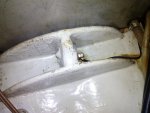
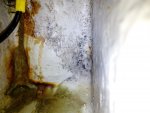
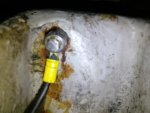
The culprit is a weeping bonding bolt (edit: stud) that passes through the internal framework that supports the
P-bracket (see pics).

That top bolt (edit: stud) is dripping very slightly, but continuously.

We haven't relaunched this year yet, and I'm wondering how to stop the drip.

I've been advised that all I need to do is to remove the two nuts, then clean up a bit, before putting a blob of CT1 sealant followed by a washer, and reassembling.

Any thoughts, please .... is that a 'proper job' or a short term bodge that might cause longer term problems?

There's no sign of movement on the outside.
 

Attachments
  • IMG_20190501_151459 (1).jpg
    IMG_20190501_151459 (1).jpg
    507.9 KB · Views: 49
  • IMG_20190501_151439 (1).jpg
    IMG_20190501_151439 (1).jpg
    487.4 KB · Views: 50
  • IMG_20190501_151544.jpg
    IMG_20190501_151544.jpg
    489.2 KB · Views: 49
Last edited:
CT1 you describe would be a quick fix and could work fine for a long time and I doubt would cause significant further problems. That said the
bigger job would be to have the whole P bracket removed and rebeded and all bolts redone, it looks like they have been glassed over when the boat was made. Is there any movement in the P bracket facilitating this weep?
 
Last edited:
Thanks for your thoughts.

There's no sign of any crazing, inside or out, as far as I can see, and I can't sense any movement at the P-bracket if I try to give it a fairly vigorous shake by hand.
 
Thanks for your thoughts.

There's no sign of any crazing, inside or out, as far as I can see, and I can't sense any movement at the P-bracket if I try to give it a fairly vigorous shake by hand.

As suggested the water ingress could be halted with a suitable sealant, CT1 if that's "what floats your boat" , but you will be preserving a situation in which corrosion ( crevice or galvanic ???) of the stainless steel bolt ( stud???) will continue. The rust stain indicates that it is already well under way and you might be horrified by the state of the bolt or stud if you remove it.

i dont understand from your pictures, but I dont know how the Westerly is screwed together, how water is actually getting to that bolt ( stud?) The other end is not on the outside is it ? The leak you see may be the initial indication of something more serious.

I would also question the need and the wisdom of the bonding, but presumably the boat was constructed in the days when it was fashionable to bond all bits of underwater metalwork to sacrificial anodes.

If Vyv Cox comes this way take note of what he has to say.
 
Last edited:
It looks someone put a stud into the P-bracket with bonding strap at a later stage. On my P-bracket on the Konsort which is similar it is not bonded and is isolated from the prop shaft and anything else by the cutlass bearing. As it's isolated it should not need bonding. My P-bracket is bronze as well so if yours is too then putting a stainless steel stud into it can't be ideal. I would also expect the P-bracket to have been sealed into the mounting slot as well as bolted in (bolts are glassed over) and would not expect water to get to where it is coming out. I think to do things properly it would be a case of removing and refitting/sealing the P-bracket. May not be that easy as it may well be 'cemented' in place and after even removing the glassed in bolts it may be very hard to get out without some surgery. If the P-bracket is rock solid then I don't see why you shouldn't temporarily remove the stud and reseal it to get sailing and then do the big job at the end of the season.
 
Thank you (I think!), VicS for confirming that some of my darker thoughts are not just based on ignorance.

I have no idea how the water is getting to the stud: that has been playing on my mind.

I can see no obvious crazing, or cracks, externally.

The bolt (edit: sorry... yes, it's a stud) looks as if it just goes through the supporting frame, then is presumaby screwed into the P-bracket.

As you suggest, I am nervous of just 'sealing in' the problem.
 
Last edited:
Thanks for that, neilf39.

I'm beginning to think it might be worth spending a few quid on getting a trusted local boatbuilder to take a look: I've sailed fairly widely, in a wide variety of boats, for well over forty years ...... but, sadly, I'd never, ever, mistake myself for any sort of engineer.
 
Last edited:
I bought a Westerly Falcon 35, a couple of seasons ago.

For the first season, the bilges were absolutely dry.

Last season, however, the bilges under the double berth, in the stern cabin, were always wet.

The culprit is a weeping bonding bolt (edit: stud) that passes through the internal framework that supports the
P-bracket (see pics).

That top bolt (edit: stud) is dripping very slightly, but continuously.

We haven't relaunched this year yet, and I'm wondering how to stop the drip.

I've been advised that all I need to do is to remove the two nuts, then clean up a bit, before putting a blob of CT1 sealant followed by a washer, and reassembling.

Any thoughts, please .... is that a 'proper job' or a short term bodge that might cause longer term problems?

There's no sign of movement on the outside.
It looks as if there are two bolts under that glass as well. To pinch/hold the P bracket in.
No sign of movement outside? That is good. Is there any Sika seal outside? Or just glassed in? I suspect if just glassed, in that water is seeping up the side of the bracket and then through a poorly sealed bonding bolt. I would remove the bonding bolt, grind off the glass from those two bumps and reveal the “pinch bolts” then remove those to check and replace. If really paranoid, draw the P bracket, otherwise a good inspection in situ, replace the pinch bolts with good sealing, if water is getting to them, so is oxygen to the buried P bracket. Tighten them up well and replace the bonding stud with good sealing
 
Thanks Mr Heckler.

I'm just off now, to do a bit more poking around, to see if I can get a better idea of where the water might be getting in, and also to try and work out exactly how the P-bracket is fitted.
 
Thanks Mr Heckler.

I'm just off now, to do a bit more poking around, to see if I can get a better idea of where the water might be getting in, and also to try and work out exactly how the P-bracket is fitted.

Looking at NeilF post. It looks as if your bonding stud is non std so disregard the bit about grinding off the glass on those two bumps. It might just be bad sealing on the retro stud. Check the P bracket is sound out side, a good shaking will give a good indication. Is it bronze or brass? If not stainless, then corrosion of it can be discounted, that rust will be coming from that stud. Just remove that, clean up the hole good, check with a good light through the hole and replace the stud with a brass or bronze stud and washer and seal it well.
PS Just found a pic of a similar boat and its P bracket, its yellow metal so there wont be any SS corrosion of the bracket inside the glass, https://westerlyfalcon.wordpress.com/#jp-carousel-261
 
Last edited:
Looking at NeilF post. It looks as if your bonding stud is non std so disregard the bit about grinding off the glass on those two bumps. It might just be bad sealing on the retro stud. Check the P bracket is sound out side, a good shaking will give a good indication. Is it bronze or brass? If not stainless, then corrosion of it can be discounted, that rust will be coming from that stud. Just remove that, clean up the hole good, check with a good light through the hole and replace the stud with a brass or bronze stud and washer and seal it well.
PS Just found a pic of a similar boat and its P bracket, its yellow metal so there wont be any SS corrosion of the bracket inside the glass, https://westerlyfalcon.wordpress.com/#jp-carousel-261

Thanks again .... that came through just as I was swilling the last of my coffee before heading off out.

The survey, dated 18th May 2017, states, "The shaft is supported at the aft end by a ‘P’ bracket which is well installed and serviceable".

We've not hit anything, or got caught up on anything, during our ownership, and it all feels very solid (though I've not been too enthusiastic with my adventurous with my testing: muscle power only, no sledge hammer involvment!)..... so I'm hoping it's all still structurally very sound.

Just a mystery, to me, as how the water gets in there.

Right... I'm off to investigate.
 
A bodge that I used on the hull/keel joint of a Falcon, recommended on the WOA forum some years ago, to apply on the hull/P bracket joint outside.

Get strip of thin rubber (wet suit repair tape I think) and cover the joint with CT1 or similar, then apply the tape over the top to tidy it up and give a bit of protection.

This kept our keel joint dry for 12 years, even though the original sealant was showing signs of falling out when the bodge was applied.

Our P bracket never showed a problem but it had a similar bonding cable.

Deek
 
Your P-bracket seems to be installed in a better way than mine was. My account of replacing it is on the website. It appears that yours is fitted to a grp socket and held up by two nuts and bolts that I can see in pic 2. Water at the bond stud indicates that the sealant has broken down, so corrosion at the stud may be repeated at the bolts.

I doubt that there is great urgency, so sealing the stud as you have suggested should be fine for a season but in the longer term I would remove the bolts, drop the P-bracket and rebed, replacing bolts and stud as necessary.
 
Huge thanks to everyone on this thread: it has all been really valuable.

Heckler even managed to come up with a picture of my very own P-bracket, taken when Celtic Spirit was hauled ashore in Poole for our survey.

I've just got home ....

The P-bracket seems absolutely rigid, as far as I can test just with muscle power, and I can't see any visual witnesses to any damage either internally or externally.

The stainless bonding stud unwound easily, and, despite what looked like a fair bit of rust staining, it was actually fairly clean, with even the thread in pretty good nick.

So I think I'll go along with what seems to be the concensus: I'll not replace the bonding stud, seal the hole, then have more of an investigation in the autumn.

I feel as if I owe a few beers.....if anyone is coming to Burnham on Crouch, or if you see Celtic Spirit somewhere.... be sure to give me a shout.

Cheers!
 
A useful thread. I have the same problem with my p-bracket. I'm in the process of it just now. I'd be interested to hear if you got around to removing it?
 
I had a weeping bolt on the rudder stock on my Turbo 36.

When the boat was out of the water and had had a couple of weeks to thoroughly dry out I removed the nut and washer which were on the inside, and simply dripped some Captain Tolley's into the gap between the bolt thread and the hole every few days until eventually the gap was filled. Replaced the washer and nut, problem entirely solved with nil further disturbance of the assembly.
 
A useful thread. I have the same problem with my p-bracket. I'm in the process of it just now. I'd be interested to hear if you got around to removing it?

I'm rather embarrassed to admit that, for several reasons, my boating activities with Celtic Spirit, have been rather seriously curtailed, since 2019.

Sadly, she sat ashore, largely ignored, until a few months ago.

I cleaned up the weeping stainless stud (which seemed to be in good condition), and refitted it, with a good dollop of sealant.

She's been afloat, since then, and the bilges have stayed dry.

We'll be getting her ashore again, in the next couple of weeks, so will be able to undertake something closer to a proper job over the winter.
 
Last edited:
I have done a bit more digging - literally!

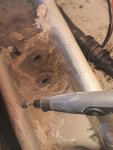
Mine was leaking on the port side, the stud side and there was evidence that water was pushing up from lower than the stud fixture. Not being entirely happy to just seal the leak from the inside I wanted to remove the p-bracket and re-seal the whole thing. Now am not so sure. Having removed coating/glass on the side on the side that had been leaking it has exposed metal beneath. This is presume is either the top of the p-bracket itself or its the top of a female housing that the top of the p-bracket "slots" into, but I do not know. Given this, I do not want to go full surgery on this only to cause and bond in an alignment issue. Afer removing the two p-bracket retaining bolts and hitting it there is no movement whatsoever - it's definately bonded!

The digging that I have managed to do seems to have removed all material that seemed to have been affected by moisture, so think some fresh glass and flo-coat and sealing up the stud hole should stop it leaking. I'm thinking of grinding back some material from the outside and then fill with thickened epoxy to stop water from coming up from underneath. As a side-note, I am surprised at how much of the glass fibre lacked any original impregnation of resin. I will re-glass using polyester resin which is less dense and impregnates more readily than epoxy resin.

20221114_192718.jpg
 
cwh

Huge thanks for taking the time to post that update.

I haven't delved that far into mine, so would be really interested to hear what you find when you take your surgery to the next stage: I hope it doesn't involve too much hasssle and swearing.
 
Top