Weather helm/rudder design

Hi all,

Last year I suffered quite severe weather helm in high winds (30+). A strong gust would round the boat up, and seemingly nothing I could do would stop it. The helm became very heavy, and spilling the main didn't seem to help once the "round up" had got going.

From this I've decided that the main needs a third, deep reef, but on top of that given some further research I think the rudder has a design flaw.

The rudder on my Corribee is a balanced spade rudder. It's balanced not far off 50%.

I've read an account of a chap fitting a newbridge skeg moulding to his boat and it doing wonders for the issues I've described, but I am reluctant to go down this route since fitting a skeg is going to be a serious project.

As such, I've decided to experiment with the rudder. I've made (am making) myself a new one with slightly more surface area (nothing excessive) and intend to mount it with a refresh bias aft, of about 2/3. I'm hoping that moving the centre of effort aft a bit will help.

What are your opinions? Am I doing the right thing?

Cheers,

Nathan

I experimented with rudder shape on my Trident a year ago, when i found the old one had a badly corroded stock. TBH I would be very surprised if the Corribee has a 50% balanced rudder. That would make her virtually impossible to handle. I increased mine to 20%, and it made her very very light on the helm and quite twitchy.

But as others have said, I do not think you are going to gain much by playing with the rudder. The problem is far more likely to be in the rig. What you describe is pretty close to classic 'overpowering' - far too much sail up for the wind strength causing you to lose control. In order to get enough sail up to keep going in light winds, the boat has a fairly large sail area for the size/weight of the hull. At 30 knots there is far too much sail up, and although crashing around lee rail under may be exciting, it is not at all efficient, and a lot of the power of the rig is effectively being wasted in just tipping the boat over. At a good angle of heel the hull creates far more drag, again slowing her down. An extra deep reef in the main will solve all this, and you may well find her going significantly faster as a pay off.

Paying atytention to tuning the rig - mast rake, luff and foot tension of the main etc - will also make significantly more difference than messing about with the rudder.
 
TBH I would be very surprised if the Corribee has a 50% balanced rudder.

You are right. I've done something silly.

http://onkudu.files.wordpress.com/2008/07/dscf0447.jpg

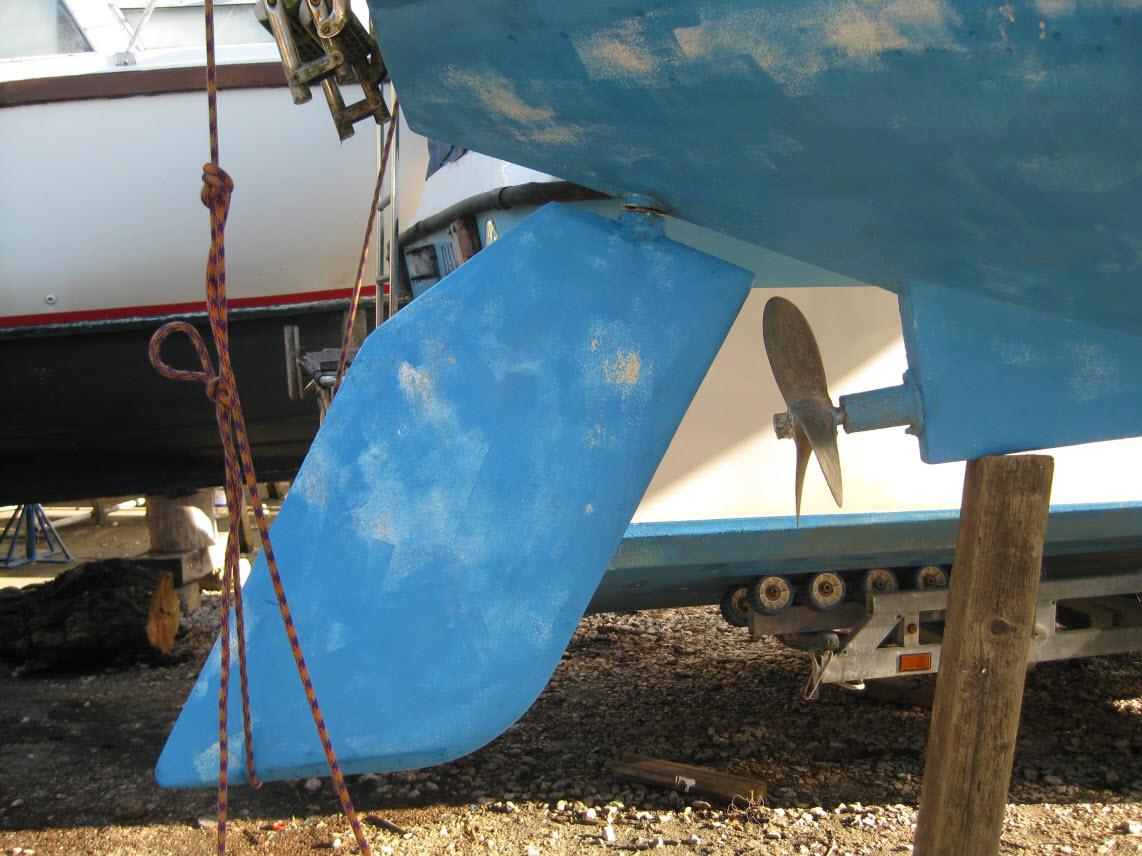
There's a pic of the old rudder, and I hadn't realised what I was thinking until I've just looked at it.

I was taking the area each side of the fork as the balancing (not quite, but it's towards 50/50). A small brain fart stopped me realising that the rudder does not pivot around that point, but directly downwards from the stock.

I've going to set the new rudder up as best as I can (I've made most of it already) and see how it is in the water with rig adjustments. If there's still a problem, I'll correct it over the winter.
 
I do not think you have to be a naval architect to construct a new and better rudder - when I redesigned the rudder on my old Macwester 26 (famous for heavy and weather helm) I used the proportions from the Vetus spade rudders which have about 17% of the balance area forward of the pivot and I agree with the comments that at 20% balance area the rudder would be twitchy.
You may have two separate problems ie heavy helm and weather helm. The better balanced and perhaps a bit bigger rudder will I think improve the heavy helm and ease the weight when weather helm is in play but sail balance and mast rake is only part of the problem which includes hull shape, and not much to be done about that!
 
Try towing a tender all the time. I went out for a quick sail the other night and left the tender on a painter on the stern.
I noticed straight away that my normally slight weather helm had become serious lee helm.
 
Weather Helm

Weather helm can be caused by:
Too much main area (or too little jib)
Main too full
Main sheeted harder than jib
Mast raked too far aft
Keel/CLR too far forward
Allowing excessive heel

A bigger rudder will do a bit to move the CLR back.
But I would think the first place to look for a significant effect would be the size and fullness of the main.
In 30kts, I would want the main to be very flat, perhaps 5% camber at most, and the max camber no more than 45% back from the mast.
Do not sheet the main too far inboard. That implies either letting the traveller down to leeward at least a foot, or having a very powerful kicker that will give the equivalent leach tension.
Conversely, you might try sheeting the jib harder, if you are setting a working jib, it might be usefully sheeted inside the shrouds or use a barber hauler to angle the sheets in.
If the top of the jib is twisting off and doing no work, move the jib lead forward to apply more tension to the leach.
(edit sometimes easier to achieve this by raising the jib up the forestay on a tack pendant)
Check your reefing arrangement is giving good tension along the boom in the reefed main.
Check you are getting good halyard tension and it's not slipping or stretching.
Does your rig permit the mast to bend due to the kicker, this can be useful to take fullness out of the main. Should not be over done on a masthead rig though.

A third deep reef (reducing luff to about 55-60%) is useful, but should only be needed with storm jib rather than working jib.

If your main is sound but unreasonably baggy, then talk to a sailmaker for a few nips and tucks, or find a racing keelboat class to 'donate' you a younger one perhaps?
Maybe a smaller, flatter main could be kept for windy passages?

Don't fiddle with the rake to balance the reefed rig, the rake should be set with reference to full sail

Hope the above helps. YMMV, each rig is a little different.

Alternatively, find some lighter wind to sail in, 30kts is not what your boat was dreamed up for! :-)
Good Luck with the rudder BTW, please make it stronger than you think it needs to be!
 
Last edited:
As LW395 has mentioned in strong winds the reef in the main and a large jib will reduce the weather helm; you are bringing the centres of effort and centre of lateral resistance closer together, neutralising the helm. Too much CE ahead of the CLR will induce lee helm.
Possibly you furled the jib, allowing the main to dominate, hence weather helm.
I usually reef the main twice before the jib is reduced,and let off the mainsheet sliders to leeward but sheeted hard,and kicker on.
I also use the Cunningham to bring the flow forward and flatten the mainsail.

ianat182
 
They certainly played around with the bilge keels and skeg/rudder. The mark3 ended up, IIR, with slightly towed in bilge keels that had a degree of foil shape on one surface when viewed in plan, and the final skeg was quite long, with a partially balanced rudder attached to it.
Ironic really that the later cabin was smaller ! Some people suggest that Newbridge 'may' have deepened the hull slightly in order to compensate for the reduced inside 'headroom'.

The long skeg is def very good, easy to get em to sail themselves though shifting the crew weight around will have an effect on heel and therefore balance.
 
Weather helm can be caused by:
Too much main area (or too little jib)
Main too full
Main sheeted harder than jib
Mast raked too far aft
Keel/CLR too far forward
Allowing excessive heel
...

Lots of great advice in there, thank you!

Mast raked back too far aft is a likely culprit. With the roller furling it's very hard to adjust the forestay, so under somebodies advice (I can't remember who) it was suggest that I simply use the back stay to tension the rig. This has, I observed this morning, introduced quite some rake in to the mast. I think the key is to take everything on board and have a jolly good play in Preston Dock on a windy day.

The main is essentially as new, but I didn't bother with the sheet track since it was very old and fiddly to use (wing nuts!). I have bought a new system and will be fitting that.

Thanks again.
 
Try towing a tender all the time. I went out for a quick sail the other night and left the tender on a painter on the stern.
I noticed straight away that my normally slight weather helm had become serious lee helm.

lightbulb.jpg


Thank you!
 
Balance

A lot of advice about balance centre of lateral resistance and effort. Ignore it.That is only applicable if the boat is essentially flat. As soon as there is any large heel the boat will round up. Reduce jib area will stop round up by reducing heel. Similarly I find with a shy spinnacker the boat will round up despite huge increase in sail area forward.
A larger, especially deeper rudder will aid in control of the boat when rounding up. Balance of the rudder will reduce tiller loads however in both cases the drag will still occur when you ask the rudder to force the hull to go straight especially when the rudder is at 45 degrees (with the hull) to vertical and so try to lift the stern.
If you have furling jib then you need to look at an additional storm jib for sailing in 30knots. If you sail in 30 knots often take the furler off and resort to good hank on jibs of suitable size. reefing the main is good but you must reduce the jib as well. olewill
 
Following my previous post, I've uploaded a couple of before and after photo's:
My original rudder:

Old_Rudder.jpg


and the new one:

side.JPG


the original rudder had all of the symptoms of weather helm and she would happily screw up into the wind.
With the new rudder she is well balanced with slight weather helm and I've had her 'rail under' with no sign of screwing up.
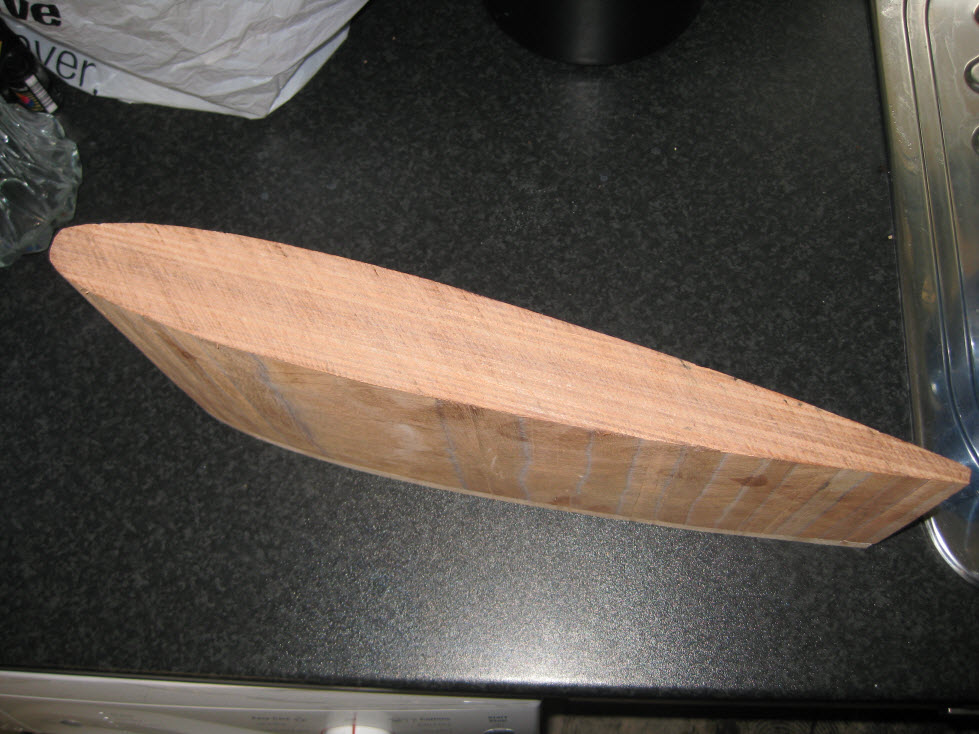
The original rudder had no 'profile' to speak of, and I think that one of the biggest benefits gained is from using a true airfoil profile that actually generates lift. When beating she now needs about 3 - 5 degrees of opposite helm, whereas with the previous rudder she needed more like 10 degrees which had her on the 'point of stall' and when pressed further control was lost.

Here is the bottom section that was cut off the new rudder during construction, this shows the profile:

section.JPG


It could be argued that if she was screwing up into the wind she was overpowered, and that is correct, BUT, in the area that I sail it is very common to have offshore winds that are gusty, and as she was set up previously, I would have to set the sails to suit the maximum gusts, with the new rudder I can now set her up for the 'background' wind and can still control her during the gusts therefore making better progress.

Looking at the picture of KUDU's existing rudder, there doesn't appear to be much of a profile and I think that modifying this would produce significant gains.

I learned a hell of a lot about my own yacht going through this process.
Good luck, and please keep us up to date with your progress Nathan.
 
Following on from Olewill's comments the heeling of the boat creates a different hull shape, a deformed teardrop section, and I suspect has the similar effect of a wing by creating the two varying pressure water flows (laminar flow ) over the length of the immersed hull, creating, dare I say it, increased/excessive 'lift',- weather helm.

Obviously lot of thought goes into a design of the hull to obtain the even flow in wetted areas, particularly when heeled ,when waterline length was increased with the old counter sterns,in extreme cases almost doubling, the lwl.

An example of this is the scow (think Fireball dinghy ) where it is sailed heeled slightly ,to reduce wetted area and for a finer profile under water.


ianat182
 
Top