wear or corrosion lip seal on shaft

pcatterall

Well-Known Member
Joined
2 Aug 2004
Messages
5,508
Location
Home East Lancashire boat Spain
Visit site
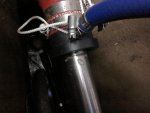
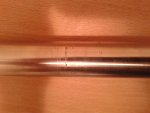
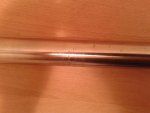
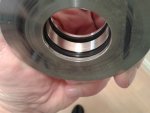
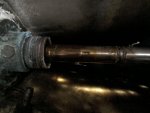
The photos show my prop shaft with the tides marine lip seal in place and the bellows pushed back to reveal the worn ring. The second photo shows the shaft with the seal removed completely.

The new shaft and seal were fitted in 2013.

When cleaned up it didn't look quite so bad but there still 2 clear worn grooves. I have now fitted a PSS seal which clamps away from the worn grooves. I did polish the shaft with 400 and 600 wet and dry.


on the 'dry' side of the grooves were 2 'craters' which just looked like some corrosive liquid had been sitting on the surface and eaten into it,


Hopefully the PSS will be ok but I submit the photos for comment. In a previous thread we discussed whether crevice corrosion rather than mechanical wear was the culprit as the boat had been left in warm med marinas unused for long periods ( in excess of a month at a time)
 

Attachments

  • propshaft.jpg
    propshaft.jpg
    82.9 KB · Views: 1
  • IMG_20140101_000358.jpg
    IMG_20140101_000358.jpg
    83.8 KB · Views: 1
The advantage of the superior (IMHO) PSS is that the wear is on the rotor not the shaft. Pitting would likely be crevice corrosion.

Was the new shaft fitted in 2013 Duplex stainless ?
 
The advantage of the superior (IMHO) PSS is that the wear is on the rotor not the shaft. Pitting would likely be crevice corrosion.

Was the new shaft fitted in 2013 Duplex stainless ?

Not sure and cant find out what SS was used ( I didn't know about these issues at that time!) I only know it does not attract my magnet!
Any new shaft will be one of the super duper special grades with high corrosion resistance. Another lesson learned!
Thanks all
I
 
Difficult to make anything out in pic1 but the groove in pic2 suggests crevice corrosion to me. It is all explained on my website but simply, water at the point of the crevice, or of a pit that occurs by exactly the same mechanism, has a lower oxygen content than the water at the surface. A cell is thus created and electrons pass between the two areas, consuming the metal.

Here is a pic of the crevice corrosion on the stainless steel part of my PSS seal. As far as I know it took place over winter with the boat hauled out, although I cannot be certain of that. The SS collar was previously the other way around, where corrosion occurred between it and the graphite face. I reversed it to use the good face and now wash down with fresh water before wintering the boat.
PA190412_zpsahq70s2i.jpg
 
How did you find out there was crevice corrosion on the face of the PSS seal. Was it by an off chance inspection before launch or was there a fault and found the crevice corrosion during investigating the fault.

My boat with my PSS seal is in the water year round, do you think regular inspection for crevice corrosion is needed in either your case, hauled at end of season or in my case being in the water all year round.
 
How did you find out there was crevice corrosion on the face of the PSS seal. Was it by an off chance inspection before launch or was there a fault and found the crevice corrosion during investigating the fault.

My boat with my PSS seal is in the water year round, do you think regular inspection for crevice corrosion is needed in either your case, hauled at end of season or in my case being in the water all year round.

It was leaking water a little and I noticed some black wear product sprayed into the bilge. I have heard of one other case of the same thing but the two seem to be isolated incidents. Of course, the manufacturer has never heard of any! I think it is worth an occasional look but of course it is not very easy to do. Looking out for leaks and wear debris seems sufficient.
 
Every couple of years or so I strip my PSS shaft seal down this year was to fit a new bellows as done 6 years service . But I notice corrosion on the prop shaft and stainless rotor on the opp side to the two set screws. Manufactures cant seem to say why this has happened.
Not to happy as the idea of the PSS is not to damage the prop shaft . Also the set screws leave their marks I notice.
 

Attachments

  • 20151112_110342.jpg
    20151112_110342.jpg
    88.4 KB · Views: 1
  • 20151112_110259.jpg
    20151112_110259.jpg
    90.1 KB · Views: 1
  • 20151112_110247.jpg
    20151112_110247.jpg
    86.8 KB · Views: 1
Every couple of years or so I strip my PSS shaft seal down this year was to fit a new bellows as done 6 years service . But I notice corrosion on the prop shaft and stainless rotor on the opp side to the two set screws. Manufactures cant seem to say why this has happened.
Not to happy as the idea of the PSS is not to damage the prop shaft . Also the set screws leave their marks I notice.

Can't really blame the seal manufacturers, difficult to think of any type of connection to a shaft that is permanently wet that would not suffer crevice corrosion. The 'damage' does not affect the operation of the seal, in contrast with types that rely on good finish on the shaft to work properly. The only option would be a smear of sealant when placing the collar but the seal faces are very sensitive to contamination and it might be a step too far.

Nice photos though! May I use one for the website please?
 
vyv , Yes please feel free to use my photos . I am chuffed that they are of use . My PSS seal also features on your site . So I am doing well.

Where my slight corrosion appeared opp set screws, on rotor & shaft , this time I have put a slight !! bit of 2 part Epoxy adhesive just to cover the corrosion area to make a barrier glued to inner front edge of rotor , all a bit precise. Will see how goes .
Also the new bellow is much softer/ flexible than old one and PSS say only 20mm of preload so both of these might help.
Pleased with seal overall .
 
I guess that the corrosion occurs at the interface of the O ring and the shaft? As vyv says at least this is not at a lip seal as with my Tides Marine seal where the issue was A) the drip and B) the concern that the rough corroded ring would soon chew up the lip seal.
 
I guess that the corrosion occurs at the interface of the O ring and the shaft? As vyv says at least this is not at a lip seal as with my Tides Marine seal where the issue was A) the drip and B) the concern that the rough corroded ring would soon chew up the lip seal.

Hard to explain but the slight corrosion happened on the sea water side of rotor in front of first O ring opp side to set screws , in photo its above my finger about same width .


My bonding is working fine , and theres no electrical leakage .

So with new bellow and O rings , hope that sorts it . A you say not like the tides seal.
 

Attachments

  • 20151112_110745.jpg
    20151112_110745.jpg
    86.9 KB · Views: 0
yes, actually I had! I don't know if there are issues of the crevice corrosion type in warmer climes. I was temped to go back to a stuffing box especially as mine would be easy to access unlike the one in my previous boat which was a nightmare.
 
Have you thought of fitting a stuffing box & greaser

I replaced mine with a PSS. It was totally reliable and didn't leak a drop. However, greasing was a chore, grease always found its way into the bilge and needed regular cleaning up. Access to the greaser was very poor, for which I needed to move two folding bikes, cushions and bed boards. Extending the greaser with a tube to a more convenient location was only partly successful, as the grease in the tube dried out with engine heat and needed rodding out. So a change to a PSS that genuinely needs no attention at all was a huge improvement.
 
Top