Wayfarer or small keelboat for small budget cruising?

There won't be space on the foredeck of a 23 footer for the inflated 2.3m dinghy, but you can deflate it, roll it up then lash it down there. You'd want to stow it below or off the yacht when you were absent to avoid it being stolen or it's life being shortened by excessive exposure to UV.

I can't remember the movement of the boat in a chop being much of a problem when inflating/deflating dinghy, but the wind catching the inflatable certainly could be frustrating. Do always tie it on with a longish line before you start pumping up or down, or lifting it over the side of the yacht!

I bought a new Plastic 1.8m round-tail inflatable - relatively cheap, small and light, but found it unsatisfactory for my needs. As well as the boat being shorter, the tubes are narrower than other inflatables, so there is very little freeboard. It was OK in a well protected harbour in moderate conditions, but I wouldn't feel safe in it in open water, or even strong winds in a harbour. The narrowness of the tubes also meant that I couldn't row properly or effectively, because the low rowlocks position meant my legs prevented me pushing down the oar handles low enough for the blades to clear the water on the return stroke. If carrying a passenger they would have to perch precariously on the narrow tube across the stern, barely out of the water - and my usual companion was a lightweight - I doubt you could realistically carry a heavy person, or at least they'd have to row and whoever was lightest perch on the stern. There was remarkably little space inside the boat, most of which was taken up by my legs. If there were 2 people you could only really carry a couple of smallish bags, one on the lap of the passenger and another behind the rower. Whenever I went away for a few days with my girlfriend, I'd have to make two (or more) trips between the shore and the boat, at both beginning and end of trip, to shift both her and stores, etc..

I traded that almost new 1.8m in for a second-hand old (1980s) Zodiac of IIRC 2.8m. Despite (because?) its age it was a much better dinghy than the little Plastimo in all respects - material strength and flexibility, construction, size, generous diameter tubes, oars, etc., except it was too big for inflating and deflating on my foredeck (or cockpit). Even on its side, once part inflated the ends would jam against or under the guard wires, forestay or something else, and inflating/deflating it on its end was just too unwieldy,espcially in any wind. (I didn't mind the fact it probably took almost twice as long to pump up as the 1.8m, because of the additional length, width and tube diameter.)

I ended up buying a new 2.3m inflatable, which I haven't used a great deal as I was berthed in a marina for a while, when it only got occasional use on trips, but has seemed the best compromise for me. I wish the material was as flexible (= packs down smaller and easier & nicer to handle) and strong as the ancient Zodiac. (I don't think modern Zodiacs have the same material, sadly.)

As I said before, for load carrying and coping with waves and weather, a rigid dinghy is much better. I forgot to mention earlier that a rigid dinghy is much easier to row, to cover distance, to make progress against (or even acrosss) tides and strong winds. If you have a mooring consider having a rigid dinghy for use there, and an inflatable on board for use on voyage.
For me, I suffer from seasickness on a mooring so have only anchored 5 times in 20 years of owning my current boat. However, you have written a brilliant summary of the problems of dinghies on yachts. I thought that I was the only one who could not row a dinghy because of the fixed position oars. One of mine is a Wetline & I cannot row it at all. My daughter uses it OK to get to our Squib mooring, but has an outboard to use once clear of the shore.
I have a 50 year old Avon Redcrest & I have no problem rowing that as the oars can be slid outwards so they miss my legs. They are also a better shape. The tanks are bigger & the rowlock position is better. The seat can be partially deflated to allow one to get one's knees lower. The seat on the Wetline is a rigid one & is too high. I find the Avon very easy to row long distances if on my own, 2 up gets harder
As for carrying it on a yacht. I do not carry it on my current 30 ft one but I did have it on my 25 ft Stella. I used to deflate the front buoyancy tank & roll that up. I poked that part under the kicking strap of the boom. The stern of the (inverted) dinghy would be over the hatch. But to get inside I just ducked under it- as if the lid was still slid shut. In port I tied it up to the boom to give me more headroom.
 
Thanks for that I'm of the same opinion at the moment my current boat required enough blood, sweat and tears I don't want to repeat the process unless its a massive upgrade :). Interesting when you say deck stow do you mean deflated or inflated. I'd say it would be a lot easier not having to inflate and deflate every time you go ashore but the challenge is finding something suitable that would fit. I've seen 1.8m dinghys perhaps they would do the job
I agree with Littlesister that 1.8m is too small. Not only hard to row but they can flip over when you get in - I had one but now use an old hardtail 2.3m Zodiac. A soft tail (old Avon type) deflates to a more compact package and stow behind or just in front of the mast depending on your boat. Lash it on well! The rowlocks on most modern inflatables are dreadful and the solid rubber old Avon ones are much stronger. I will swop to an Avon in due course. The little spray hood is very useful. Check the weight of any dinghy you consider - they are literally a pig to move about.

I have a 36ft boat now and keep the dinghy on deck in the marina. Inflated makes foredeck work difficult and I part or fully deflate. As others say it isn't a big job to inflate, not much longer than emptying a towed dinghy of water or using davits. But in benign and settled conditions and on short coastal passages I tow it. In the old days, as in my previous post, we towed the dinghy. We moved to small rigid dinghies in later years as they row and tow better (less drag, more overtaking risk). Our dinghies journeyed by sea behind the boat through the Pentland Firth and round Cape Wrath. Towing dinghies was not unusual then on small boats although not so often seen in Northern waters. Now boats and dinghies are bigger, plus towing dinghies in all conditions is one of the few bits of my childhood sailing that I wouldn't repeat.
 
I might be romanticizing the open boat wayfarer experience. There is something about being exposed to the elements and really using your skill rather than equipment that seems attractive to me.
I share your romanticism - especially whenever I get a bill that is charged by the foot! The reality is that unless you are really an intrepid adventurer, or you have complete flexibility to sail when the weather dictates and no competing interests, you will hanker after the luxuries you currently have so you can actually use the boat more.

I always wondered with wayfarers if you had a few of those inflatable tubes underneath them and a sort of block and tackle system attached to an anchoring point would you be able to move them up and down the shore in remote areas?
Singlehanded? Probably not - or at least not as a regular thing. Two people can move one downhill on the right beach with three rollers but only after you take as much weight out the boat as possible. A lumpy beach, very soft sand, wrong slope all make it worse. Possible and straightforward are of course very different things. There is nothing romantic about unpacking all your kit onto the beach, manhandling a boat for an hour, repacking your kit etc!

If you are solo and only ever solo, the 1.8m dinghy is probably ok in the sort of conditions you might want to row ashore in any boat. weight might be as important for getting it on/off the deck up from the saloon etc as the deflated size.
 
For me, I suffer from seasickness on a mooring so have only anchored 5 times in 20 years of owning my current boat. However, you have written a brilliant summary of the problems of dinghies on yachts. I thought that I was the only one who could not row a dinghy because of the fixed position oars. One of mine is a Wetline & I cannot row it at all. My daughter uses it OK to get to our Squib mooring, but has an outboard to use once clear of the shore.
I have a 50 year old Avon Redcrest & I have no problem rowing that as the oars can be slid outwards so they miss my legs. They are also a better shape. The tanks are bigger & the rowlock position is better. The seat can be partially deflated to allow one to get one's knees lower. The seat on the Wetline is a rigid one & is too high. I find the Avon very easy to row long distances if on my own, 2 up gets harder
As for carrying it on a yacht. I do not carry it on my current 30 ft one but I did have it on my 25 ft Stella. I used to deflate the front buoyancy tank & roll that up. I poked that part under the kicking strap of the boom. The stern of the (inverted) dinghy would be over the hatch. But to get inside I just ducked under it- as if the lid was still slid shut. In port I tied it up to the boom to give me more headroom.
I had a Redcrest 50 yrs ago, until it was stolen, and its replacement then started to leave black marks on the topsides, so I replaced it with a later model Redstart. This has larger tubes and rows much better than the old Redcrest, though it will only take three people. We used to do the half-inflated trick but later boats would take a folded dinghy. The newer pumps with an extractor function make this even easier, but folding a dinghy is something of an art and needs brains and not brawn.
 
I have cruised an 18ft trailer sailer (bradwell 18) the length of the scottish western seaboard around the isles and the east coast of Ireland. I had an inflatable which I had no problems carrying and inflating. I only rowed it, as my boat could get close inshore.
The yacht had a 6hp lomgshaft. I didn’t have an autopilot ( tho I do now, and by god what a difference it makes :) ) I think the margin of comfort and safety between a small keel boat with proper cabin and a wayfarer are considerable. Its just so much more pleasant to be in when the weather is shite. And you are talking west coast of scotland and ireland, so youwill get a lot of shite weather :) Much comfier sitting out highwinds and pissing rain in a decent cabin with two burner cooker and grill
, and soooo much more room to store beer and wine in. I even now have a deisel heater in my wee 18footer, its sheer decadence on that boat. Couldnt be done on a wayfarer :)
 
Last edited:
Meant to add, my inflatable is big, looks a bit daft towed behind the wee boat :) bit I can fit 4 folk in it if I wanted to, usually just me and tons of room for gear. I use long oars, makes rowing it so much easier, they split in two for storage.
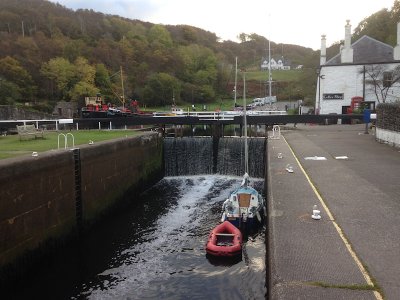
This is the dinghy being towed in the crinan canal and then showing it stored behind the mast when I left in Kinlochbervie for a couple of weeks. I lash it across the guard rails.
1D1721B0-656D-4549-B22F-E409B7F4D1D3.jpeg9685D327-53A7-43EF-822E-C109F98C523C.jpeg
 
Last edited:
I converted my Folkboat from roller reefing to hanks as it's safer and faster to douse sail. My genoa has the halyard back to the cockpit in the normal way. It also has a downhaul from the the head of the sail, down through a block at the tack and back to the cockpit; imagine it being an 'endless line' for up/down. To douse the sail the halyard is released and the downhaul pulled, taking no effort or time. With the sheets pulled in the sail's clear of the water, and once settled up for the night, I put a sail cover on. The sail is left in place all year, and shows no sign of deterioration at all.
My Honda 2.3 is on the stern, and has an 'extra' long shaft fitted to stop cavitation.
All in all these 2 mods cost a few hundred pounds and have taken me around Scotland a number of times. I do now have a working inboard as well, which is a bonus of course, but to sail with roller genoa; no way.
 
Meant to add, my inflatable is big, looks a bit daft towed behind the wee boat :) bit I can fit 4 folk in it if I wanted to, usually just me and tons of room for gear. I use long oars, makes rowing it so much easier, they split in two for storage.
This is the dinghy being towed in the crinan canal and then showing it stored behind the mast when I left in Kinlochbervie for a couple of weeks. I lash it across the guard rails.
View attachment 159144View attachment 159145
Many thanks for this very inspiring! These are the kind of trips that I want to do and seeing you able to do it on a small boat gives me confidence. It is tempting to want to move up in size but I think with good planning small boats can comfortable pull these adventures off as well.
 
I converted my Folkboat from roller reefing to hanks as it's safer and faster to douse sail. My genoa has the halyard back to the cockpit in the normal way. It also has a downhaul from the the head of the sail, down through a block at the tack and back to the cockpit; imagine it being an 'endless line' for up/down. To douse the sail the halyard is released and the downhaul pulled, taking no effort or time. With the sheets pulled in the sail's clear of the water, and once settled up for the night, I put a sail cover on. The sail is left in place all year, and shows no sign of deterioration at all.
My Honda 2.3 is on the stern, and has an 'extra' long shaft fitted to stop cavitation.
All in all these 2 mods cost a few hundred pounds and have taken me around Scotland a number of times. I do now have a working inboard as well, which is a bonus of course, but to sail with roller genoa; no way.
Yeah I'm kind of thinking the same in regards to hank on. Its just I have a pretty new set of hank on sails and I assume they set shape and sail a bit better than the equivalent roller furling. But are they good enough to merit folding them up and lugging them down below everytime who knows :)
 
I converted my Folkboat from roller reefing to hanks as it's safer and faster to douse sail. My genoa has the halyard back to the cockpit in the normal way. It also has a downhaul from the the head of the sail, down through a block at the tack and back to the cockpit; imagine it being an 'endless line' for up/down. To douse the sail the halyard is released and the downhaul pulled, taking no effort or time. With the sheets pulled in the sail's clear of the water, and once settled up for the night, I put a sail cover on. The sail is left in place all year, and shows no sign of deterioration at all.
My Honda 2.3 is on the stern, and has an 'extra' long shaft fitted to stop cavitation.
All in all these 2 mods cost a few hundred pounds and have taken me around Scotland a number of times. I do now have a working inboard as well, which is a bonus of course, but to sail with roller genoa; no way.
I do like the downhaul brought aft, and I could easily route a line aft to the cockpit using the routing used for the old furling line. I think I will try this and honestly feeling daft for not realising it as an idea before.
 
Dinghy sailor and recent small yacht convert, here.

I refitted a Wayfarer over the lockdown period and gave it every optional extra: roller reefing genoa, slab reefing main, fancy cockpit tent, new everything. I did this with the hope sailing it around the Inner Hebrides. It was a great boat. I sold it…

For me, the faff of transporting and rigging/ de-rigging, storage, etc was robbing me of time during trips away. Solo sailing is fine in a W if you can reef. Weather windows are tighter and have to be respected, which can cut down potential sailing days. The stopper for me was that my wife wasn’t keen.
Cruising a Wayfarer, esp one with modern kit is a great experience and the Wayfarer Association folk are lovely people and great sailors. Much to reccomend.

My current boat is a 23 footer and that’s in a marina in an area I want to sail- drive there and 30mins later you’re sailing. It’s comfortable and Mrs Wode approves. Singlehanding is pretty straightforward. Consequently, this boat has seen much more use.

In your position, I’d keep the Ruffian. Spend enough to make it a “good” boat of its type and enjoy it for a few years. When it comes time to sell, you’ll be able to move it on more easily than a boat that requires tons of work.

My 3D Tender 230 airdeck lives in the forepeak deflated and I have a 12v Itiwit paddle board pump that gets it up in 10min. Honda 2.3 on the pushpit.

Plastimo furlers are basic but robust and cheap.

I’d join the Ruffian class and get their opinion on motors. Inboards can be a world of pain.

That She 27 looks like it will need a few spending on it and it’s on the south coast.
 
Top