
Watermaker installation - fresh water into two tanks

simonthepom

New Member
Joined
7 May 2014
Messages
7
Visit site
I'm in the final stages of installing our watermaker (an FCI Aquamiser+). I'm not sure how to connect the fresh water (product water) to our two 300l tanks. Each tank has a separate deck filler hose that I could T-into but what happens when one tank is full? I imagine the water will just continue to flow into the other tank, but wanted to check here first.

Also, what happens when the second tank is full, any excess water doesn't have anywhere to go, which sounds like a disaster waiting to happen... How do you ensure it doesn't overflow? Is it simply a case of monitoring the flow rate and doing a few calculations as to when tanks are full? Keen to hear anyone's experience.

I've thought about adding tank gauges but this adds quite a few more €'s to the whole project, which is already quite a bit over budget...

Thanks for your advice in advance.
 
I fitted a 3 way valve in the outlet of my watermaker one outlet to each of my tanks and the third to a sink spout so I could test the water before directing to the required tank.

I do have a float gauge in each tank but the vent/overflow of each tank goes to a spout at the galley sink so if the tank overflows it just goes down the galley sink drain or sink overflow.
 
Last edited by a moderator:
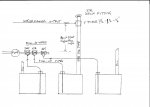
Our watermaker outlet goes into a T piece in the filler pipe of the stb tank. This pipe is 1.5" diameter and the watermaker connection is 3 feet above the 3 way pickup manifold before the pump. This creates a head of water if needed. This way the water only goes into the stb tank first.

To fill up the port tank you open the stb tap and the port tap when the stb is full, and the head of water feeding the stb tank and the pressure of water in the stb tank will force water back up the port lifting pipe and fill up the port tank. Open the aft tap and that fills too.

A simple system with no need to drill holes in all the tanks or the need for any extra taps. A simple diagram is attached - with no vent pipes shown!!!!water pick up diagram.jpg
 
I'm in the final stages of installing our watermaker (an FCI Aquamiser+). I'm not sure how to connect the fresh water (product water) to our two 300l tanks. Each tank has a separate deck filler hose that I could T-into but what happens when one tank is full? I imagine the water will just continue to flow into the other tank, but wanted to check here first. T

Also, what happens when the second tank is full, any excess water doesn't have anywhere to go, which sounds like a disaster waiting to happen... How do you ensure it doesn't overflow? Is it simply a case of monitoring the flow rate and doing a few calculations as to when tanks are full? Keen to hear anyone's experience.

I've thought about adding tank gauges but this adds quite a few more €'s to the whole project, which is already quite a bit over budget...

Thanks for your advice in advance.
When one tank is full, the water won't run into the other tank unless your cross connection valve is open. I take it that the two tanks are not permanently connected? :disgust:

When or if both tanks are full, either you switch off the water-maker, or the excess will come out of the vents. Frankly, I don't see your problem.
 
A level gauge for our water tank was one of the very first things I fitted when we bought our boat 9 years ago.
With reasonable sized tanks (60 galls) it's a no brainer and has been invaluable.

I can't believe you have the money to buy and fit a water maker but not a tank gauge; unthinkable in my eyes, but as they say, each to their own.

The four essential gauges required on a boat:-
Fuel
Water
Battery
Holding tank
 
My watermarked feeds a five way manifold, three valves for tanks, one for pickling and one for tasting. The manifold to tanks pipes feed to a T in the pick up line between the tank and the isolation valve for the pick up. The tank vent feeds out above the head sink, so any over flow from the tank is immediately visible in the heads. There is no problem with over filling a tank. As soon as the tank is full and water starts coming from the over flow/vent, then the manifold to the next tank is opened and that tank is filled. The only draw back is that you can't draw from the tank that is being filled.
 
You just cut into the pipe feeding the water pump and the water enters there. Assuming both tanks are connected to the pump supply ( I can't see any other option ) hey will simply fill until full
 
You just cut into the pipe feeding the water pump and the water enters there. Assuming both tanks are connected to the pump supply ( I can't see any other option ) hey will simply fill until full

That will only fill the tank you are using. If you have just emptied a tank, and switched to the full one your water maker use will be wasted.
 
When one tank is full, the water won't run into the other tank unless your cross connection valve is open. I take it that the two tanks are not permanently connected? :disgust:

When or if both tanks are full, either you switch off the water-maker, or the excess will come out of the vents. Frankly, I don't see your problem.


This is how mine works. Never had a problem. I put the water into the main tank and adjust the cross tank connectors to decide which if any get the excess. When the tanks are full the extra water coms out of the tank vents, just the same as if I overfill using a hosepipe. What's the problem. Yes the Watermaker will not like the back pressures but it's not going to be a regular thing.

If you are living on-board I very strongly encourage you to fit tank gauges so you know the state of your tanks daily. Pretending to yourself that you are keeping track leads to worry about how much water you have left and are consuming....
 
Thanks for all the advice.

I should have mentioned that while we don't have tank gauges, we do have a flow meter near the water pump, so it's not like we have no idea how much is in the tanks.

With the advice above, I'm off to the chandlers here in Olbia, Sardinia to see what parts they have - not too hopeful based on my experience of Italian chandlers so far. I might have to wait until we get to the Baleaics where I'm told there's a wide availability of parts.

I'm thinking a very basic two way manifold with valves to divert product water to both or one of the tanks, pretty straightforward.

Trundlebug - thanks for your wise words of wisdom, but as you say, each to their own. Out of all the liveaboards I've met this year in the Med, I doubt that more than 10% of them would have your 4 "essential" gauges, just saying...
 
Top