
Water trap/muffler for Yanmar 4jh-te

Caladh

Well-Known Member
Joined
25 Oct 2009
Messages
1,540
Location
Out there again and no longer dreaming
Visit site
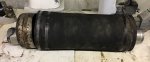
I have removed 25 year old exhaust and trap from my yacht. The exhaust was v hard and the muffler was leaking - see picture below with very rusty s/s ends. I am looking to replace and the nearest I can find is here - Water-cooled exhaust muffler with water lock, 76mm, 150hp, Stainless steel with neoprene bellowsWater-cooled exhaust muffler with water lock, 76mm, 150hp Stainless steel with neoprene bellows - AB Marine service/
but the costs is jaw dropping! I am unsure if I can replace it with a Vetus equivalent, non seem to have the bellows arrangement. Wondering now what to do and asking if anyone has done a similar project. The exhaust pipe diameter in 76mm. TIA98F9B542-815A-47DC-9B0A-44B8D32546C9.jpeg
 
That is a Volvo type muffler and lucky to have lasted that long. Vetus is a completely different design but does exactly the same thing. Expect you will need a WLOCKLP75 which is typically £100 cheaper than the type you have. You may find the dimensions a bit different so check before you buy.
 
That is a Volvo type muffler and lucky to have lasted that long. Vetus is a completely different design but does exactly the same thing. Expect you will need a WLOCKLP75 which is typically £100 cheaper than the type you have. You may find the dimensions a bit different so check before you buy.
I think I’m actually going to need the NLPH75 model due to space constraints in the engine compartment. It’s only money…..
 
Excellent bit of kit. I fitted that type to a previous boat for the same reasons of limited space. Takes a bit of time to get your head around the different combinations of orientation of the spigots to get the best pipe runs.
 
Excellent bit of kit. I fitted that type to a previous boat for the same reasons of limited space. Takes a bit of time to get your head around the different combinations of orientation of the spigots to get the best pipe runs.
The pipe run is pretty much horizontal from the down pipe from the exhaust and thru the engine compartment. Ready to bite the bullet . However not impressed with their pdf instruction manual on line which says -:
2 Installation
2.1 Installing waterlock NLPH
Instal the waterlock as vertical as possible.

….yes as vertical as possible. Surely they don’t actually mean that ? !!!!!
 
This is where I got my silencer, although I only required the 51mm version:
https://www.oltrevela.com/exhaust-silencer-o-76-mm-osculati-51-390-09
N.B. When replacing an exhaust silencer, it is essential to select one with the same internal volume as the one being replaced, as it must accomodate all of the volume of water that flows back from the after part of your exhaust system when you switch off your engine.
Having had to replace mine two years ago, I have formed the intention to remove and inspect It every three years. The main thing to look out for is obviously leaks caused by rust breaking through from the inside, but also, give it a shake, to make sure that the internal baffle has not come adrift, which is a sure sign that it is deteriorating. I suspect that the one that I replaced was the original one fitted by Dufour, in which case it lasted twenty years.
 
This is where I got my silencer, although I only required the 51mm version:
https://www.oltrevela.com/exhaust-silencer-o-76-mm-osculati-51-390-09
N.B. When replacing an exhaust silencer, it is essential to select one with the same internal volume as the one being replaced, as it must accomodate all of the volume of water that flows back from the after part of your exhaust system when you switch off your engine.
Having had to replace mine two years ago, I have formed the intention to remove and inspect It every three years. The main thing to look out for is obviously leaks caused by rust breaking through from the inside, but also, give it a shake, to make sure that the internal baffle has not come adrift, which is a sure sign that it is deteriorating. I suspect that the one that I replaced was the original one fitted by Dufour, in which case it lasted twenty years.
The volume is decided largely by the diameter of the exhaust pipe - up to 60mm is around 4.5-5l and over that around 10l. This works with most typical installations in smallish yachts with small diesels (under about 80hp). Don't think there are any baffles inside the rubber ones - just a large diameter rubber hose with stainless steel endplates. The weakness is crevice corrosion around the lower part of the outlet tube where it sits in stagnant seawater for most of its life. I have had failures on 2, both in the same place and both repaired for not much more than 10% of the replacement cost. Rarely is there any problem with the inlet which is above the water level or the rubber.
 
The volume is decided largely by the diameter of the exhaust pipe - up to 60mm is around 4.5-5l and over that around 10l. This works with most typical installations in smallish yachts with small diesels (under about 80hp). Don't think there are any baffles inside the rubber ones - just a large diameter rubber hose with stainless steel endplates. The weakness is crevice corrosion around the lower part of the outlet tube where it sits in stagnant seawater for most of its life. I have had failures on 2, both in the same place and both repaired for not much more than 10% of the replacement cost. Rarely is there any problem with the inlet which is above the water level or the rubber.
The volume is indeed largely decided by the diameter of the exhaust pipe.....plus the length of the after part. Obviously smaller boats will have smaller diameter pipes, and dimensions that limit the length of the pipe, resulting in a typical volume, while everything is scaled up as the size of boat increases.
This is the one that I bought, to replace themanufacturer's original:
Silenziatore di scarico diam. 51 mm
It has a volume of 5litres.
The original did have a baffle, a semi-circular s/s plate which had broken loose, originally welded to the front s/s component, intended to attenuate surges of water into the forward section of exhaust pipe. I was able to spot a similar arrangement inside the new one. There were also "cradle"-style feet, held in place by the "jubilee"-type pipe clips that secured the rubber part to the s/s parts. The ones on the original had long since parted company with the rest of the item. While I made a temporary repair with epoxy putty, and could have had it repaired by my grandaughter's partner, probably for free, I chose to replace it with a new one.
Curiously, while I ordered it from an Italian Osculati reseller ,(see "rivenditori Osculati" on the website,), it was made in Denmark and posted from Belgium!
 
The volume is decided largely by the diameter of the exhaust pipe - up to 60mm is around 4.5-5l and over that around 10l. This works with most typical installations in smallish yachts with small diesels (under about 80hp). Don't think there are any baffles inside the rubber ones - just a large diameter rubber hose with stainless steel endplates. The weakness is crevice corrosion around the lower part of the outlet tube where it sits in stagnant seawater for most of its life. I have had failures on 2, both in the same place and both repaired for not much more than 10% of the replacement cost. Rarely is there any problem with the inlet which is above the water level or the rubber.

I did some experiments with the waterlock on my boat after discovering it was full of water when I disconnected the exhaust one day. I found that if the engine was turned off after a couple of minutes at tickover the waterlock was left full; if it was turned off after running at 2000 rpm for a few minutes the waterlock was left nearly empty. So I concluded that the waterlock wasn't actually achieving anything and removed it.
 
I did some experiments with the waterlock on my boat after discovering it was full of water when I disconnected the exhaust one day. I found that if the engine was turned off after a couple of minutes at tickover the waterlock was left full; if it was turned off after running at 2000 rpm for a few minutes the waterlock was left nearly empty. So I concluded that the waterlock wasn't actually achieving anything and removed it.
If you observe your exhaust while the engine is running, you will notice that the water emerges not in a steady flow, but in pulses. This is because it collects in the water trap and while its level is low the exhaust gas does not require much pressure to escape through the exit port even though it might actually be covered with water, see the drawing here:
Silenziatori di scarico
However, as the trap fills more, particularly when runing at low revs, the water can't escape until it builds up enough pressure to blow the whole lot out of the rear pipe, hence the pulses of water. When you run at higher revs the water will be ejected more efficiently, but there is always the possibility that some water will remain in the system, and given half a chance ( e.g. the absense of a water-trap), will surge forward into your crankcase, if for instance, your engine has stopped with the exhaust valve of the aftermost cylinder open and you surf down the face of a wave and suddenly decelerate at the bottom of the trough.
I have a feeling that by chance you observed that your water-trap was empty because you looked just after it had been emptied. If you had run your engine for a few seconds longer before looking the chances are that it would havebeen full.
If it were me I would put it back, it's there to protect your engine.
 
Top