Water system, help please?

SiteSurfer

Well-Known Member
Joined
18 Jun 2015
Messages
1,262
Visit site
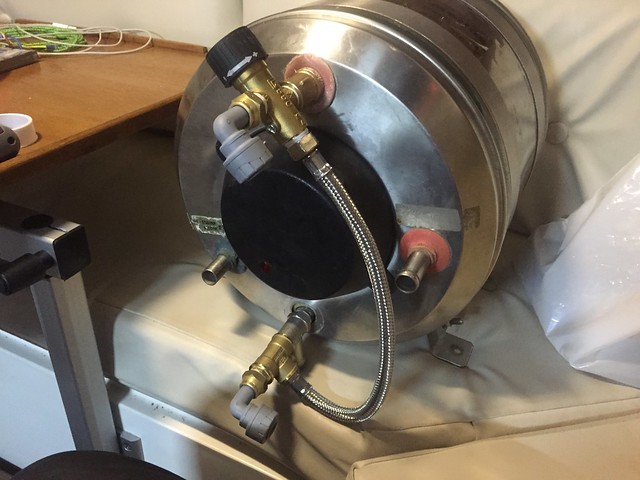
Hi all. I've spent the last couple of days fitting a calorifier from scratch and reworking the water system.

Having found a great spot for it centrally and carefully made up the whole thing outside and then inserted it into the hole, added a Jabsco water filter and removed the gas heater from the circuit.

On pressurising the system the problems started, initially the feed pipes on the water filter flew off, I found out that the little blue clips needed to be pressed hard in... Anyway - their calorifier filled and as the system came to pressure, bleeding the taps etc - the 1/2 inch fittings started to leak - only a small drop but not right - the ones affected are the fittings directly to the calorifier, I made the all up with ptfe tape.

The Jabsco water filter is chucking water out of the threaded body part, took it off and checked carefully that the rubber seal was on, still leaked, wound a ton of ptfe tape around the threads and put it back on, still leaks...

So my question - can the jury recommend :
A) what can I use on the 1/2 inch fittings that acts like a sealant other than ptfe tape?
B) has anyone else had this issue with a Jabsco water filter and how did you fix it?

I need to go to screw fix or similar in the morning so a brand that's easily available would be extremely useful to have please!

Thanks people.

A rather soggy boat owner...
 
I used Hep2O fittings. They just push on and stay put. You need to get some extra inserts in case you need to take them apart after fitting, as you need a new one each time.

On the calorifier, there were tapered spigots attached to the copper pipes, so fitting the plastic pipes to them was fine.

PTFE is the common standard for threaded plumbing fittings I believe.

Had a sod of a time after taking my Jabsco filter apart to clean. The system needs to be completely depressurised, or the O-ring pops out of place, meaning copious leaking.

Best of luck.
 
The fittings I made up that don't leak(!) are in fact the push on type which come after the 1/2 inch ones... The only reason for the brass ones is for the thermostatic valve and none turn valve. What's irritating is that the fittings are wound up quite tight and still drip.

On the subject of the water filter, did you ever fix it? I've checked the rubber ring and it appears to be ok, one thought occurred to me that the body may be a one time fit thing, and after fitted once it's a throwaway ?
 
PTFE is another word for Teflon, and the tape is intended more as a lubricant than as a seal. By lubricating the tapered threads with a turn or two of Teflon tape, you're able to screw them in so tightly that the threads become watertight.

If your brass threads are tapered, then just apply a neat couple of turns of tape (in the direction that winds it tighter when inserted) and do it up FT with a pair of big spanners. Shouldn't leak.

If the threads are straight, then they're meant to clamp down on either a rubber O-ring or a fibre washer, not seal on the threads, and PTFE tape is the wrong thing.

(We do assemble straight-threaded skin fittings and ball valves this way, using excess PTFE as a sealant of sorts, but it was always a bodge. Just a widespread bodge, because the market is too niche to sell the right thing for a sane price, and the pressure on yacht skin fittings is basically nil so it works ok. Freshwater plumbing is a) higher pressure and b) catered for by proper fittings.)

Don't know about the filter thingy, but adding PTFE tape is highly unlikely to be anything other than a bodge. Any slight faults (protruding mould sprue etc) in the plastic bits hindering the seal perhaps?

EDIT: If you're determined to add sealant, Loctite do various suitable goops that go on as a thickish liquid and then set inside the joint.

Pete
 
Last edited:
That's interesting, I don't think the fittings are tapered, at least they appear to be straight anyway. The assembly instruction suggested using loctite, but in my ignorance I assumed that was thread lock and having had a night mare with locked joints before decided that tape was the answer.....

Off to buy some fernox and see if that works.
 
Purchased some Fernox leak sealer and reassembled every joint carefully and then gorillaed them up, all but one are now fine and the last one which is the one direct to the calorifier hot outlet has a tiny tiny drip once every 30 seconds or so.

I "fixed" the water filter by dremelling off the thread stop on the body and adding Fernox to the thread, no leak now :) (I can hear several of you wincing at the thought of having to do such a mod to something that should just work, but I was desperate!).

Im leaving the Fernox to go off now for a couple days and will continue fitting it at the weekend, at least its not like a swamp in the boat now.
 
By ' Fernox ' do you mean LSX ?

It's quite good for assembling things but nobody ever fixed a leak by applying PTFE or Goo - I did 5 years as emergency plumber.

The fittings have to fit, end of.

The push-fit jobs of all makes I used are fine as long as everything is straight on square, not too high pressure ( domestic mains is OK but I prefer not ) - beware the tolerances in plumbing kit vary a lot, it's not like aviation stuff; I found anything marked ' Eagle ' particularly dubious.

So the answer is to try everything very thoroughly indeed; this is only stuff that would be an inconvenience if it failed, not sink the boat - right ?
 
If so, probably a bad sign; things either fit and work or they don't.

An example is domestic taps, when they leave a dribble people's natural instinct is to apply the equivalant torque to the Flying Scotsman pulling on the thing, when what it really needs is a simple new washer - if in an area with lots of erosive grit in the water, grinding and re-seating too.
 
Scared to tighten them any more!
I should add that these fitting are collars and so forth and do feel quite "agricultural".
 
I have to admit that what I read on this thread is rather different to what I was taught 35-40yrs ago helping my uncle doing home piping installation using old school iron pipes 1/2inch and 3/4 mainly, cutting threading and bolting on elbows, tees et al.

In every case threads were definitely not tapered, and you definitely had to add this hair/string/cannabis thing (on the direction of the bolts) and apply some carmin paint before tightening them together.
Never ever bleeding leaked, vacation house still has them, whole house is falling apart, plumbing is fine!
So that's what I'm doing even now when assembling stuff either in the house or boat. Never ever leaks either. Just replacing the carmin paint with PTFE tape :rolleyes:

SF, do you have any experience on plumbing, or is it your first go?
Do you have a feel for what is tight, what is very tight and what is "shit, I cracked the casing tight"?

good luck

V.
 
As it happens, I've just come back from the boat and a day replacing the pressure relief valve on the calorifier and the Aquafilter. The calorifier involves four joins. Well, three of them are dry, but one that I assembled at home seeps slowly, perhaps a few drops per hour, so I have decided to live with it rather than repeat the necessary acrobatics.

I have used an Aquafilter for many years and never had trouble with leaks. It can be very stiff to screw and I had to resort to a strap spanner today to get the old one off. I normally put some PTFE grease on the thread and hand turn it until the marks meet at the front. I rather suspect that your O ring may be out of position.
 
First go at plumbing - period, having avoided it for 49 years... funny how the boat has suddenly made me learn new skills.

I do like the push fit stuff, but come on chaps - it can't be this complicated, screw a brass jobbie onto another brass jobbie and surely thats it?
I would like to think I'm aware of whats tight, however I draw the line at using a torque wrench to determine how much gorilla to use. I leant on it a bit using pipe pliers and 2 hands....

The offending drip is coming from the collar against the hot output, all the others are leak free now.
IMG_0107 by Owen Lees, on Flickr
 
i think if i cant fix the issue i'll remove all the valve gubbins as the other fittings are perfect (the push on ones) as they have a plastic insert into the threaded hole.

The ones that have been playing up are literally just collars, female to female.
 
Top