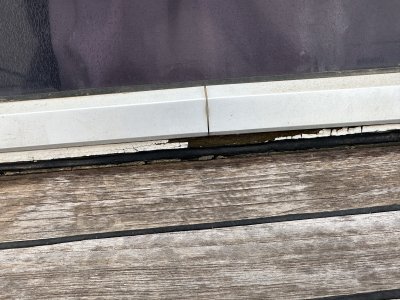
Water Infiltration trough sikaflex?

AleCiotti

Active Member
Joined
15 May 2024
Messages
44
Visit site
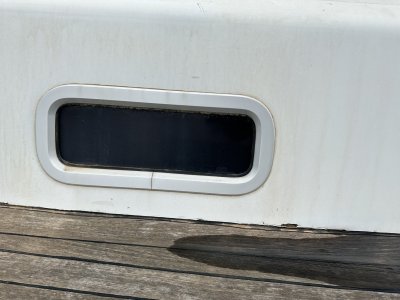
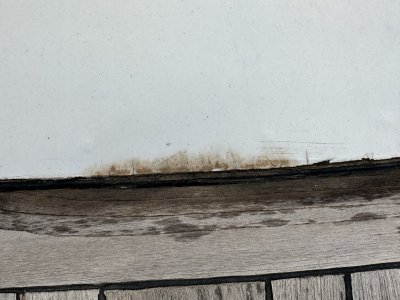
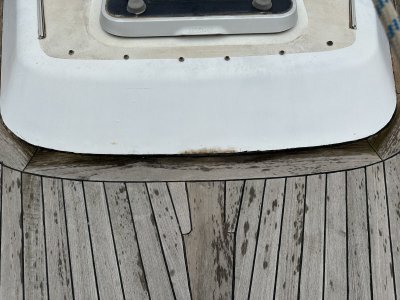
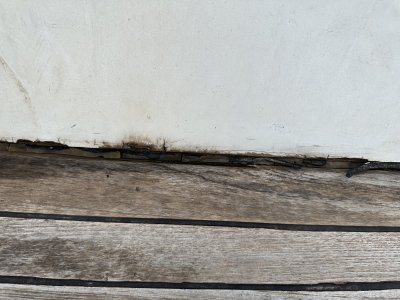
Hi guys, i have multiple water infiltration on my boat that I think are coming in trough a deteriorated wood and sikaflex, but I'm not sure that is it, as you can see from the photos the wood is also sort of corroding..

Im not sure how to fix this, if I should just remove old sealant and replace it and/or if I have to recoat the white with something..

Thanks in advance!

 

Attachments

  • IMG_0445-min.jpg
    IMG_0445-min.jpg
    1.7 MB · Views: 44
  • IMG_0446-min.jpg
    IMG_0446-min.jpg
    1.3 MB · Views: 42
  • IMG_0447-min.jpg
    IMG_0447-min.jpg
    1.4 MB · Views: 36
  • IMG_0448-min.jpg
    IMG_0448-min.jpg
    1.7 MB · Views: 37
  • IMG_0451-min.jpg
    IMG_0451-min.jpg
    1.8 MB · Views: 40
  • IMG_0452-min.jpg
    IMG_0452-min.jpg
    1.9 MB · Views: 42
Welcome to the forum

The water is not coming through the sealant, but the bond between the sealant and the substrate (wood or GRP) has failed allowing freshwater in and potentially rot. There is no alternative but to remove it - both sealant and wood - until you get to solid. How big this job will be depends on how far the water has penetrated and what the teak is attached to and how. If you are not confident about your skills suggest you get a surveyor or a shipwright experienced in this type of work to assess it for you. What boat is it?
 
If you are a capable, diy kind of guy grab yourself a Stanley blade and a more flexible retractable blade and remove all old sealant, every chance it's not only failing but keeping any water that's getting past it from making an easy exit and contributing to timber problems. If timber problems are superficial mostly with only v small soft bits, in the short term at least you could use some decent weather to let everything dry out before sorting it out.Can you access behind problem from inside?
 
Fein make a multitool attachment especially for sealant seams, well worth it for this kind of job.

I think it is best not to use a knife as you are very likely to cut open wood that was protected at first. Unless you have a roof or tent over the boat.
I suggest you tackle it immediately.

Make sure that it can start drying without getting wet again. Stuff like this gets worse on an exponential scale.
 
Welcome to the forum

The water is not coming through the sealant, but the bond between the sealant and the substrate (wood or GRP) has failed allowing freshwater in and potentially rot. There is no alternative but to remove it - both sealant and wood - until you get to solid. How big this job will be depends on how far the water has penetrated and what the teak is attached to and how. If you are not confident about your skills suggest you get a surveyor or a shipwright experienced in this type of work to assess it for you. What boat is it?
Hi guys, thanks a lot for all the replies, the boat is a custom Starkel 56 made of wood (under the teak there is wood).

How do I go about taking out the decayed wood? do I sand the white surface until I get to the wood and then start scraping out all that is decayed?

After I manage to take out the decayed wood, with what do I fill the hole? and should I gelcoat the surface once filled and try to bring it back to original?

Thanks again for the support guys!
 
OK. It is wood epoxy construction and the weakness of this method is that water ingress such as is evident from your photos is not easy to fix. I expect the white surface is epoxy glass sheathing over wood and the teak deck may be glued on either with epoxy or a polyurethane adhesive, similar to the caulking in the seams. It looks like the caulking is also failing on the teak deck - the signs are slower drying after rain on the edges of the strips, clearly showing in the photo of the front of the coachroof at the joint between the deck and the coachroof then along the seams on the deck.

This is not unexpected on a 20+ year old boat of this type and just removing the damaged wood and filling is not a good idea. This is a very specialist form of construction and suggest you find a surveyor or shipyard familiar with the design and construction to assess the damage and draw up a schedule of repairs. Definitely not a DIY job unless you really understand what you are doing. I own a boat of somewhat similar construction but fortunately without the teak deck and although I have carried out repairs from water ingress in the past I take advice from a specialist before doing work. I would not tackle the work required on your boat.

Sorry if this sounds negative but the boat deserves to be repaired properly.
 
OK. It is wood epoxy construction and the weakness of this method is that water ingress such as is evident from your photos is not easy to fix. I expect the white surface is epoxy glass sheathing over wood and the teak deck may be glued on either with epoxy or a polyurethane adhesive, similar to the caulking in the seams. It looks like the caulking is also failing on the teak deck - the signs are slower drying after rain on the edges of the strips, clearly showing in the photo of the front of the coachroof at the joint between the deck and the coachroof then along the seams on the deck.

This is not unexpected on a 20+ year old boat of this type and just removing the damaged wood and filling is not a good idea. This is a very specialist form of construction and suggest you find a surveyor or shipyard familiar with the design and construction to assess the damage and draw up a schedule of repairs. Definitely not a DIY job unless you really understand what you are doing. I own a boat of somewhat similar construction but fortunately without the teak deck and although I have carried out repairs from water ingress in the past I take advice from a specialist before doing work. I would not tackle the work required on your boat.

Sorry if this sounds negative but the boat deserves to be repaired properly.
Thank for your reply, i completely understand what your saying and I agree, although I can't do such a job at this time, and I need to use the boat just for this season, at the end of the season I will have a professional wood boatbuilder assess and fix the problem.

But for now, just to fix the problem temporarily for 2 months or so, what could I do? add gelcoat where is missing and then replace the sealant that connects the deck to the gelcoat?

I hate to do stuff like this but I have no other options at the moment.. Thanks in advance!
 
Important thing is to stop more water getting into the failed joint. I have used this screwfix.com/c/sealants-adhesives/flashing-tape/cat16240005 as a temporary measure while waiting proper repairs. Remove any loose material clean and dry then apply the tape. some warmth from a hot air gun helps it adhere well. Cosmetically not very nice but I think you can paint it. Easy if a bit messy to remove when the proper work starts. The failing seams in the deck are a different problem as there really is no temporary fix. The caulking has to be removed and replaced.
 
Hi,
Yes I agree with the above. It looks very much like you could do a nice temporary fix by removing the loose sealant and as suggested using tape above and below joint, fill the joint with sealant. You can get a very smart finish relatively easily. You could fill other areas and paint . id not bother trying to gel coat, you could use flowcoat and just apply with a brush. You may find some of your leaks are from the window frames. A quick fix here is scrapping a little of the old sealant out and just running fresh sealant in to the frame. wipe off excess with a rag and white spirit. Dont despair most boats leak in areas youd not expect them too.

Steveeasy
 
Top