Water in oil again & exchange Jabsco pump

Today someone suggested that cranking the engine with the seacock open could have flooded the exhaust. Yes,it could, but surely the engine would hydraulic before water got into the oil? (after layup it did take a few cranks to fire up but it was fine when running)
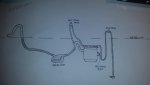
And a quick sketch of my system if anyone has any other ideas?
2017-05-01 19.37.46.jpg
 
Last edited:
I have the same system as the OP and have recently experienced the same problem of water in the oil. In my case diagnosis
was made easier by the fact that the ballbearing situated down stream of the oil seal was almost solid with rust.

I replaced the water pump seals,bearings and shaft and now all is well.
Could capillary action be the explanation as to how water " jumped " the drain hole?
 
I have the same system as the OP and have recently experienced the same problem of water in the oil. In my case diagnosis
was made easier by the fact that the ballbearing situated down stream of the oil seal was almost solid with rust.

I replaced the water pump seals,bearings and shaft and now all is well.
Could capillary action be the explanation as to how water " jumped " the drain hole?

The pump is the only logical explanation so i think i'll gamble and buy a new one.If its not that its one less thing to worry about for a few years!!!
 
The pump is the only logical explanation so i think i'll gamble and buy a new one.If its not that its one less thing to worry about for a few years!!!

Thought it was a likely explanation but I'm not so sure now .

£400 is a lot of money to spend without a more positive diagnosis.
 
If I may add my two pennyworth to the discussion..

I noted from the OP's original post his engine was a Mitsubishi based unit. I'm actually dealing with the aftermath of raw water pump failure myself. My engine is a Vetus M4.14 aka Mitsubishi K4E-61dm with an engine geared raw water pump. The engine is now in pieces in my workshop after the raw water pump seals failed and filled my engine with salt water, causing enough pressure to blow out the back oil seal, and fill the gearbox bell housing with the contents of the sump.

Its caused one hell of a lot of damage, and at this present moment in time I don't know if the engine is economically recoverable. Vetus parts being priced as they are.

I've no complaints whatsoever with the engine as the auxiliary in my boat, but the design of the raw water pump enabling seawater to enter the engine with seal failure leaves an awful lot to be desired..
 
If I may add my two pennyworth to the discussion..

I noted from the OP's original post his engine was a Mitsubishi based unit. I'm actually dealing with the aftermath of raw water pump failure myself. My engine is a Vetus M4.14 aka Mitsubishi K4E-61dm with an engine geared raw water pump. The engine is now in pieces in my workshop after the raw water pump seals failed and filled my engine with salt water, causing enough pressure to blow out the back oil seal, and fill the gearbox bell housing with the contents of the sump.

Its caused one hell of a lot of damage, and at this present moment in time I don't know if the engine is economically recoverable. Vetus parts being priced as they are.

I've no complaints whatsoever with the engine as the auxiliary in my boat, but the design of the raw water pump enabling seawater to enter the engine with seal failure leaves an awful lot to be desired..

Does your pump not have the large cut-outs shown above to allow the water to escape into the bilges rather than find its way past the crankcase-side seal?

Richard
 
Does your pump not have the large cut-outs shown above to allow the water to escape into the bilges rather than find its way past the crankcase-side seal?

Richard

No Richard.. the pump fitted to my engine was of the Jabsco variety. Ok, these pumps do have a slot to drain water that has bypassed the seal, but it is small, and on subsequent inspection was found to be choked with salt.

I did try to load a diagram but there seems to be a glitch in the system.
 
Theory is that water will not get past the drain slots but in practice if there has been a long term leak with a build up of salt crud that water does get past the seal remember that only one seal is actually sealing as the go back to back and yes the o ring is not recommended in several applications
 
Before you go buy a new pump I suggest you try Premier Pumps. They repair and refurbish Jabsco and Johnson pumps and many other types of pumps.
07593776722 - no connection just a satisfied customer :-)
Fair winds
John
 
Theory is that water will not get past the drain slots but in practice if there has been a long term leak with a build up of salt crud that water does get past the seal remember that only one seal is actually sealing as the go back to back and yes the o ring is not recommended in several applications

Just a thought.
As this seems to be a recurring problem would it be possible to fit a double lip seal in place of the standard oil side seal ?
 
Just a thought.
As this seems to be a recurring problem would it be possible to fit a double lip seal in place of the standard oil side seal ?

It should be. I fitted double lip seals to the pump on my last boat. Physically the same dimensions if i remember correctly.
 
To me the water pump is wrongly assembled. One of the lip seals covers the spy hole, the water can not escape through the spy hole and it ends up inside the engine. Water pressure is higher than the pressure in the engine. the water pump has two lip seals. One isolates the engine the other the pump. When the seal on the pump side is defect water should flow out of the spy hole. I assume the pump was wrongly assembled and the spy hole is covered by the second lips seal on the engine side. The shaft is also worn, that´s why the water in the pump goes through the seal and instead to escape it ends up in the engine. Have seen this before. By the way did you change the bearing as well? Normally you change the two lip seals, bearing and shaft of the pump.
I would exchange the pump from and use second source supplier (cheaper). Since the oil is only grey means that just a few drops of water ended up in the engine oil. If it is more than a few drops the oil becomes milky. You are lucky.

P.S. excuse my english I am german. Mounting procedure for lip seals see Richards comment below.
 
Last edited:
P.S. excuse my english I am german. The metal spirals in the lip seals should be made out of stainless steel, spirals of the lip seals should point to the middle (spy hole).

It may be a language misunderstanding but the lips of a seal with a spring/spiral should normally face towards the liquid which is being contained. The seal at the pump end of the shaft will therefore have the spring facing towards the impeller (water) and the seal at the engine end will have the spring facing towards the engine (oil).

Richard
 
No Richard.. the pump fitted to my engine was of the Jabsco variety. Ok, these pumps do have a slot to drain water that has bypassed the seal, but it is small, and on subsequent inspection was found to be choked with salt.

It seems daft but my Johnson pumps have large cutouts in the the body all round the middle of the shaft .... and mine are belt driven pumps so there's no chance of water entering the crankcase. I could have a sealed body casting. In engineering terms, it's a buggers muddle! :confused:

Richard
 
It's a fairly common problem on VP MD 2B series engines. Sea water is pumped past the engine oil seal when the water seal fails and you have a milky engine which cons you into thinking you have a cylinder head gasket failure. Don't ask how I know! Just traced an ingress of water to the engine compartment to a failed water pump seal on my present MD17 D. Luckily I caught the problem before the salt crud built up and diverted the salt water into the engine.
 
Top