Water heater/boiler installation pipe length

antaris

Well-Known Member
Joined
12 Jul 2012
Messages
249
Location
Athens, Greece
astarteginfizz.wixsite.com
Hope everybody is well.

Currently at home and planning the installation of a water boiler/heater to 37ft sailing boat (a 70s Gin Fizz).

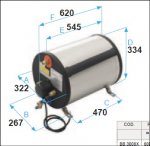
I got my self one of those:
boiler.jpg
(Italian ATI 30lt, boiler /electric).

The boiler must be connected to engine cooling system - and it needs to be lower than the engine itself, to bleed proper. Unfortunately, this factor makes it all difficult... It fits near the engine, but I will have no good inspection access.

Under the settee looks promising, but will require a 4-5 metre pipe run (round galley, etc., as no space under floorboards). So: how far away from the engine can I install a boiler? How long can the connecting pipe lengths be?

Thank you all!
 
That looks like a calorifier, rather than a boiler. It doesn't necessarily have to be lower than the engine, but it will make it easier to bleed if it's lower than the engine header tank, if one is fitted. Close to the engine is better, because the heating water circulation is dependent on the engine circulating pump.
 
I've got a Sunfast 37 and the hot water tank is on the aft side of the starboard bulkhead under the saloon seat in the corner, must be a 4 or 5 metre run?
 
That looks like a calorifier, rather than a boiler. It doesn't necessarily have to be lower than the engine, but it will make it easier to bleed if it's lower than the engine header tank, if one is fitted. Close to the engine is better, because the heating water circulation is dependent on the engine circulating pump.

Apologies, quite possibly a calorifier, as you say. Yes, the engine does have a header tank and it is (supposedly) better to install lower - of fit an extra small tank (whose name I forget now, but I really do not want more systems anyway)!
 
Hope everybody is well.

Currently at home and planning the installation of a water boiler/heater to 37ft sailing boat (a 70s Gin Fizz).

I got my self one of those:
View attachment 88251
(Italian ATI 30lt, boiler /electric).

The boiler must be connected to engine cooling system - and it needs to be lower than the engine itself, to bleed proper. Unfortunately, this factor makes it all difficult... It fits near the engine, but I will have no good inspection access.

Under the settee looks promising, but will require a 4-5 metre pipe run (round galley, etc., as no space under floorboards). So: how far away from the engine can I install a boiler? How long can the connecting pipe lengths be?

Thank you all!
Even if it is mounted lower than the engine header tank if the hoses dip down then up to the calorifier you may still get an airlock, in which case you will need a bleed valve at the high spot near the calorifier to bleed the air out. Once you have located the correct ports in the engine to connect the hoses to, suggest you fit an isolation valve to both ports so if you get any leaks you can isolate and continue to run the engine.

Www.solocoastalsailing.co.uk
 
The shorter all the pipes are the better. But remember that the further the Calorifier is from the tap the longer it will take for hot water to get to the tap. And I think that's almost as important and I'd go for longer pipes to engine if that got the Calorifier closer to the galley tap.
 
Even if it is mounted lower than the engine header tank if the hoses dip down then up to the calorifier you may still get an airlock, in which case you will need a bleed valve at the high spot near the calorifier to bleed the air out. Once you have located the correct ports in the engine to connect the hoses to, suggest you fit an isolation valve to both ports so if you get any leaks you can isolate and continue to run the engine.

Www.solocoastalsailing.co.uk

Totally so - now I need to source two valves that can take the heat all right...
 
Or keep a length of copper pipe or even a purpose made hose joiner and the appropriate jubilee clips wired to the calorifier. No reliability issues and will still work when needed.

To easily make a loop and bypass the calorifier?

It crossed my mind - but should the issue happen after hours of running the engine - would the 80-90 degrees C water be an issue? I'd have to wait for it to cool down, in order to assemble the loop!
 
I think Iliade was suggesting using a small length of copper pipe to break the hoses from the engine to the calorifier to enable you to bleed the pipes, not so that you could bypass the calorifier. Once you’ve got the hoses from the engine to the heating coil you need to let well alone unless a fault develops. I’ve never needed to isolate the calorifier in 6 years of living aboard or 5 years of summers.
 
Hope everybody is well.

Currently at home and planning the installation of a water boiler/heater to 37ft sailing boat (a 70s Gin Fizz).

I got my self one of those:
View attachment 88251
(Italian ATI 30lt, boiler /electric).

The boiler must be connected to engine cooling system - and it needs to be lower than the engine itself, to bleed proper. Unfortunately, this factor makes it all difficult... It fits near the engine, but I will have no good inspection access.

Under the settee looks promising, but will require a 4-5 metre pipe run (round galley, etc., as no space under floorboards). So: how far away from the engine can I install a boiler? How long can the connecting pipe lengths be?

Thank you all!
Both my Benes have/had the calorifier under the aft end of the stbd saloon seat. About 1.5 mtrs from the engine. A straight run from the engine. Bog std car heater hose, the original is still fitted. A little bleed tap on the inlet connection By the calorifier facilitates bleeding. No header tank.
 
Just for info, the calorifier in our motorsailer is at least a metre above the engine. I put a bleed valve with a float above the calorifier, used when I first filled the system, but never since. Coolant can be added to the engine as required in the normal way.
 
Thank you everybody for the responses. By the looks of it, provided that I plan carefully, everything is possible. I honestly thought the distance/height would be an issue - given freedom to move, I shall be all fine... I guess!

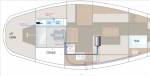
Here is the plan, so far. I am thinking of not installing a dedicated cold water supply to calorifier - I will "steal" cold from where the two T-joints are noted. I hope this is not an issue, as I presume that the water pressure remains constant throughout the network (me no engineer!):

water system.png

I am still worried about pissing about with the cooling network of the engine. A leak can be very hazardous - so I will include an isolation/loop solution nearby, just in case.

Thanks, once again!
 
Thank you everybody for the responses. By the looks of it, provided that I plan carefully, everything is possible. I honestly thought the distance/height would be an issue - given freedom to move, I shall be all fine... I guess!

Here is the plan, so far. I am thinking of not installing a dedicated cold water supply to calorifier - I will "steal" cold from where the two T-joints are noted. I hope this is not an issue, as I presume that the water pressure remains constant throughout the network (me no engineer!):

View attachment 88308

I am still worried about pissing about with the cooling network of the engine. A leak can be very hazardous - so I will include an isolation/loop solution nearby, just in case.

Thanks, once again!
You don't need a "loop" , just 2 isolation valves on the engine ports. The hot coolant water from the engine to calorifier is not the full flow of engine coolant so you just need to isolate both the ports and the main coolant flow continues to circulate round the engine. Your layout looks good although my preference is to have a thermostatic mixer valve in the pipework in the forward heads so you get a stable water temperature for showering and don't risk scalding yourself.

Also, the calorifier will have a pressure releif valve which will occasionally release some hot water which needs to be either piped into the bilge or, as i do, into a half litre bottle that i empty occasionally so keeping the forward bilge dry.

www.solocoastalsailing.co.uk
 
Thank you everybody for the responses. By the looks of it, provided that I plan carefully, everything is possible. I honestly thought the distance/height would be an issue - given freedom to move, I shall be all fine... I guess!

Here is the plan, so far. I am thinking of not installing a dedicated cold water supply to calorifier - I will "steal" cold from where the two T-joints are noted. I hope this is not an issue, as I presume that the water pressure remains constant throughout the network (me no engineer!):

View attachment 88308

I am still worried about pissing about with the cooling network of the engine. A leak can be very hazardous - so I will include an isolation/loop solution nearby, just in case.

Thanks, once again!

That's a really useful locker, I'm not sure I'd want to lose that one.
 
You don't need a "loop" , just 2 isolation valves on the engine ports. The hot coolant water from the engine to calorifier is not the full flow of engine coolant so you just need to isolate both the ports and the main coolant flow continues to circulate round the engine. Your layout looks good although my preference is to have a thermostatic mixer valve in the pipework in the forward heads so you get a stable water temperature for showering and don't risk scalding yourself.

Also, the calorifier will have a pressure releif valve which will occasionally release some hot water which needs to be either piped into the bilge or, as i do, into a half litre bottle that i empty occasionally so keeping the forward bilge dry.

www.solocoastalsailing.co.uk
Suggested mixer valve Thermostatic Mixing Valve TMV 2/3 - 15mm - 12162 | BES.co.uk for shower.

www.solocoastalsailing.co.uk
 
Top