Water from engine anti-siphon breather valve

lupins

New Member
Joined
12 May 2014
Messages
7
Visit site
Hello all,

Whilst vaguely familiar with engines I wouldn’t say that they are quite my strong point so apologies in advance for anything which may sound naive but I really would appreciate anyones take on this!

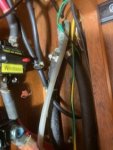
In my engine bay, water comes directly through the seacock, through the impeller and is then fired up into a U bend which is what I can only describe as an anti siphon valve/breather (see attached image). From here it then goes to the heat exchanger. The issue is that at the top of this Ubend/Antisiphon valve there is a little spiggot with a short pipe coming off (you should be able to just make it out from the picture). Each time the engine is run, a steady drip of water which increases in ferocity to a little stream comes out. Now, this is quite annoying as the small pipe attached to the top of this u bend is rather short and means that everything in the vicinity gets a good spraying of seawater.

Is there a way to stop this? Someone has suggested it doesn’t need an antisiphon valve as the pipework sits higher than the exhaust elbow and other critical parts. Another suggestion was that this is quite normal and to make a longer hose going into the bilge but I also quite like the idea of my keel bolts not sitting in seawater. Another suggestion was that potentially the antisiphon valve has a small ball/socket arrangement in the top which could have seized meaning that seawater is continually passing through when the engine is fired up and so a new one could sort this issue.

As you can tell, very clueless on the matter and would appreciate any feedback as to how I can best sort this.

Thanks in advance!
 

Attachments

  • 4D358871-BE1E-4197-B40D-2A1947AF71A1.jpeg
    4D358871-BE1E-4197-B40D-2A1947AF71A1.jpeg
    19.6 KB · Views: 100
The photo's too small and blurry to identify the fitting, but if it was installed with only a short pipe then I'd assume it's the type with a valve in and is intended for air to go in but no water to come out. The valve could be a ball or it could be a little rubber thingy; either way it seems to have failed. You should be able to open the valve part of the fitting to free up the ball, replace the rubber thingy, or otherwise investigate and fettle it.

Pete
 
It looks to me like a siphon-break, but not an anti-syphon valve, as such.

I think you will find that the fitting is just a 'T' arrangement, and the small diameter tube is just an outlet for the water when under pressure (i.e. when seawater pump going). When the pump stops air can be drawn back up the pipe breaking the syphon (assuming the fitting is mounted high enough).

The flexible plastic pipe (also colloquially known as a 'piddle tube') just needs to be long enough to dispense the water somewhere suitable. Some people like to have the piddle tube outlet in the cockpit, so they can immediately see that there is water flowing when the engine is on (the water then just flows down the cockpit drains) . Others prefer to have it outside the hull (though a small-bore skin fitting), because they don't like the water in the cockpit, because the noise of the water flowing makes them want to pee all the time, and/or they're not so concerned about constantly monitoring the water flow. On some boats/engines (e.g. some Bukhs), the piddle tube outlet is plumbed into the exhaust near the outlet end of the exhaust.

In the event that you do have an anti-syphon valve, then it is not functioning correctly. That should prevent water coming out when the water circuit is under pressure, but allow air in when it is not. Such valves are very simple, but can get held open by salt crystals forming. Correcting this usually just involves disassembly of the valve (a very simple mechanism) and thoroughly rinsing the crystals out with fresh water (a good annual maintenance task, if you have such a valve). These valves usually have a fitting for a piddle tube, but as its usually not flowing, this can drain to the bilge. (But if so make sure that if the valve does start to leak water that it won't be drawn into the engine air intake - Don't ask how I know that! :rolleyes:)

Vetus and others sell syphon valves that work as described, but they seem inordinately expensive. Much cheaper anti-syphon valves can be bought (and are used for e.g. toilet water intake siphon breaks), but these are not specified to handle the raised temperatures in cooling water systems (perhaps not relevant to you if the siphon break is between the pump and the engine cooling intake, rather than between the engine cooling outlet and the exhaust elbow).
 
I have problems in that sometimes the vacuum valve leaks a lot of water & sometimes none. Like you I do not want it draining into the bilge. My solution is to put the tube into a 5 litre can next to the engine & collect the water. Every so often I check the rate that it is filling & if it is a lot,then I can remember to empty it more regularly. However, to avoid this destroying the effect of the syphon I have drilled a tiny hole in the tube just above where it enters the can so that when the engine stops the valve will draw air & not water back from the can
 
Yes, you definitely need it. It stops water syphoning back into the engine when you switch off. almost certainly it needs stripping down and cleaning if it is leaking when running. The better types do not leak, as suggested even when clean there is a dribble then lead the tube to a bottle to collect the water. Other types have no valve and the pipe is led overboard or into the cockpit. Otherwise performs the same function of breaking the syphon when the engine stops.
 
LittleSister has just about said it all - I can only add that although the picture is too blurred to make out detail the fitting does look a bit green & corroded to me and as prv & Tranona suggests taking apart and clean might rectify the situation.
and to confirm what Tranona says you do need it. Mine was the type leading to a fitting in the transom to jettison the water. It blocked once and end result was water syphoning back into the engine.
 
Last edited:
I think you will find that the fitting is just a 'T' arrangement, and the small diameter tube is just an outlet for the water when under pressure (i.e. when seawater pump going).

If it was that type, you’d expect whoever installed it to have fitted a pipe that drained somewhere sensible, rather than spraying all over the engine bay.

People do do silly things, I suppose.

Pete
 
I have one of these and it is piped with clear plastic tubing into the cockpit drain, it dribbles water continuously when the engine is running ...I never took any notice of it....do i understand correctly that it is meant to dribble continuously?
 
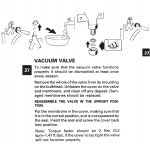
It looks like an older Volvo Penta anti-syphon valve (sometimes called "vacuum valve"). If you unscrew the top, there's a little copper diaphragm which, when water is flowing, is pressed upwards to seal the outlet. When the engine stops, the diaphragm drops slightly and allows air in to break the syphon. Deposits on the diaphragm and housing cause it to leak a dribble of water. You can get a new diaphragm from VP dealers.

If you take it apart, it's easiest to turn it upside down first.

If you decide to replace the whole thing, there are lots of plastic ones available.

post-3599-1227486736.jpg
 
I can't add much - the advice above is pretty much sound. What you are hearing here is that just about every boat has & needs one of these, there are different types, they all need servicing/checking, and will likely need replacing sooner or later.

I'm a fan of the Vetus ones, AIRVENTV is my A/S valve of choice. I am completely aligned with the people who have the non-valve type so they know when the water is flowing, but if your water pipe is before the heat exchanger, that is extra cooling water not going through the engine, so I prefer to just check & service annually.

Good luck!
 
I think pvb above has it - I have the Yanmar version. It works OK - but it needs dismantling and a good clean every year to stop it dribbling.
 
We had exactly same problem on same valve and I just replaced it. Old one was so old and rusty to be repaired or take the risk and flood the engine...
 
The first time I seviced mine, I took out a small plastic component, like a flexible tube that does what PVB describes, but it could easily be put back in the wrong way. It needs to be put in so that you can suck air through it into the water circuit rather than having it blow water out. (If I let it blow water out with the engine running,it would close and not let air in when the engine shuts down.)

If you have the same, give it a good suck after you've cleaned the salt away! Then you know which way to fit it. ?
 
Top