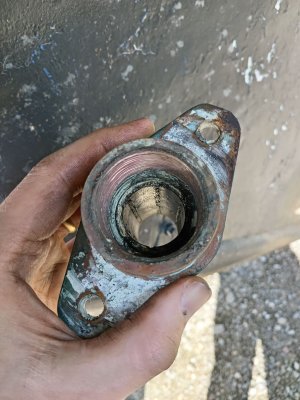
Washer in stern tube/ cutlass bearing holder?

Captain Crisp

Well-Known Member
Joined
1 Mar 2015
Messages
414
Visit site
Hi all,
I have had a recurring leak through the threads where my stern tube meets my cutlass bearing holder. In the past I have tried blocking it with heldtite and other similar jointing compound products. Doesn't seem to work for more than a season and it's a bugger to take apart to renew. Was wondering whether I could put a washer in?
Any other tips gratefully received...
Ta, Crisp
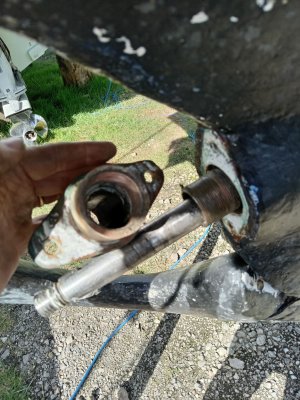
IMG_20250330_134352_MSf5LHF88d.jpeg

IMG_20250330_134357_NyZ7sLDW62.jpeg
 
I had a leak at the other end of the similar stern tube on my Twister [where the stuffing gland screws onto it] and I repaired it sealed it successfully with Loctite 572, Thixotropic Thread Sealant:

1743356037926.png
 
I had a leak at the other end of the similar stern tube on my Twister [where the stuffing gland screws onto it] and I repaired it sealed it successfully with Loctite 572, Thixotropic Thread Sealant:

View attachment 191441
Evening, Poignard.
I used this before but it still started leaking... Having said that I wasn't so successful at getting the tube out stern wards. I'll be able to get more coverage this time.
Is the washer idea stupid?
Many thanks
Crisp
 
Evening, Poignard.
I used this before but it still started leaking... Having said that I wasn't so successful at getting the tube out stern wards. I'll be able to get more coverage this time.
Is the washer idea stupid?
Many thanks
Crisp
Are you absolutely sure the leak is through the threads and not beween the flange on the bearing holder and the 'stern post'?

I don't see what the washer would achieve. There wasn't one there when the boat was built, and she has managed without one for decades.
 
Are you absolutely sure the leak is through the threads and not beween the flange on the bearing holder and the 'stern post'?

I don't see what the washer would achieve. There wasn't one there when the boat was built, and she has managed without one for decades.
I think so - there was plenty of unbroken sikaflex between the flange and post. I also noticed that the tube turned at the aft end whereas it was still sealed within the greaser at the engine end. I think perhaps I didn't put enough loctite in...

I was thinking a fibre washer might provide a seal between the tube end and the CB holder?
 
When I had a stern tube and housing like that I wrapped some caulking cotton around the end of the tube, filled the gap with polysulphide then on the flange before tightening down until it bottomed. Locking screws in. no leaks and not too difficult to unscrew.

Loctite is a waste of time on the threads of the housing. That stuff is to stop the thread undoing - which it can't do because the locking screws stop it from turning.

Your problem suggests you are simply not using enough sealant.
 
When I had a stern tube and housing like that I wrapped some caulking cotton around the end of the tube, filled the gap with polysulphide then on the flange before tightening down until it bottomed. Locking screws in. no leaks and not too difficult to unscrew.

Loctite is a waste of time on the threads of the housing. That stuff is to stop the thread undoing - which it can't do because the locking screws stop it from turning.

Your problem suggests you are simply not using enough sealant.
In this application, the Loctite 572 is not intended to stop the thread undoing. It is a thread sealant.
 
The stern tube is flooded and the shaft is running in the water that enters through the grooves in the cutless bearing. The water is prevented from getting into the hull by the stern gland at the inner end. There is no reason to seal the threads at the outer end but the interface between the bearing holder and deadwood must be leak-free. It is normal also to seal the hole in the deadwood through which the stern tube passes. The stern gland may be required to drip to lubricate the stuffing box but the threads where the fitting is screwed on to the inner end of the tube must be watertight.
 
The stern tube is flooded and the shaft is running in the water that enters through the grooves in the cutless bearing. The water is prevented from getting into the hull by the stern gland at the inner end. There is no reason to seal the threads at the outer end but the interface between the bearing holder and deadwood must be leak-free. It is normal also to seal the hole in the deadwood through which the stern tube passes. The stern gland may be required to drip to lubricate the stuffing box but the threads where the fitting is screwed on to the inner end of the tube must be watertight.
The threaded joint between the stern tube and the outboard bearing is inside the hull moulding, which is not very thick at that point. So if the threads were not sealed, water would leak into the hull.

The threads have to be sealed, and so does the interface between the flange and the hull.
 
Ah, I see that there appears to be a gap round the tube at the outer end. I have only worked on the stern tube of one GRP boat (a Westerly Renown) and it's stern tube was liberally coated with gunge before it was inserted to seal the gap between it and the hull, which as usual with a Westerly was generously thick. There was also IIRC a plate inside that was a neat fit on the shaft. Reaching it to put nuts on the ends of the two bolts that held the mounting for the Cutless bearing was interesting and my memory of the whole tortuous process has faded from memory.
 
In this application, the Loctite 572 is not intended to stop the thread undoing. It is a thread sealant.
If the seal is made by closing the gap between the tube and the hull with caulking cotton and a smear of sealant on the tube threads there will not be leaks. from what the OP says he did not use enough sealant.
 
The one that I was working on was old technology so I used an old joint sealant:- Boss white and hemp. All of the threaded section was outside the hull and the tube was, as I said before, sealed to the hole bored through the glass fibre rear face of the shaft tunnel with some kind of mastic sealant. The housing was then screwed onto the end of the tube until the flange came up against the rear face, which was previously smeared with mastic. It was then prevented from unscrewing by two bolts into nuts inside the hull. Holding the nuts while the bolts are tightened involves a lot of ingenuity and a long device to hold the socket on the end.
 
The threaded joint between the stern tube and the outboard bearing is inside the hull moulding, which is not very thick at that point. So if the threads were not sealed, water would leak into the hull.

The threads have to be sealed, and so does the interface between the flange and the hull.
Second that.. on a previous boat of mine the screw holes passed through the hull and were open at the inner end, the threads in the fibreglass were also worn. I ended up using some epoxy filler to line the screw holes and re-cut the threads, then used some PTFE tape and sikaflex on the screws to ensure the threaded holes were leak free. It worked!
 
Second that.. on a previous boat of mine the screw holes passed through the hull and were open at the inner end, the threads in the fibreglass were also worn. I ended up using some epoxy filler to line the screw holes and re-cut the threads, then used some PTFE tape and sikaflex on the screws to ensure the threaded holes were leak free. It worked!
Cross purposes here perhaps as the OP seems to be talking about the threads of the cutless housing onto the stern tube rather than the locking screws into the deadwood.
 
Top