
WARNING near death experience with Eberspacher

JimC

Well-Known Member
Joined
30 Aug 2001
Messages
1,570
Location
Lancashire
Visit site
Wife and I went to spend the weekend on our boat which is afloat in Whitehaven Marina. It was cold so we were glad of our Eberspacher. We even considered leaving it on overnight on a low setting, something we'd never done before, but decided not to. In the morning it was very cold so we fired up the Eberspacher first thing. A few hours later wife thought it seemed a bit hazy in the cabin, thought it was her eyes at first, no noticeable smell. I opened the cockpit locker where the Eberspacher lives and great clouds of choking smoke billowed out. Hurriedly switched off the Eberspacher and waited for the smoke to clear. I found that the heater's exhaust elbow had broken at the weld leaving the short part still attached to the heater so all the exhaust gasses were being discharged into the locker and leaking from there into the acommodation.
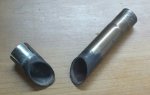
exhaust elbow fail.jpg

There is a Kidde CO alarm in the saloon but it hadn't sounded, perhaps because diesel exhaust contains relatively small amounts of CO, though still potentially lethal.

https://www.ncbi.nlm.nih.gov/pubmed/18643868

The type of elbow that failed is widely marketed e.g. on ebay.

If you have one of these I urge you to replace it with a one piece elbow such as

https://www.ebay.co.uk/itm/Eberspacher-or-Webasto-Heater-24mm-Exhaust-Elbow-Stainless-Steel-252481800202/291066509053?epid=2174474839&hash=item43c4ea76fd:g:lx8AAMXQuu9Rk4Qk:rk:2:pf:0

If your exhaust goes straight onto the heater without an elbow then of course none of this applies to you.
 
Last edited:
WHy would you need this elbow? ALl of mine have had the exhaust hose fixed directly to the outlet. What purpose does it serve?

Luckily, as your CO alarm has shown, it is rather hard to kill yourself with eberspacher exhaust, due to the low levels of CO produced by burning small quantities of diesel. Not impossible, I might add, but very difficult.
 
Thank goodness everyone is okay. Worth remembering that it's not only the Eber exhaust to be worried about; it's equally/more important to ensure that air intake is well clear of main engine's exhaust.

This MAIB report highlights a faulty installation by Kreuger Ltd (large South Coast Eberspascher dealer) which almost had tragic consequences.
https://assets.publishing.service.gov.uk/media/547c715fe5274a428d00010b/chapter2.pdf

Well worth checking installations in the cold weather. Also, FWIW I have installed a second CO alarm close to the heater.
 
It seems a bit unfair to headline this as an Eberspacher problem, as clearly it wasn't.

It's a generic eberbasto and unknown quality stainless welding problem.
Any welded stainless part which gets hot, like an exhaust, can see a lot of stress.
The elbow might also have a lot of leverage on it.
Corrosion of poor welding is also possible.

I'll check our system again tomorrow!
 
WHy would you need this elbow? ALl of mine have had the exhaust hose fixed directly to the outlet. What purpose does it serve?

I have to agree, the elbow doesn't really achieve anything. It also introduces an extra pipe-pipe joint, as well as a restriction in the exhaust flow caused by the abrupt 90 degree bend. Plus, as the OP discovered, another potential failure point.
 
Thank goodness everyone is okay. Worth remembering that it's not only the Eber exhaust to be worried about; it's equally/more important to ensure that air intake is well clear of main engine's exhaust.

This MAIB report highlights a faulty installation by Kreuger Ltd (large South Coast Eberspascher dealer) which almost had tragic consequences.
https://assets.publishing.service.gov.uk/media/547c715fe5274a428d00010b/chapter2.pdf

Well worth checking installations in the cold weather. Also, FWIW I have installed a second CO alarm close to the heater.

An important point ref the warm air intake, but worth stating that in this case the CO that caused the problem initiated from a petrol engine. Petrol creates significantly more CO than diesel and in my opinion every petrol boat should have a CO alarm or two for this very reason.
 
I have to agree, the elbow doesn't really achieve anything. It also introduces an extra pipe-pipe joint, as well as a restriction in the exhaust flow caused by the abrupt 90 degree bend. Plus, as the OP discovered, another potential failure point.

Installations differ: in my case the exhaust needs to turn through 90 degrees quite close below the heater. I think this can be better achieved with a (serviceable!) elbow rather than by forcing the ribbed exhaust tube into a tighter curve than it wants to go round.
 
Installations differ: in my case the exhaust needs to turn through 90 degrees quite close below the heater. I think this can be better achieved with a (serviceable!) elbow rather than by forcing the ribbed exhaust tube into a tighter curve than it wants to go round.

Well the sharp 90° abortion on your link could surely be improved on!
 
I’ve seen exhausts in bad condition and holed in certain instances after a little light tapping with a screwdriver but never seen one completely broken!

A good bit of kit to have right near the heater is an optical smoke detector as this will pick up fairly small leaks from the exhaust, certainly if in an enclosed space.

I guess it only serves as another reminder as to regularly visually inspect and service regularly!

Just out of interest to the OP, does your exhaust go up out of the heater or down out of the heater? I.e. could water going down the exhaust create rusting in the elbow as nowhere for it to go?
 
Just out of interest to the OP, does your exhaust go up out of the heater or down out of the heater? I.e. could water going down the exhaust create rusting in the elbow as nowhere for it to go?

No, it's all downhill to the outlet in the transom. Good advice re. the smoke detector.
 
A good bit of kit to have right near the heater is an optical smoke detector as this will pick up fairly small leaks from the exhaust, certainly if in an enclosed space.

The exhaust from a properly adjusted diesel heater is clear; I can't see an optical smoke detector being any use.
 
You’ll always get the smoke on start up and for the first few minutes whilst the burner chamber heats up. For £10, it’s a worthwhile exercise.

Customer of mine has a largeish Hardy and his aft engine room optical smoke head picked up a slightly holed exhaust on his Webasto wet system. New exhaust and it never went off again to my knowledge.

The exhaust from a properly adjusted diesel heater is clear; I can't see an optical smoke detector being any use.
 
You’ll always get the smoke on start up and for the first few minutes whilst the burner chamber heats up. For £10, it’s a worthwhile exercise.

So it would only work if there's an exhaust fault before start-up, but wouldn't show an exhaust fault which develops whilst the heater's running. Still not convinced that's a solution.
 
Top