
I have had the same quandry - in fact it was when my Volvo was brand new and the oil had been inserted by the Volvo dealer, so apparently the correct volume. I understand there can be a bit of air lock in there (at the top?) which comes and goes sometimes when dip stick is used, or sailing, or more likely at am oil change - so that the oil level can be a bit ambiguous.I changed the oil in the sail drive, and on inspection, it appeared I have slightly over filled it!
Is there margin for error or should I take my Pela down and suck some of the oil out?
View attachment 90880
Indeed, see my post #4.On the Yanmar saildrives overfilling can lead to overpressuring (becuase there is a smaller volume of air to compress when things heat up). The overpressuring can cause oil to be forced out of the shaft seal and then,when everything goes cold, a slight vacuum is caused which can draw sea water into the drive and the next thing is your oil looks like egg yolk as it gets emulsified. If may be completely different on your volvo but if it were me I would keep the level closer to the bottom mark than the top and not leave it overfull.
Why is the dipstick not calibrated to allow for the expansionIndeed, see my post #4.
Every engine/gearbox/differential/hydraulic pump/coolant system etc that I own is always kept topped up to the "maximum" mark, apart from my two sail-drives, which are always on the "minimum" mark.
The principle has been discussed on here several times over the years.
Richard
Carefully with a drinking straw!I always keep my saildrives on the bottom mark, unlike everything else which is filled with oil, so I would take out the excess. However, I'd just suck it out with a few sucks and blows on a length of hosepipe or similar.
Richard
It's a good point. I think that the answer is that Yanmar, and possibly other sail-drive manufacturers, state that the seal must be changed every two years. In that sense, the seals are always virtually brand new and the springs are tight and the rubber is supple. In that state, they can withstand the higher pressure/vacuum cycle.Why is the dipstick not calibrated to allow for the expansion
It seems crazy to have a dipstick with max and min markings if the lower mark must be taken as the max fill level or risk blowing oil seals.
It's a good point. I think that the answer is that Yanmar, and possibly other sail-drive manufacturers, state that the seal must be changed every two years. In that sense, the seals are always virtually brand new and the springs are tight and the rubber is supple. In that state, they can withstand the higher pressure/vacuum cycle.
However, who really wants to change these seals so often? The answer is to lower the pressure/vacuum range as much as possible, consistent with keeping sufficient oil in the sail-drive to ensure that it is always well lubricated. The minimum mark is obviously that mark and this should extend the usable life of the seals to four or five years or even longer.
Sheer luck and other operating conditions will obviously play a big part in how long the seals actually last, but why not load the dice in your favour as much as possible if there is no downside.
Richard
I'm not sure whether you are agreeing or disagreeing with me.There is no requirement to change seals every two years within the Yanmar SD20 & SD50 Periodic Maintenance Table published within the Operation Manual.
The min and max levels are just that. The min or max quantities of oil required to meet the requirements of lubrication, heat transfer etc under prescribed conditions of operation. Interestingly, the manual recommends filling to the upper level mark.
I imagine that designing the lubrication system on a saildrive is quite a challenge. There are long, small area galleries to lubricate the bottom shaft and these notoriously air lock, potentially leading to a number of issues, including level concerns.
Yanmar reduced the recommended oil capacity of the SD50, by providing a new dipstick to older models, to address an issue of the main input shaft seal blowing.
There are reported early life failure of the lower seal but these appear to be a mechanical failure (load from the prop) rather than by over pressure.
I'm not sure whether you are agreeing or disagreeing with me.
If you are disagreeing, then you have missed the point, but please feel free to keep filling your sail-drive to the maximum mark if that is your preference.
Richard
You're stating the facts that you know about. I'm stating the facts that I know about which are in my Yanmar sail-drive manual.I was neither agreeing nor disagreeing with you, Richard. That's a futile and pointless endeavour as you're always right (including the times when you do a 180) and always like the last word
I was merely stating facts.
You're stating the facts that you know about. I'm stating the facts that I know about which are in my Yanmar sail-drive manual.
Richard
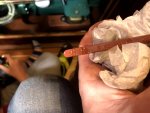
Volvo will, almost certainly, simply quote from the manual as manufacturers are normally only interested in covering their backsides.Thank you all for the cracking advice - especially the advice that meant I could leave the "big guns" Pela at home and grab from my epoxy gear a syringe and a bit of fuel hose I had laying around.
![]()
This worked perfectly, and got us just inside the H mark (before the boy managed to pull the end of the syringe off and get oil everywhere - the perils of educating the next generation! The first mate was not best pleased!)
On the issue of not setting the saildrive to the H mark, I'll see if I can get a comment from VP directly to see what they advise. Originally these were specced to run on hydraulic oil as opposed to engine oil. Does engine oil expand more perhaps?