Volvo Saildrive corrosion

cpedw

Well-Known Member
Joined
1 Jun 2001
Messages
1,327
Location
Oban
Visit site
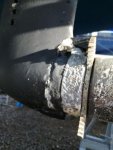
There was a lot of white dust on these patches at the joint between the body of the leg and the bearing housing though the underlying structure seems to be sound. Should I be worried? What would be the best treatment for these areas where the coating has been damaged?
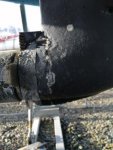
Saildrive 1.jpgSaildrive 2.jpg
I am a fan of simple procedures such as one shot with a spray can. But I don't want to replace the saildrive in the near future!
 
Clean it back to bare metal, etch primer or Hammerite all metal primer, then Trilux. I assume the coating is already Trilux. Probably best to remove the prop, cutter and anode before doing the job. Check that the anode attachment area is on clean aluminium and that the screws are also clean with no grease on them.
 
The enamel on the lower part of the leg adjacent to the bearing housing also appears to be compromised, as it seems to be blistering. IMHO it would be advisable, along with cleaning the bearing housing, to also investigate this area, and in the likely event of finding similar corrosion, to undercoat with Hammerite SMP, then coat the whole leg with a two-pack coating designed for outboard engines followed by your favourite suitable saildrive antifouling.. This is what I did and it lasted 6-7 years before it needed further attention. I got the two-pack coating from my local chandelry, Marine Parts Direct, who also sell online (Thanks Colin, enjoy the ARC !), but a similar product would probably be widely available in chandelries throughout the UK
Edit: If doing this you'll need to strip off all antifoul etc., right down to the original enamel, and abrade with a suitable grade of sandpaper.
 
Last edited:
In addition to repairing the coating, which is essential, ensure that the leg is not connected to anything electrically and that the gasket is clean and dry.

On Volvos the leg is normally isolated, although there are exceptions in which the engine is also isolated.
 
Thanks for the advice, which prompts a question about the anodes:

That anode in the photos is 2 seasons old, with little apparent erosion. The 3 piece anodes by the prop have completely disappeared in a season. It has been like this in the 4 years of my ownership. Does this suggest that the 1 piece anode isn't connecting properly? What sort of resistance should I expect to measure between anode and saildrive and where on the leg can I usefully put the probe?
 
No. There is no connection between the prop anodes and the drive anode as they are electrically isolated. The anodes on the prop go quickly because the prop is made of big chunks of "bronze" and stainless that don't like eachother. Nothing to worry about with the slow wear on the drive anode. Difficult to have a poor connection here if the face of the seal housing is clean and the screws holding the anode on are done up tight.
 
Tranona,
I will add from personal experience. It's very easy to have a poor electrical connection between the saildrive anode and the saildrive. I found this to my cost, and should have been alerted by the lack of material loss on the anode. The reason for the anode lasting so long was the poor electrical connection. Worth checking with a multimeter, I would be looking for about 1 ohm or thereabouts. I now go for belts and braces and hand an anode over the side which I connect to the saildrive upper gearbox. Not the engine since this should beisolated on a VP.
 
The problem with an anode over the side is that it does not come into play until the anode attached to the saildrive is depleted as this is the one that is closest. So while it is useful if the boat is in the water for extended periods such that the main anode may have insufficient bulk, it does not necessarily reduce the depletion rate.

BTW you don't say how or why you had poor continuity. Pretty difficult as properly installed a 120 style anode (like the OPs) has direct metal to metal contact with the housing plus the 2 set screws nd a 130 style has a large contact area through the screws and attachment lugs. Way better than the somewhat hit and miss of the common hull anode to prop shaft on conventional stern gear.
 
The over the side is an extra, and I know it will not be as effective as the shaft one (unless it is depleated or fails), but cannot do any harm (unless I depart and forget to lift it:-(). My anode issue was discovered after corrosion was found on the SD bearing housing, On removing the 2 piece anode (VP130), the screws were covered in white deposits and I think there was poor electrical continuity between anode and the SD.
 
Multimeter in hand, I put 1 probe on the saildrive anode. Where do I stick the other probe (be kind now!) to measure the anode/saildrive resistance? It's all going to be covered in paint and other insulating stuff isn't it?
 
Multimeter in hand, I put 1 probe on the saildrive anode. Where do I stick the other probe (be kind now!) to measure the anode/saildrive resistance? It's all going to be covered in paint and other insulating stuff isn't it?

There will be an oil drain plug in the bottom of the leg. You could safely scrape any antifouling off that.
 
Sounds simple... but for a few moments I was thinking the same as you... all visible parts of the leg are nicely primed, painted (or coated in whatever) and antifouled. :/
 
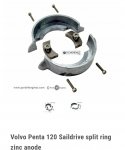
Whilst on the subject of 120SD anodes and corrosion. Has anyone tried one of the two part kits as sold below. Did the fittings provide sufficient conductivity to allow them to work well and how good were the anodes themselves?

I know it's not too hard removing the propeller but being able to change the anode quickly during a summer lift, scrub and launch might be less of a rush.

Volvo Penta 120 Saildrive split ring zinc anode

20211111_132802.jpg
 
While convenient to change, they have considerably less bulk than the one piece anode so potentially shorter life. Been around for a while, but never really caught on. could well be more difficult to ensure continuity because the screws only go through the anode rather than through the lugs as well on the 2 piece 130 type - which also have more than twice the bulk.
 
It all depends how much shorter life.

Mine last two years before I swap them out. They would probably even do another year or two.

If these did two years then swapping then would be a while lot quicker anyway ( and less worry about the prop coming off afterwards)... I just can't quite bring myself to using non specific anodes :/
 
Whilst on the subject of 120SD anodes and corrosion. Has anyone tried one of the two part kits as sold below. Did the fittings provide sufficient conductivity to allow them to work well and how good were the anodes themselves?

I know it's not too hard removing the propeller but being able to change the anode quickly during a summer lift, scrub and launch might be less of a rush.

Volvo Penta 120 Saildrive split ring zinc anode

View attachment 125655
I tho About given them a go as I could change while in the water , but as yet not got around doing it
 
If you have a folding Volvo prop it would be (it is) inordinately difficult in the water to remove the prop, remove the standard one piece anode and replace the prop - nightmare comes to mind. It would be even more difficult to be sure that the various locking bolts, the little Allen bolts that secure the stainless shafts, and the 2 interlocking nuts and tab washer on the shaft itself - I'd say don't even think about it unless you are desperate. Loctite will set off underwater - but you would never be sure that the Loctite had not washed off before or as you re-assembled. We have done it - but it needs 2 people - one in the water and one handing each component in turn (and needs meticulous planning). It also needs to be completed in warm water - not the icy cold water of the Southern Ocean - as it takes a long time. It is not difficult to guess how we know. With 300mm tides off Tasmania's west coast drying out is not possible.

To me the 2 part anode is the way to go.

We have found that the shaft anode last forever (a slight exaggeration :) ) and we replace it because the 2 fixing holes seem to wear preferentially - not because the anode it self wears. The 3 part prop anodes last a good 12 months, with plenty to spare - enough for another year as long as you check toward the end of their life.

Jonathan
 
Top