At see
New Member
I am a newbie with a small motor boat (a 22' Steber "Persuader") fitted with a raw water cooled Volvo Penta 2003 and a sail drive. It think the date of inception is about 1986. It is a tidy little boat, if somewhat eccentric.
I have read with interest, verging on fascination, the very informative and perceptive posts about the raw water cooling system on Volvo Penta 2000 series and in particular 2003. I think that I have it cracked as to how it is intended to work.
I had mine scream "overheating" at me the other day. The pipe from the thermostat dome to the exhaust mixer was very hot. Backing off revs settled everything down. Water was blowing and not particularly hot. No steam was blowing.
I assumed a blockage in the water distribution pipe was somehow involved, because. first, the water pipe at the back of the block to the exhaust mixer was cold and did not become hot until the motor was off. and, second, the very hot external pipe from the thermostat dome to the exhaust mixer, which seemed to suggest a lot of work in that area.
First question: Does the bypass pipe from the end of the distribution pipe to the exhaust mixer ordinarily stay cold/cool in operation, before, or after, the thermostat opens?
As an aspect of that question, I am puzzled as to where the water fed into the distribution pipe goes once it is sprayed onto the injectors/cylinders if the thermostat is closed until 60 degrees is achieved and the second pipe is opened, and that water is not apparently going out the bypass pipe at the end of the block (which is remaining cool). Is this issue all in my head?
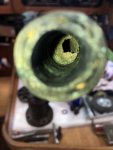
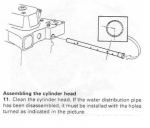
I disconnected the water feed pipe/port connection to the block and the bypass pipe from the block to the exhaust mixer and put a probe through the water distribution pipe (a Russian, Belarus tractor, dip stick...but that is another story) to check for a blockage. No apparent significant blockage. I blew into all the ports up to and including the exhaust mixer and got no apparent resistance. I have not yet used vinegar, or whatever, treated the distribution pipe to clean the holes in it, if they are blocked. That doesn't appear likely given that the motor is blowing water from start and the thermostat to exhaust mixer pipe remains cool for some time and then heats up, which, I assume, shows the thermostat is working in a conventional way, as is any earlier cooling mechanism (ie the distribution pipe).
Then I opened the drain valve at the bottom back of the block and got... nothing. It was literally dry on being removed. After I removed it I probed inside. Viscous muddy goop to an unknown depth! So the next stage step is to address removing the goop.
Second question: I assume that removing the goop adjacent to the valve is just a step towards opening the water cooling galleries in the block that are presently blocked or, at best, not functioning optimally. Can a "bottom up" solution work, ie just cleaning out the bottom chamber as aggressively as possible, or is a top down approach also needed, ie coming in through the distribution pipe and/or the thermostat port with some chemical weapon against goop.
Third question: can anyone identify where there is a diagram of where the water galleries are in a Penta block? That may give some clues as to how to probe mechanically or chemically.
I appreciate that anyhting to do with a Penta is a mixture of serious engineering and chemistry mixed with pure magic, but any thoughts would be appreciated.
Cheers,
At see
I have read with interest, verging on fascination, the very informative and perceptive posts about the raw water cooling system on Volvo Penta 2000 series and in particular 2003. I think that I have it cracked as to how it is intended to work.
I had mine scream "overheating" at me the other day. The pipe from the thermostat dome to the exhaust mixer was very hot. Backing off revs settled everything down. Water was blowing and not particularly hot. No steam was blowing.
I assumed a blockage in the water distribution pipe was somehow involved, because. first, the water pipe at the back of the block to the exhaust mixer was cold and did not become hot until the motor was off. and, second, the very hot external pipe from the thermostat dome to the exhaust mixer, which seemed to suggest a lot of work in that area.
First question: Does the bypass pipe from the end of the distribution pipe to the exhaust mixer ordinarily stay cold/cool in operation, before, or after, the thermostat opens?
As an aspect of that question, I am puzzled as to where the water fed into the distribution pipe goes once it is sprayed onto the injectors/cylinders if the thermostat is closed until 60 degrees is achieved and the second pipe is opened, and that water is not apparently going out the bypass pipe at the end of the block (which is remaining cool). Is this issue all in my head?
I disconnected the water feed pipe/port connection to the block and the bypass pipe from the block to the exhaust mixer and put a probe through the water distribution pipe (a Russian, Belarus tractor, dip stick...but that is another story) to check for a blockage. No apparent significant blockage. I blew into all the ports up to and including the exhaust mixer and got no apparent resistance. I have not yet used vinegar, or whatever, treated the distribution pipe to clean the holes in it, if they are blocked. That doesn't appear likely given that the motor is blowing water from start and the thermostat to exhaust mixer pipe remains cool for some time and then heats up, which, I assume, shows the thermostat is working in a conventional way, as is any earlier cooling mechanism (ie the distribution pipe).
Then I opened the drain valve at the bottom back of the block and got... nothing. It was literally dry on being removed. After I removed it I probed inside. Viscous muddy goop to an unknown depth! So the next stage step is to address removing the goop.
Second question: I assume that removing the goop adjacent to the valve is just a step towards opening the water cooling galleries in the block that are presently blocked or, at best, not functioning optimally. Can a "bottom up" solution work, ie just cleaning out the bottom chamber as aggressively as possible, or is a top down approach also needed, ie coming in through the distribution pipe and/or the thermostat port with some chemical weapon against goop.
Third question: can anyone identify where there is a diagram of where the water galleries are in a Penta block? That may give some clues as to how to probe mechanically or chemically.
I appreciate that anyhting to do with a Penta is a mixture of serious engineering and chemistry mixed with pure magic, but any thoughts would be appreciated.
Cheers,
At see


 . Topped it up a few times and then assembled the engine less thermostat and anode before running the engine in gear for 30 minutes. Lots of white stuff dissolved stuff came out of the exhaust. Refitted a new anode and the old thermostat and again ran for an hour in gear. Now this is quite aggressive treatment, so its your choice if you go down this route. VP used to sell a slightly weaker cleaner to do the same thing.