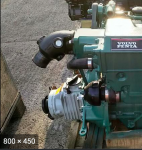
Volvo MD22 White smoke from engine

benduncan72

New Member
Joined
2 Jul 2021
Messages
2
Visit site
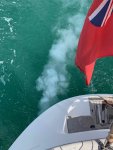
Hi. Ive just bought a boat with a Volvo MD22 engine in it. It runs very well. No alarms go off. However after a period of running white smoke comes from the exhaust that concerns me. This does not happen at start up only when it reaches temperature and is under load of approx 1000 rpm. Additionally the engine bay feels very hot. The engine is 21 years old and has had light use and has been serviced annually. She's been out of the water for two years but had a full service prior to launch and has had a long delivery passage (36 hrs) motor motorsailing.
I have attached a photo to illustrate. Any thoughts or advice would be greatly appreciated. Many thanks in advance.
 

Attachments

  • IMG_2319.jpeg
    IMG_2319.jpeg
    658.3 KB · Views: 28
Smoke - or steam? Smoke is persistent, it drifts off into the distance. Steam evaporates and is gone a few yards away. Which is it?

White smoke signals unburned fuel, unlikely to appear after an engine reaches operating temperature and only at certain RPM. Unlikely - not impossible.

Steam however can only occur when an engine is hot or hot-ish, and if it only does this at 1000RPM it implies a lack of cooling water flow. If it clears at higher revs I'd suspect the impellor is worn/damaged and can't shift much water at low revs but manages - just - at higher speeds. Is there a healthy flow of cooling water from the exhaust? If not check weed-trap, impeller and water inlet/seacock ( for obstructions/barnacles inside ) in that order for ease of effort.
If there is healthy flow from the exhaust it's possibly the exhaust elbow coked up.

But my money is on a choked weed-trap (checked at a glance) or much more likely a worn impeller these are also the easiest to detect and to fix.
 
Smoke - or steam? Smoke is persistent, it drifts off into the distance. Steam evaporates and is gone a few yards away. Which is it?

White smoke signals unburned fuel, unlikely to appear after an engine reaches operating temperature and only at certain RPM. Unlikely - not impossible.

Steam however can only occur when an engine is hot or hot-ish, and if it only does this at 1000RPM it implies a lack of cooling water flow. If it clears at higher revs I'd suspect the impellor is worn/damaged and can't shift much water at low revs but manages - just - at higher speeds. Is there a healthy flow of cooling water from the exhaust? If not check weed-trap, impeller and water inlet/seacock ( for obstructions/barnacles inside ) in that order for ease of effort.
If there is healthy flow from the exhaust it's possibly the exhaust elbow coked up.

But my money is on a choked weed-trap (checked at a glance) or much more likely a worn impeller these are also the easiest to detect and to fix.


Thanks so much for the thoughts...
I think it's more steam than smoke as it does dissapate fairly quickly. It gets worse at higher revs and only appears slightly at lower revs. There is a healthy flow of cooling water at all times. the impeller is new, the water filter is clean and I'll check it again and the sea cocks are all composite and brand new.
I did get a burst hose that comes off the heat exchanger and into the exhaust. The water pressure coming from that burst hose was quite high pressure. The hose is original so it may have just worn out?
I'll take a look at the exhaust elbow - is that fairly straight forward?
Thanks again.
 
if your thermostat is stuck your engine might be over heating despite the full sea water flow.

There shouldn't a lot of pressure in the hose connected to the exhaust. I'd check the water injection connection to the exhaust as well.
 
Pyrojames makes a good additional point but that burst hose sounds likely to be connected. Even so, thermostats are designed to fail safe - ie open so you'd expect the engine to run cold, not overheat if it fails.

High pressure in the hose between the heat exchanger and the exhaust is not normal (but does imply the water pump is good) - that outlet should flow pretty freely into the exhaust which suggests even more strongly that you have a coked up exhaust elbow restricting cooling water flow.

Exhaust elbow removal - easy? Depends largely on access. Bolts can get badly corroded and be hard to remove but I'm not a Volvo person so I'd wait until someone who is comes by with the correct info. But as a general principle I'd expect the metal of any elbow to be just cool enough to touch all around its circumference where it meets the rubber exhaust hose. If it's scorchio or varies much there's likely to be a problem inside.

Four nuts to undo by the looks of it, plus two hoses but Volvo experts will be along to help I've no doubt.


Screenshot 2021-07-02 at 15.05.22.png
 
Last edited:
I'm no engineer, but that's not a lot of water (as steam) coming through so (IMHO) it's going to be one, two or all three of:

1) Impellor
2) Heat Exchanger (which if the impellor has lost some vanes is also going to be a problem, potentially, as the vanes will be somewhere in or near the heat exchanger)
3) Exhaust bunged up.

Boats eh? Who would have one?
 
Another clue may be being out of the water. When the engine was first started the impellor ran dry and failed......
 
Almost certainly the exhaust elbow is coked up. Buy stainless for longevity or standard cast if beer tokens thin on the ground. Both available from Parts4engines, the standard exhaust elbow is listed under the Perkins M50 parts (same engine, give or take).
 
I'm no engineer, but that's not a lot of water (as steam) coming through so (IMHO) it's going to be one, two or all three of:

1) Impellor
2) Heat Exchanger (which if the impellor has lost some vanes is also going to be a problem, potentially, as the vanes will be somewhere in or near the heat exchanger)
3) Exhaust bunged up.

Boats eh? Who would have one?
Another clue may be being out of the water. When the engine was first started the impellor ran dry and failed......

In order...

1 & 4). No, that's LOTS of sream where there should be none. Firstly it's not the impellor(sic). Impeller is fine as high pressure is reported at heat exchanger outlet. Nothing else can create that pressure.
2). No. If heat exchanger is blocked by debris (despite impeller providng high pressure) then again, how is there high pressure at the outlet - downstream of the theoretical blockage?
3). 'bunged up" exhaust? A fair point - the interior of exhaust hoses has been known to separate from the body of the hose and collapse to constrict the bore severely. That is certainly something to eliminate but comes at the same stage as removing exhaust elbow. It is uncommon but not unknown. If the elbow proves clean I'd certanly check the bore of the exhaust all the way to the transom next.
 
The water elbows rot quite well, the stainless ones are very nice, about 60 quid.
Ex elbow and water elbow both easy to remove.

When was cambelt last done?
 
Top