Volvo MD2020 - Head removal advice needed

Agree, but I reckon the white smoke he's seeing is mainly un-burnt diesel due to poor combustion (maybe with a bit of oil smoke mixed in).

No it isn't.

Black smoke = unburnt fuel
Blue smoke = oil is being burned
White is more often steam, but it can be other things.
 
Black smoke - carbonised/partially-burnt diesel
White smoke - un-burnt diesel.

I took a sample of the exhaust water, I couldn't detect any presence of diesel in either by touch or by smell. hard to describe the smell, but the best I can liken it to is a slightly burnt bbq smell. My old MD2B used to have lots of unburnt diesel, in a following wind it was very unpleasant and used to leave a residue everywhere, including me. If it was unburnt diesel i'd recognise it.
 
Black smoke - carbonised/partially-burnt diesel
White smoke - un-burnt diesel.

Yes to the black smoke, it's from an overly rich fuel air mix. The white smoke (rather than steam) certainly can be unburnt diesel. A failed injector can cause huge clouds of white smoke, depending on the failure mode.

Worth noting though, Garys engine has new injectors and a new fuel pump, as part of last years engine rebuild, plus the injection system was professionally checked last week. Also worth noting (again) it had the head rebuilt as part of last years work, which included valve stem seals. Also, (again) valve stem seals will not cause any one of the symptoms that Gary has.

** Note, i have not been professionally involved with Garys engine, either during the rebuild or its current problems.
 
Yes to the black smoke, it's from an overly rich fuel air mix. The white smoke (rather than steam) certainly can be unburnt diesel. A failed injector can cause huge clouds of white smoke, depending on the failure mode.

Worth noting though, Garys engine has new injectors and a new fuel pump, as part of last years engine rebuild, plus the injection system was professionally checked last week. Also worth noting (again) it had the head rebuilt as part of last years work, which included valve stem seals. Also, (again) valve stem seals will not cause any one of the symptoms that Gary has.

** Note, i have not been professionally involved with Garys engine, either during the rebuild or its current problems.

I get all that, but you're still missing the point. The smoke is not the problem, but simply a consequence of another problem.

The reason for the lumpy idle and lack of revving is due to lack of or incomplete combustion. This is what is causing un-burnt fuel in the exhaust and hence the white smoke.

What he needs to get to the bottom of, is why he has poor combustion.

I doubt that the problem has anything to do with the fuel system.
 
Last edited:
I get all that, but you're still missing the point. The smoke is not the problem, but simply a consequence of another problem.

Seriously ? That's a bit like saying falling off the cliff wasn't the problem, the sudden stop at the bottom was. Of course the root cause of the problem needs addressing. Correctly identifying and understanding the symptoms go a long way here.

The reason for the lumpy idle and lack of revving is due to lack of or incomplete combustion. This is what is causing un-burnt fuel in the exhaust and hence the white smoke.

You assume it's smoke, not steam/vapour.

What he needs to get to the bottom of, is why he has poor combustion.

He needs to consider all of the symptoms and to take into account things that can easily be ruled out.

I doubt that the problem has anything to do with the fuel system.

Fuel is the least likely thing in this case, considering the evidence. New fuel tank, new Racor filter, new lift pump, new injector pump, new injectors and a professional check last week. Cross fuel off of the list.

Glow plugs - If someone can explain how glow plugs cause raised compression and water in the oil, i'm up for some new glow plugs. They can't, so cross them off the list too.

Valve stem seals - Early signs of failure are blue smoke on initial start, clearing after a short time. Really bad ones can cause blue smoke while the engine is running, but rare. Gary has no blue smoke and the valve stem seals in his engine are nearly new. Additionally, valve stem seals will not cause any one of his other symptoms. I'm crossing those off of my list.

Head gasket - Water in the cylinders will cause excessive compression, poor starting when cold, steam from the exhaust but one might expect some coolant loss. A failed gasket could also let some coolant into the oil, again expecting some coolant loss, although there is only a very small amount of water in the oil, could even be condensation. This is still a possibility, IMO.
 
Last edited:
It won't be steam from a stone cold engine and exhaust. Any water vapour from the engine would condense in the exhaust.

It could well be a bit of water/moisture in the cylinders that is causing the lack of combustion and hence the white smoke, but going back to the start of the thread, my advice would be:-

First - check the glowplugs (cheap and easy to do)
Next - check the engine breather circuit (cheap and easy to do)
If neither of those have an effect, get the head off and have a look inside.
 
+1, would like to know when & how the timing jumped a tooth... prepare for the third option and don't forget the torque wrench

First - check the glowplugs (cheap and easy to do)
Next - check the engine breather circuit (cheap and easy to do)
If neither of those have an effect, get the head off and have a look inside.
 
Last edited:
It won't be steam from a stone cold engine and exhaust. Any water vapour from the engine would condense in the exhaust.

It could well be a bit of water/moisture in the cylinders that is causing the lack of combustion and hence the white smoke, but going back to the start of the thread, my advice would be:-

First - check the glowplugs (cheap and easy to do)
Next - check the engine breather circuit (cheap and easy to do)
If neither of those have an effect, get the head off and have a look inside.

+1, would like to know when & how the timing jumped a tooth... prepare for the third option and don't forget the torque wrench

Can either of you explain how glow plugs are causing excessive compression, a rise in diesel knock and water in the oil ?

Can either of you explain how the crank case breather is causing excessive compression, a rise in diesel knock and water in the oil ?
 
It won't be steam from a stone cold engine and exhaust. Any water vapour from the engine would condense in the exhaust.

It could well be a bit of water/moisture in the cylinders that is causing the lack of combustion and hence the white smoke, but going back to the start of the thread, my advice would be:-

First - check the glowplugs (cheap and easy to do)
Next - check the engine breather circuit (cheap and easy to do)
If neither of those have an effect, get the head off and have a look inside.

That sounds like a sensible plan ............... do the easy things first ... leave the more complicated and expensive things 'til last

I believe the crankcase breathing is via internal passages. No PCV or even external hoses, but consisting of an internal passage in the valve cover which runs from the valve/rocker arm side of the valve cover into the inlet tract side of the cover.
The gasses pass through a wire mesh filter which acts as a simple oil separator before entering the inlet air flow.

Obviously check these passages are clear and unobstructed, and clean the filter assuming this information is correct
 
Last edited:
That sounds like a sensible plan ............... do the easy things first ... leave the more complicated and expensive things 'til last

I believe the crankcase breathing is via internal passages. No PCV or even external hoses, but consisting of an internal passage in the valve cover which runs from the valve/rocker arm side of the valve cover into the inlet tract side of the cover.
The gasses pass through a wire mesh filter which acts as a simple oil separator before entering the inlet air flow.

Obviously check these passages are clear and unobstructed, and clean the filter assuming this information is correct

Same question to you then :

Can you explain how glow plugs are causing excessive compression, a rise in diesel knock and water in the oil ?

Can you explain how the crank case breather is causing excessive compression, a rise in diesel knock and water in the oil ?

An extra one for you, can you explain how a blocked crankcase breather filter will cause any of Garys symptoms ? Might also be worth explaining how the filter can be blocked, without the engine exhibiting any of the usual symptoms of having a blocked breather ?
 
Can either of you explain how glow plugs are causing excessive compression, a rise in diesel knock and water in the oil ?

Can either of you explain how the crank case breather is causing excessive compression, a rise in diesel knock and water in the oil ?

We have to take someone's word about the compressions, and as far as water in the oil is concerned, it could be a number of things. All we do know for sure is that it runs lumpy and smokes on cold start, so the advice is to look at the cheap and easy things that might cause this first before stripping the engine apart.

I once had a "marine engineer" tell me that I had a blown head gasket or cracked head due to coolant loss and excess pressure in the expansion tank and suggested I might want to consider a new engine (he just thought "coolant loss + pressure in the tank = head gasket, cracked head, or cracked block"). I sent him away.

It turned out that the coolant loss was due to a £4 rubber seal gone in the header tank, and the excess pressure was due to a blocked engine breather.

So what would have cost me £10k+ had I listened to him, ended up costing me £4 and took me about an hour to sort (once I'd actually found the cause of the problem, which took a while).

ALWAYS do the cheap and easy things first.
 
Last edited:
Is the compressions high on all cylinders?
Also when you start the engine and its running lumpy you could crack open the injectors one at a time to see if the engine is only running on two cylinders on start up. It would narrow the fault to a particular cylinder, then take it from there.
 
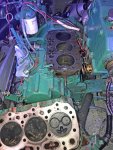
After checking the glowplugs (all OK), the head came off on Saturday.

md2020b-head-gasket-2.jpg


md2020b-head-gasket-1.jpg


Two problems, head gasket gone, and evidence of water in cylinder 3, presumable having entered via the exhaust.

So head off to be skimmed and will research how to improve the exhaust to eliminate any possibility of back flow.
 

Attachments

  • md2020b-head-gasket-1.jpg
    md2020b-head-gasket-1.jpg
    420.2 KB · Views: 4
After checking the glowplugs (all OK), the head came off on Saturday.

md2020b-head-gasket-2.jpg


md2020b-head-gasket-1.jpg


Two problems, head gasket gone, and evidence of water in cylinder 3, presumable having entered via the exhaust.

So head off to be skimmed and will research how to improve the exhaust to eliminate any possibility of back flow.
And there is your prob! In your pm you say the waterlock is 2 mtrs away from the engine! One of the points of the waterlock is to collect the raw water backflow if the rubber exhaust pipe is not empty when the engine stops. All the instructions for them say that you should size them so that they are bigger than the capacity of that exhaust pipe! I hate to say this but if the system has been like this all along then your previous probs could have been caused by this.
 
After checking the glowplugs (all OK), the head came off on Saturday.

md2020b-head-gasket-2.jpg


md2020b-head-gasket-1.jpg


Two problems, head gasket gone, and evidence of water in cylinder 3, presumable having entered via the exhaust.

So head off to be skimmed and will research how to improve the exhaust to eliminate any possibility of back flow.
The raw water has not been blown out completely from the exhaust pipe, no water lock close to the engine to collect the backflow, it then backflows and some goes in number 3 and the when you turn the engine over it hydraulics and busts the head gasket etc etc.
Get some one to check the flatness of the head, it may not need skimming. Then put the water lock immediately below the exhaust elbow and then make sure you have an antisyphon loop higher than your exhaust elbow just before it exits the boat. If the waterlock wont go below the elbow then you may have to make a high rise elbow or buy one.
 
Last edited:
We have to take someone's word about the compressions,

Rather than take the word of the specialist that looked at the engine Gary should discount it an follow some random suggestions from some nameless blokes from the internet ?

I once had a "marine engineer" tell me that I had a blown head gasket or cracked head due to coolant loss and excess pressure in the expansion tank

Very simple job to carry out a test that would determine, without doubt, whether or not combustion gases are present in the coolant.

ALWAYS do the cheap and easy things first.

Much more effective to check think that might actually be causing the problems.

FYI, i called in on Gary Saturday morning and had another look around his engine. Just to put an end to the silly notion that his problem was glow plugs, i tested them. Guess what the result was ?
 
Last edited:

Other threads that may be of interest

Top