Volvo 2000 series Raw water cooling

karlfaeunst

New Member
Joined
26 Jul 2012
Messages
7
Visit site
Can anyone tell me exactly how the raw water cooling works on a volvo penta 2002?

I understand that the water is bypassed to the exhaust until the engine reaches a certain temperature. The thermostat then opens and some of the water is directed to the head to cool the engine, which then comes out of the top of the TS housing and along the exposed pipe to the other exhaust elbow connection.

What I don't understand is how this happens? The water enters the engine at the front of the block just below the thermostat and goes directly through the block to the exit pipe which is connected to the elbow. It looks like the the thermostat opens and blocks a hole when the engine is up to temperature which somehow forces the water through the engine.

During winterising it is said that you should run the engine with the thermostat removed to ensure that that water is passing through the block. However, if the thermostat has to be in the open position to block a hole then how can removing it make the passage of water take the route it would take when the TS is open?

It's probably very simple but I just can't figure out exactly what's happening, doe's anyone have any drawings or know how to explain it?
 
The cooling water goes into the cylinder head at the front, and into a distribution pipe. This pipe runs through the head and has holes to allow water to flow out at different angles. When the engine is cold, the water can't escape from the block, so just passes through the distribution pipe and into the exhaust elbow. When the engine heats up, the thermostat opens, allowing hot water out of the head - this water is then piped to the exhaust elbow. There's enough resistance in the pipework to ensure that the positive pressure of the seawater pump forces cool water out of the holes in the distribution pipe once the thermostat opens.

The thermostat has to be removed for winterising, otherwise the antifreeze mixture wouldn't get into the water jackets, it'd just go straight through the distribution pipe and out into the exhaust.

Here's a (fairly poor) diagram from the VP workshop manual...

volvo2000seriescooling_zps84f87031.jpg
 
pvb's explanation would seem to be correct but I have been unable to find the perfect explanation. I posted the question a few weeks back and have had some correspondence with people who service these engines for a living but have yet to hear the perfect explanation. The problem as I see it is that the pump is a positive displacement type, whose discharge cannot be throttled. Therefore the bypass has to be sized for the maximum flow of the pump, and the pipework resistance described by pvb does not exist. It is very difficult to believe that the system resistance through the perforations, block, thermostat and external pipe (and calorifier coil, if fitted) is lower than straight through the bypass and around the two 90 degree bends.
 
Yes PVB's explanation does make sense, the discharge hole at the elbow for the bypass pipe is only about 2-3mm diameter which would cause the pressure difference. If the thermostat was blocking the hot water escape path from the head when it was closed, and opened it when it was open, then the cooling water would be diverted through holes in the bypass pipe to the engine, as this would probably be the path of least resistance. Provided that nothing is silted up or blocked with salt and calcium.

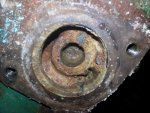
The thing that baffles me is that when the thermostat opens it would appear that the plunger actually blocks a passage to divert the flow of water. Attached is a photo looking down into the engine below the thermostat housing. It looks to me that when the thermostat opens it blocks that center hole, when it's closed I can't see how it's blocking anything. You would think that by removing it to winterise you are actually preventing the blocking of that hole which would prevent the water from being pushed through the engine block?

As you can see I need to do some serious descaling on my engine :eek:


20130325_163135.jpg
 
Any updates? I assume PVB is correct, and when the engine is warm enough, there are two flow paths and the thermostat opens the flow through the block, and out through the upper pipe.

My question is does the water flow rate out of the exhaust change significantly with a warm engine?
Another question- the PO left two water pump gaskets. One was 0.2mm thick and thew other was 0.4mm. I fitted the 0.4mm. Should it matter?
 
Last edited:
Any updates? I assume PVB is correct, and when the engine is warm enough, there are two flow paths and the thermostat opens the flow through the block, and out through the upper pipe.

My question is does the water flow rate out of the exhaust change significantly with a warm engine?
Another question- the PO left two water pump gaskets. One was 0.2mm thick and thew other was 0.4mm. I fitted the 0.4mm. Should it matter?

Since this thead is 10 years old then I'd be surprised if the OP replies :D.

It doesn't matter if the thermostat is open or closed, eventually all the cooling water goes out the exhaust, its just a matter of which route it takes..
Not sure about the gasket.
 
My own engine did have a thermostat, and the way it was 'plumbed' meant that the flow through the exhaust was unchanged by the engine temp. I imagined it as being that the thermostat wasn't a switch, but was an always open valve with the biggest leak being temperature variable: when cold, the cooling water was mostly going one side of the thermostat to the exhaust. When up to temperature, the water was predominantly going around the engine. The flow past the thermostat being the same.
My engine wasn't Volvo, but I'd imagine that it wasn't too different.
My answer's a long version of Ceirwan's, and I do hope that it helps. (y)
 
When I do a theoretical pumping system analysis it gets complicated. If the pump was a true positive displacement type, then the flow should be constant and just the pressure change when the thermostat opens. A drooping flow/ pressure curve gives me a changing total flow when the thermostat opens. But not much at a constant speed. Change the speed and the effect is easily masked. Theoretical stuff for old engineers....
 
Last edited:
On the Bukh direct cooled engine the thermostat operation has two actions, when cold the water is kept in the block and the water pumps .through the bypass, as the thermostat opens the water flows out of the block and at the same time the bypass is restricted by the thermostat, At full temperature with the thermostat fully open the bypass is closed. In operation the thermostat will fluctuate with temperature and allows more or less water to flow from the block and regulates the flow of the bypass. Very clever, very little to go wrong. Like all Buhk spares the thermostat is very expensive, it looks much like any thermostat, but perhaps the rate of Opening/Closing is more controlled.
 
The Bukh system makes more sense. I guess Volvo were trying to use generic components to keep the cost down. Would be a good solution if I had access to the back of the engine to clear flow blockages.
 
The Bukh system makes more sense. I guess Volvo were trying to use generic components to keep the cost down. Would be a good solution if I had access to the back of the engine to clear flow blockages.

You don't need full access to the back, the cooling pipe drives out from the front and you can reach over the engine to grab it. 90% of the time, the small hole in this causes overheating in this engine.
Getting it back in might be more of an issue, it will need knocking back in.

If you've absolutely no access then your best bet is to circulate some cleaning solution through the engine, take the thermostat out, block off the bypass pipe & use a 12v pump and a bucket to circulate the solution through the block. I've had success with Rydlyme.
I used a cheap plug in tank heater from eBay to heat the solution in the bucket as it works a lot better.
 
Thanks for the encouragement. There is some access through a cockpit locker, and I will look at it next time I am on the boat. My fear is that I will get stuck with my head in the bilge, and my legs in the locker! Need a safety person to drag me out backwards. :cool: These little engines would be a breeze if you have full access, like sitting them on a workbench.

The best engine access I have ever seen was on a S&S 30 Yankee, with the engine midships, and with the covers removed, you can get to everything, right up to the point where the shaft exits the hull. Lovely!
 
Top