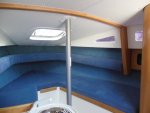
Vinyl Side Lining - plain or foam lined???

Jaguar 25

Well-Known Member
Joined
14 Nov 2012
Messages
466
Location
Liverpool
Visit site
Dr D is lined inside the cabin with vinyl side lining as well as head lining. Just removed all the side lining, not a thrilling job! Some of the lining was plain vinyl and some was foam lined. I found that a bit strange. However, the foam lined stuff made a hell of mess when it peeled off and then required a bit of effort (and more mess) to remove the remaining bits adhered to the inside of the hull.
Anyway, I was previously thinking of using foam lined vinyl as the replacement but now I am having second thoughts.
I would be interested to know what forumites recommend - plain vinyl or the foam lined version?
 
Foam lined. You will shortly be told that i am wrong and that the foam will decay and the job will need doing again and again. The latter part is true, it will need doing again and again, but at 20 year intervals.

The foam give a little insulation and stops condensation. As an example, my aft cabin has two wardrobes, side by side. One is foam backed vinyl, the other is plain vinyl. Guess which one suffers with condensation.

Another option to foam backed vinyl is to use foam, then plain vinyl. I've seen this done and it looked very neat, the owner said it was relatively easy to fit. I've just bought some to replace the vinyl behind my chart table, so i'll see.
 
I'd agree with Paul, foam-lined vinyl does offer a bit more resistance to condensation. I'd also say that foam-lined vinyl helps to even out the surface irregularities of the GRP, giving a better looking result than plain vinyl.
 
Hi Jag

When I replaced the vinyl on my old Macwester I had the same problem with broken down foam backing, I talked to a company in Bournemouth who pointed out that the foam might not be flame retardent and they offed me a vinyl backed with felt !.

The felt stuff was much better easier to glue, looked smoother and had better insulating properties.

The felt was only marginally more expensive and I would use it again if I need to do the job on my current boat.

Good luck.
 
My 35 year old boat is beginning to shed its lining. My cunning plan is to clean it well, remove the crap from the hull and cover with a close cell mat then re stick the lining.
 
What is problem not use carpet glued on instead direct to hull? No condensation, not stick to body in Summer if hot. Good for insulation too. Easy to fit.
 
My 35 year old boat is beginning to shed its lining. My cunning plan is to clean it well, remove the crap from the hull and cover with a close cell mat then re stick the lining.

I'd wondered about exactly this approach. I've tried to think if reasons why not:
Obviously, marked or damaged areas
Thickness of the new foam may mean the vinyl doesn't come far enough round to fasten
er,
 
My foam backed vinyl lasted over 40 years. Replaced last winter, but was easier by being on ply boards, so able to do most at home and fit to boat later. Use PVA instead of that horrible contact spray.
 
My foam backed vinyl lasted over 40 years. Replaced last winter, but was easier by being on ply boards, so able to do most at home and fit to boat later. Use PVA instead of that horrible contact spray.
Copydex is the stuff to use, it is.a bit like latex body paint, peels off once dry if you get it on your hands (or other places) but try not to get it in your hairy bits or clothes.
 
I recovered my cabin linings with self adhesive foam (adhesive on both sides) and then vinyl - all from Hawkehouse

The advantage is that there is no glue in confined spaces, and when fitting the vinyl you can pull it off and re-fit/finesse as you go without worrying about getting messy glue on the finished faces

The foam has a cover which you peel off in sections and activate the glue with a hot air gun, or hairdryer
 
I recovered my cabin linings with self adhesive foam (adhesive on both sides) and then vinyl - all from Hawkehouse

The advantage is that there is no glue in confined spaces, and when fitting the vinyl you can pull it off and re-fit/finesse as you go without worrying about getting messy glue on the finished faces

The foam has a cover which you peel off in sections and activate the glue with a hot air gun, or hairdryer
I had a look at their offerings at the Boat Show and decided I needed a few more mm of insulation.
 
I would also recommend double sided sticky back foam from Hawk House + pain vinyl.


easy to fit, no glue, and the foam is totally different stuff.
 
I have just used a combination of foamex pvc board (and some lining carpet) which, depending on the nature of the surface, can either be attached as panels with trim strips or, as in my case, moulded using a heat gun around the curves and attached either with velcro or screws. It has a matt white finish, is lightweight, easy to cut and if insulation is required, then adhesive foam/foil can be glued on the surface first. Worth noting that for moulding to compound curves it isn't really the answer!
 
Our Boat has vinyl covered plywood cabin and under deck linings. There were massive cold voids behind them that encouraged any condensation to form on the underside of the GRP Cabin or decks and then run down the inside of the plastic inner linings.

This is more noticeable as we come into autumn and have less ventilation open. I have recently lined these voids in the main cabin with a combination of spray on contact adhesive and aluminium bubble wrap type foil insulation. The foil insulation can be cut into small pieces to fill any voids then larger pieces with in my case up to 4 four layers of 6mm being fitted under the linings. The thin aluminium foil insulation is claimed to have the same insulation properties as 55mm of expanded polystyrene foam sheet.

I also used closed cell foam in a can to fill any inaccessible voids behind plastic inner liners.

I was wondering about removing the foam backed vinyl liner behind the bunks and using a layer of this material before refitting the vinyl.
 
Last edited:
Top