Vibration; and what coupling is this?

jcpa

Well-Known Member
Joined
15 Sep 2009
Messages
96
Location
The boat (Kelt 8.50) - at Gosport
Visit site
On my recent fortnight cruise, my Yanmar 2GM started vibrating more and more, so I ran it sparingly and at ever slower speeds until I got back to my home port and had the chance to investigate. I assumed it would be an alignment problem – partly because I found the top nuts on the mounts had become loose. The mounts themselves seem OK; the rear mounts do seem to be starting to come unstuck, but the main rubber pads ARE still fixed to the steel plates and I can still get my little finger between rubber and steel at the top.

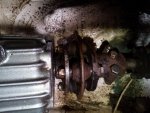
But I was surprised to find a flexible coupling between the gearbox and propshaft flanges, along with clear misalignment. I can’t find details of this flexible coupling, or how it should be set up, so I attach two pictures.20140919_113142.jpg20140919_113758.jpg
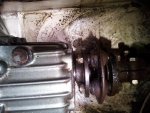
The coupling comprises four rubber donuts held on a ring, each donut having a metal core and a through bolt which connect the gearbox and propshaft flanges. The pictures do suggest that the bolts are tightened by different amounts, and that they are slack at the bottom of the coupling (furthest from camera). Does anyone recognise this coupling, and know if I can get new parts? The donuts do seem quite worn.
I have discussed my basic vibration problem with different engineers and agents, and they have said small misalignment is OK with a flexible coupling. However, I decided to try and minimise the misalignment anyway, and began by removing the coupling so I could get a clear view of the distances top and bottom. Sliding the disconnected propshaft up towards the gearbox flange suggested there was about 1mm misalignment – just from top to bottom (I’d need to make a suitable packing piece to get a better figure).
Looking at the engine mounts, I saw that the nuts that set the height on the front mounts were as low as they would go (and the top nuts on the other/top side of the mounting brackets were only finger tight). It seems to me that the nuts have simply wound themselves down under gravity and vibration. Screwing them back up (while leaving the rear mounts as they were) has tilted the engine more, and brought the two flanges into eyeball alignment (the 1mm step has gone).
Re-inserting the flexible coupling, the bolts all slip in nicely (they were a bit skew before), but I don’t know how tightly to do up the Nulock nuts: tight doesn’t seem good (no real flexibility), so I’ve backed them off about half a turn. The engine runs and maybe vibrates less, but I’ve only been able to test it at low throttle so far, when tied up alongside.
One engineer has suggested that the vibration is probably due to prop or shaft damage, or even catching a rope. I should investigate that before worrying about misalignment? A DIY check of alignment seems a simpler and cheaper first step to me, but I expect to be off to a drying grid next!
Meanwhile, any comments on my flexible coupling would be much welcomed.
 
I was mid-Adriatic passage a couple of months ago when I felt an unusual vibration on one engine at certain revs.

I played around with forward and reverse and tried different revs but nothing made any difference. It wasn't too bad at certain revs and the drive from the prop seemed fine but at other revs it felt like it would shake the boat to bits! I decided it must be the engine mountings which had failed and decided to use just the port engine.

When we were anchored the next day I swam under the boat - being a cat the saildrive props are easily accessible with a mask - and there was a very small piece of fine plastic netting, the sort that fruit at the supermarket sometimes comes in, wrapped around the prop. Probably only nine inches square.

Once pulled off the prop, everything was fine.

I cannot really believe that a small light piece of fine netting could unbalance the prop so much.

Certainly worth checking.

Richard
 
I have a coupling which looks like a double version of yours on my boat. Originally supplied by Sillette the out drive folks. As mentioned by Scottie probably a Metalastic. Sillette say these are no longer available. The ones they supply now are made from flexible plastic / nylon type discs, as apposed to rubber donuts bonded onto metal discs. I think the older Metalastic ones are better.

Big gripe I have with both old and new type is that the out drive has to be unbolted or the engine moved forward to change the coupling. Not an ideal situation. Due to the very soft Yanmar engine mounts and the flexibility of the coupling / couplings, lining up engine to out drive can be a bit of a fiddle to say the least.

Hope you can sort it.

Bob
 
Here's a picture of the flexible coupling on a Yanmar 2GM20. It's the newer plastic version and may be an idea if the donuts have gone on yours. It's an R&D Marine flexible coupling.

IMGP0332.jpg
 
Last edited:
Didn't early Mini drive shafts have this type of flexible coupling? ( I mean the rubber doughnuts)
May be a standard size.
 
The R&D coupling shown by ghostlymoron is like what I had installed on my previous two boats (Vivacity and Centaur). That flexible disc is easy to set up and always gave a trouble-free performance. Should the OP be considering a replacement for the one in his picture, this is one that I would heartily recommend.

Unfortunately for me there is not enough room to fit one on my present boat but, should I ever need to re-engine, that is what I would certainly install.
 
I can't see how that coupling ever did anything but take up space! If I understand correctly, there are two four hole flanges either side and a central disc with four bushed sleeves in it. With four bolts through the holes, the "bushed coupling" is no more than a spacer - tighten up the bolts and it's solid. For it to be effective, two bolts should go to the gearbox flange and the other two to the propshaft flange, so that the rubbers around the sleeves can articulate independantly. Mind you, there are those (such as Volvo) who do not like a flexible coupling if the engine is on flexible feet - it offers too many places for everything to wander off to.

Aligning the engine to the shaft is quoted by the engine manufacturers as being to a matter of less than ten thou! Assuming the shaft seal is on a flexible hose, it is not that critical, but you have to guess where the central position is. Basically, you need to shift the engine around in three dimensions untill the two flanges are parallel. Leave the bolts loose and work at it until you get no significant difference in gap between the flange and the spacer (feeler guages) It is actually best done whilst afloat to ensure the different way the boat's weight is supported doesn't temporarily warp her so your efforts are wasted. You'll find that three dimensional geometry will do your head in!

Rob.
 
I've never done engine alignment but there's a good method in Pat Manley's book 'Simple Boat Maintenance'. Sounds simple enough in theory but in the confines of the average engine room it's probably quite difficult unless you've got good access to the coupling and the mountings. Good luck!
 
I can't see how that coupling ever did anything but take up space! If I understand correctly, there are two four hole flanges either side and a central disc with four bushed sleeves in it. With four bolts through the holes, the "bushed coupling" is no more than a spacer - tighten up the bolts and it's solid. For it to be effective, two bolts should go to the gearbox flange and the other two to the propshaft flange, so that the rubbers around the sleeves can articulate independantly. Mind you, there are those (such as Volvo) who do not like a flexible coupling if the engine is on flexible feet - it offers too many places for everything to wander off to.

Aligning the engine to the shaft is quoted by the engine manufacturers as being to a matter of less than ten thou! Assuming the shaft seal is on a flexible hose, it is not that critical, but you have to guess where the central position is. Basically, you need to shift the engine around in three dimensions untill the two flanges are parallel. Leave the bolts loose and work at it until you get no significant difference in gap between the flange and the spacer (feeler guages) It is actually best done whilst afloat to ensure the different way the boat's weight is supported doesn't temporarily warp her so your efforts are wasted. You'll find that three dimensional geometry will do your head in!


Rob.

Rob is absolutely correct. I've recently changed my engine like for like and kept the old metalastic coupling - I originally put the 4 bolts as in the OP's picture but it was pointed out that this was wrong and the correct way to fit is as Rob suggests.

I wonder if the OP has caught his prop on something and as effectively the prop, shaft, gearbox and engine are all one connected unit , it has all been knocked slightly off kilter ?
 
Last edited:
Thanks all

Hi all, and thanks for your comments, which have supported my thoughts, and helped me find my coupling via a further google search including metalistik: it’s the obsolete item 2 on webpage http://www.tnorrismarine.co.uk/randd.php#met (which says “contact for more information”).

I was given the “Simple Boat Maintenance” book last Christmas, and I was expecting to find a simple flange to flange connection, and to follow the feeler gauge procedure described. However, I don’t have feeler gauges up to 30mm thick! The shaft flanges are not flat (no picture I’m afraid), and the rims are still about 5mm apart when the propshaft is pulled forward such that the flange centres touch. I will need to make a suitable spacer in order to “feeler gauge” the misalignment. I have seen plastic couplings shown by ghostlymoron, and will probably get one of those – and I could probably use it as that spacer to check alignment!

Yes, I had to remove the pinch bolts from the propshaft flange to get the coupling bolts out.

I quite agree that the coupling is rigid if the bolts are fully tightened, but in the state the coupling was before I started, the bolts were obviously somewhat loose (especially when rotated to the bottom). Thus I felt OK with leaving them half a turn loose when I had eyeballed an improved alignment. As I now have it, rotating the shaft shows some small lateral movement of the propshaft (by the rubber cover section), so possibly the shaft has got a slight bend – I’ll check further when I go back to the boat this week. In any case, some flexibility in the coupling would seem advisable.

One advantage of having removed the coupling was that I could rotate the propshaft separately from the engine, and I think much of the noise if not the vibration is coming from the shaft. I’ve also remembered I did have less obvious noise from the shaft once before, which was caused by the shaft anode working loose and rattling against the p-bracket. Thus, having motored gently onto the drying grid, I am quite expecting to find a similar but worse situation. How do I stop the anode working loose as it corrodes away? Surely, smearing the anode shaft interface with sikaflex would defeat the object!

Anyway, thanks again for all your comments
 
When refitting a new anode,tighten the nuts and machine screws to the max torque allowed.Then hold a lump hammer to one side and on the opposide side tap,tap with a second,perhaps smaller hammer.After each few taps see if the nuts/screws will re-tighten slightly.When the tapping has no further result,the bedding down is complete.Some thread locking compound may help also.I'm saying this without having read the OP's link to Vyv's page on this, so I'll go there now!
 
Last edited:
Didn't early Mini drive shafts have this type of flexible coupling? ( I mean the rubber doughnuts)
May be a standard size.

All the Minis I worked on (far, far too many) had inboard couplings like Item 5 in the tnorris link given previously, a sort of rubber cross. Limited space to get the U-bolts and spanners between the sub frame and gearbox always made this job tedious.
 
Hi again

I only saw the tnorris page last night (Sunday - early hours), but I am planning to call tomorrow (Monday)!

Vyv has suggested my coupling may have been wrongly connected, but I'm not sure using two opposite bolts for each flange would work - the bolt heads from one flange would probably not be sufficiently clear of the other flange.

Thanks paulclan for that stuff on anode tightening. I've booked the drying grid for tomorrow afternoon, so should be able to check the shaft issues.

Thanks again
 
If that's the type of coupling I think it is, then it needs careful scrutiny to ensure it isn't breaking up. I've had two such incidents. The last one in part resulted in the loss of my boat.
 
Thanks for the warning Elton
There is evidence of wear to the "ends" of the donuts, and I think it is time for a replacement anyway. There is also some small evidence of rubber dust/splinters by my rear engine mounts - so maybe I should change them too.
J
 
Mind you, there are those (such as Volvo) who do not like a flexible coupling if the engine is on flexible feet - it offers too many places for everything to wander off to.

Aligning the engine to the shaft is quoted by the engine manufacturers as being to a matter of less than ten thou! Assuming the shaft seal is on a flexible hose, it is not that critical,

Rob.
Basic principle is any 2 of three can be flexible between mounts coupling and stern gland

Centralising the shaft in the flexible hose is essential and not an option to get it right
 
Hi again

Just spoken to Norris, and they say the coupling was totally wrong, and they are surprised it ever worked (but I'm not sure it did, it was just what came with the boat when I bought it 2.5 years ago!). The coupling is meant for two hole flanges, with recessed holes to take the spigots poking out of the donuts. That makes more sense to me. They say I should fit the R&D 910-002 that is specifically made for the 2GM and flanges I have.

Thanks all
 
Top