alahol2
Well-Known Member
I'll have a go...
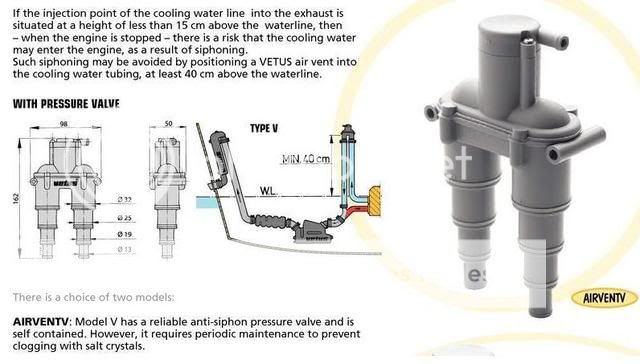
When the engine runs, water is drawn through the pump, through the anti-syphon loop, through the engine/heat exchanger and into the exhaust pipe at the exhaust mixer elbow, it is then 'blown' through the exhaust pipe and out of the transom fitting. If the exhaust mixer elbow is below water level, when the engine is stopped you have a situation where water can continue to syphon through the engine into the exhaust pipe. The exhaust pipe will fill with water (the transom exhaust exit is above the exhaust mixer elbow) and back up into the engine exhaust port, valves, cylinders!
The syphon break allows air into the top of the water column and prevents syphoning.
Incidentally, the syphon break is more commonly fitted between the cooling water outlet from the engine and the exhaust mixer elbow.
Also your exhaust pipe should have a water trap capable of holding all the water in the exhaust system (plus a bit for failed start attempts).
Hope that makes sense.
When the engine runs, water is drawn through the pump, through the anti-syphon loop, through the engine/heat exchanger and into the exhaust pipe at the exhaust mixer elbow, it is then 'blown' through the exhaust pipe and out of the transom fitting. If the exhaust mixer elbow is below water level, when the engine is stopped you have a situation where water can continue to syphon through the engine into the exhaust pipe. The exhaust pipe will fill with water (the transom exhaust exit is above the exhaust mixer elbow) and back up into the engine exhaust port, valves, cylinders!
The syphon break allows air into the top of the water column and prevents syphoning.
Incidentally, the syphon break is more commonly fitted between the cooling water outlet from the engine and the exhaust mixer elbow.
Also your exhaust pipe should have a water trap capable of holding all the water in the exhaust system (plus a bit for failed start attempts).
Hope that makes sense.
Last edited: