Valve clearance

Chris H

Well-Known Member
Joined
16 Jul 2017
Messages
614
Location
Leeds/sof
Visit site
I’ve an old MAN V8 in my tub, I’m ok with the process of adjusting the valve clearances but wondered how to get each cylinder to TDC, is there a mark on the crank pully for each cylinder ? I would imagine it’s the same procedures for most makes of engine.
 
You really do need a manual for your particular engine as some engine manufacturers seem to take great delight in making it difficult to find TDC.
Jim
 
It’s easy enough.
I did the rocker method .Found the sequence from the internet for inline 6 diesels .
V8 s ( a lot of Mack , CAT DD stateside ) also popped up in the search .
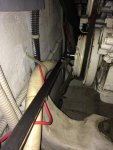
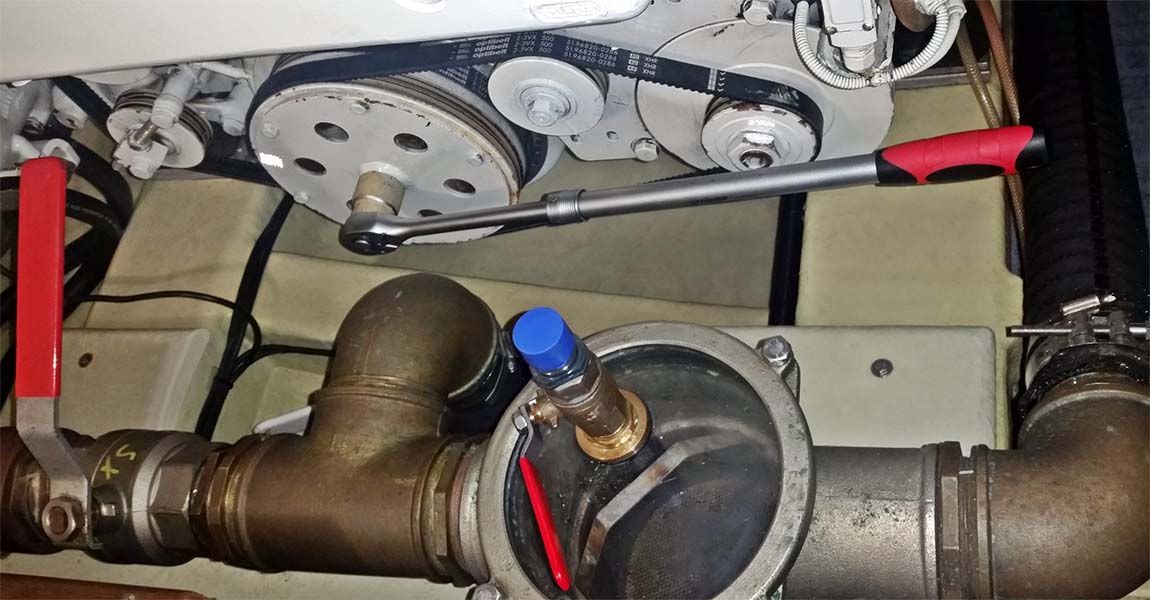
A 32 mm socket on the crank damper and an extension bar to turn it .
A bit of Sq section is what I used .Turned easy enough with 1 m of leverage .
 
Last edited:
Than manual has the sequence with a diagram of which is number 1 .
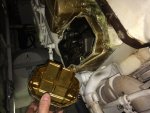
I did not replace the gaskets as they are a combo of al and rubber .No leaks btw .
899FEFC3-A512-4661-9805-8205C223EF9C.jpeg
sq box section acts as an extension to the ratchet with a 32 mm on .

7BCD9781-E13D-4357-AF43-7AF8D8D69711.jpeg
Where it goes , ratchet means you can turn it but by bit which is exactly what you want.
980AF61D-C18E-4603-868C-E8D388AB1F40.jpeg23F15272-6257-4932-9FA2-C94ED8E2A5BF.jpeg
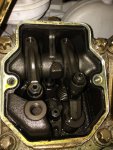
Std locking nut iirc 14 and a hex to adjust .Check the book for the clearances .
Most of the exhausts where out too bigger gap , and few of the inlet’s .A lot quieter and much more powerful straight away .It’s the exhaust timing that’s critical any delay in opening ( due to longer gap ) means less efficient evacuation.
They wear longer / open the gaps hence the tappity sound .
 
Last edited:
I’ve an old MAN V8 in my tub, I’m ok with the process of adjusting the valve clearances but wondered how to get each cylinder to TDC, is there a mark on the crank pully for each cylinder ? I would imagine it’s the same procedures for most makes of engine.
Oi, waddumean "old"?
I like to think of my engines (which IIRC are the very same as yours) as the last of the best, rather than something "old"! :cool:(y)

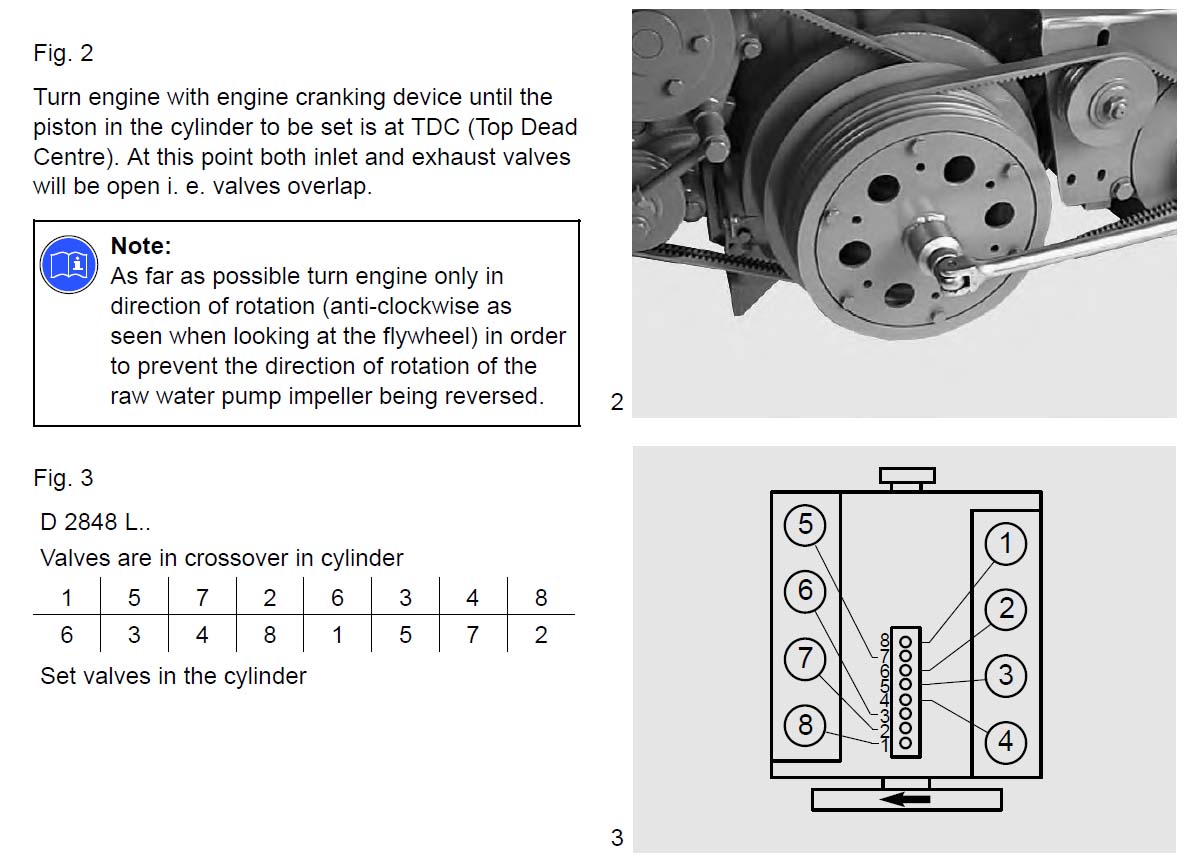
Back to the point, all you need to know is in the following drawing, from page 108 of the user manual.
The same manual also explains how to find the exact "ignition TDC" for cylinder one, but that's irrelevant because you need to find the TDC of each cylinder.
OTOH, you don't need an extreme accuracy: just open all valves covers, and spin the engine manually.
When you will see visually that BOTH valves are open in cylinder 1, that will be at its TDC, which happens to be the right position for setting the valves of cylinder 6.
Then you must spin the engine further, till both valves will open in cyl 5, and set cyl 3.
And so forth, as per Fig.3 below.

Mind, I never did that myself - my yard took care of that when I also had the injectors pulled and refurbished.
But that's what the manual says, so I can only assume it should be the right procedure.
I'd be interested to hear how easy (or not) you will find that in practice.

W9XqhJ3j_o.jpg
 
Oi, waddumean "old"?
I like to think of my engines (which IIRC are the very same as yours) as the last of the best, rather than something "old"! :cool:(y)

Back to the point, all you need to know is in the following drawing, from page 108 of the user manual.
The same manual also explains how to find the exact "ignition TDC" for cylinder one, but that's irrelevant because you need to find the TDC of each cylinder.
OTOH, you don't need an extreme accuracy: just open all valves covers, and spin the engine manually.
When you will see visually that BOTH valves are open in cylinder 1, that will be at its TDC, which happens to be the right position for setting the valves of cylinder 6.
Then you must spin the engine further, till both valves will open in cyl 5, and set cyl 3.
And so forth, as per Fig.3 below.

Mind, I never did that myself - my yard took care of that when I also had the injectors pulled and refurbished.
But that's what the manual says, so I can only assume it should be the right procedure.
I'd be interested to hear how easy (or not) you will find that in practice.

W9XqhJ3j_o.jpg
Something is lost in translation it should read valve GAP should be open Under” fig 2 “. My emphasis on GAP .

If it's TDC at end of the compression stroke, both valves should be closed. If it's TDCat end of exhaust stroke, you should be in the valve overlap zone, with the intake valvepartially open and on its way to opening fully, and the exhaust valve partially open on its way to closing.

Thus when turning you can see it’s TDC ( on compression ) when the inlet starts to rock ie open , in which case using the ratchet just back off .

When both sets of valves are closed you can tap the rockers by hand you adjust them as said just before they start to rock .
plenty of on line sequences for a V8 .
If the valves were “ open “ ie pushed down there would be no gap as the rocker arm would be pushing down .
You don’t get both open together btw ,except a bit on overlap very slightly if that but at TDC ( on compression) both are closed obviously just before the bang .

The big arrow on the pic is the FW and the damper is at the top near cylinder 1+5 .
 
Last edited:
I'm not sure of what you think is lost in translation, Porto.
I used TDC exactly as MAN did in their official repair manual (btw Chris, that's the manual I was referring to, not the user manual as I previously wrote).
They specifically explain to rotate the engine manually till in cylinder 1 both valves are open, and at that point set the valve clearance of cylinder 6.
Then do the same with cylinder 5 and 3 respectively, and then 7/4, and so on (as per table in Fig.3).
That's all - you couldn't lose anything in translation if you wanted to, methink.

That said, of course the position when both valves are open (overlap) corresponds to the TDC at the end of exhaust cycle, but that's totally irrelevant.
You could do the job equally well without even bothering to understand what TDC and/or valves overlap means.
The point is that there is only one very narrow range of valves overlap within the total 720 degres of a full 4 stroke cycle, and it's very easy to spot it visually by checking when both rocker arms are keeping the valves open.
Done that, of course you don't set the valves clearance of the cylinder with valves open, where there's no clearance at all.
It's just used as an indicator of which OTHER cylinder has the valves in the optimal position for clearance setting.

I believe the OP is quite capable to understand all that, but it isn't what he asked for.
I for one enjoyed looking at your pics, anyway.

PS for ChrisH:
I can't remember how many hours did your engines clock, and neither if you already refurbished the injectors (which is suggested every thousand hours), but FYI, it could be a good moment to do that.
In fact, while it's possible to pull and reinstall the injectors with the valve covers closed, it's much easier with the covers removed.
Just saying.
 
Last edited:
Mapism is right but as i suggested get the MAN repair manual, and please do not use an extension on a ratchet as they are designed to be used with the length of the handle they were supplied with no more.
 
I'm not sure of what you think is lost in translation, Porto.
I used TDC exactly as MAN did in their official repair manual (btw Chris, that's the manual I was referring to, not the user manual as I previously wrote).
They specifically explain to rotate the engine manually till in cylinder 1 both valves are open, and at that point set the valve clearance of cylinder 6.
Then do the same with cylinder 5 and 3 respectively, and then 7/4, and so on (as per table in Fig.3).
That's all - you couldn't lose anything in translation if you wanted to, methink.

That said, of course the position when both valves are open (overlap) corresponds to the TDC at the end of exhaust cycle, but that's totally irrelevant.
You could do the job equally well without even bothering to understand what TDC and/or valves overlap means.
The point is that there is only one very narrow range of valves overlap within the total 720 degres of a full 4 stroke cycle, and it's very easy to spot it visually by checking when both rocker arms are keeping the valves open.
Done that, of course you don't set the valves clearance of the cylinder with valves open, where there's no clearance at all.
It's just used as an indicator of which OTHER cylinder has the valves in the optimal position for clearance setting.

I believe the OP is quite capable to understand all that, but it isn't what he asked for.
I for one enjoyed looking at your pics, anyway.

PS for ChrisH:
I can't remember how many hours did your engines clock, and neither if you already refurbished the injectors (which is suggested every thousand hours), but FYI, it could be a good moment to do that.
In fact, while it's possible to pull and reinstall the injectors with the valve covers closed, it's much easier with the covers removed.
Just saying.

I read that as I can adjust two cylinders at a time, which would save time.

I’m only on 490 hours, I’m trying to get some old service history to find out if the valves have already been done.
 
I'm not sure of what you think is lost in translation, Porto.
I used TDC exactly as MAN did in their official repair manual (btw Chris, that's the manual I was referring to, not the user manual as I previously wrote).
They specifically explain to rotate the engine manually till in cylinder 1 both valves are open, and at that point set the valve clearance of cylinder 6.
Then do the same with cylinder 5 and 3 respectively, and then 7/4, and so on (as per table in Fig.3).
That's all - you couldn't lose anything in translation if you wanted to, methink.

That said, of course the position when both valves are open (overlap) corresponds to the TDC at the end of exhaust cycle, but that's totally irrelevant.
You could do the job equally well without even bothering to understand what TDC and/or valves overlap means.
The point is that there is only one very narrow range of valves overlap within the total 720 degres of a full 4 stroke cycle, and it's very easy to spot it visually by checking when both rocker arms are keeping the valves open.
Done that, of course you don't set the valves clearance of the cylinder with valves open, where there's no clearance at all.
It's just used as an indicator of which OTHER cylinder has the valves in the optimal position for clearance setting.

I believe the OP is quite capable to understand all that, but it isn't what he asked for.
I for one enjoyed looking at your pics, anyway.

PS for ChrisH:
I can't remember how many hours did your engines clock, and neither if you already refurbished the injectors (which is suggested every thousand hours), but FYI, it could be a good moment to do that.
In fact, while it's possible to pull and reinstall the injectors with the valve covers closed, it's much easier with the covers removed.
Just saying.
Yes that’s correct .
Obviously with a inline 6 I can watch them all as my mate rotated the engine .
For Chris
The “ rocking “ number 1 and the stationary 6 .Just to be sure 6 are stationary Chris is gonna need to climb back over the engine and move the damper a bit each way to confirm . As the ones to adjust are on the opposite bank of the one on rock .
You are gonna need buddy of some sort ? Or enlist on Yoga now :)

@ JH the damper as my pics is pretty close up in my case a bulk head .So it’s a phaff of contortionist proportions to keep reaching in and pulling the socket off if using a straight bar none ratcheted .
When cold the rings are not tight so air moves past easily making hand turning ok ish .
We could not do it with a std socket set bar .Anrie Schwartzernigger in his prim might have done .And you might be abke to do it with an engine out of the boat on a pallet in a work shop , but in situ with your arms outstretched it’s not so easy . It’s not a ceased and rusted up stuck nut remember .In which case yes over do it and you bust the ratchet , and you certainly not gonna be banging a hammer on it either ,You don’t have to use the whole L , just push where the person can get to moving .
Hope this helps .
 
I read that as I can adjust two cylinders at a time, which would save time.
Mmm, hang on, why/how do you read that?
I mean, of course when valves are overlapping in cylinder 1, not only in cylinder 6 but also in some others the valves will be closed.
But the cams profile isn't an on/off thing, and you must be sure to set the clearance in the position where the rocker arms play is at its maximum.
I can't see which is the other cylinder you would adjust after setting for instance #1, aside from #6 which is indicated in the previous table.
And so on for each of the others.

Ref. how to turn the engine manually, fwiw I use the telescopic socket wrench below.
"Only" 57cm long when fully extended, as it is in the pic, but enough to spin the V8s with a reasonable effort.
It's crucial to have a ratcheting wrench though, because due to the interference with other engine bits, the "usable" angle is limited.
yqJWDTGm_o.jpg
 
Last edited:
Mmm, hang on, why/how do you read that?
I mean, of course when valves are overlapping in cylinder 1, not only in cylinder 6 but also in some others the valves will be closed.
But the cams profile isn't an on/off thing, and you must be sure to set the clearance in the position where the rocker arms play is at its maximum.
I can't see which is the other cylinder you would adjust after setting for instance #1, aside from #6 which is indicated in the previous table.
And so on for each of the others.

Ref. how to turn the engine manually, fwiw I use the telescopic socket wrench below.
"Only" 57cm long when fully extended, as it is in the pic, but enough to spin the V8s with a reasonable effort.
It's crucial to have a ratcheting wrench though, because due to the interference with other engine bits, the "usable" angle is limited.
yqJWDTGm_o.jpg
Looked into this a bit further, now I get it, you get say cylinder 1 to TDC or crossover and then set the valve clearance on cylinder 6,many thanks for that chart.
 
That's exactly how I read that, though I must say it took a while to figure it out also for myself.
It would have been more logic to put the descriptions "Valves are in crossover in cylinder" and "Set valves in cylinder" to the left of the first and second line respectively, rather than above and under.
But hey, they are German, and do build decent engines. Can't expect them to be also straightforward... :p
 
Portofino
It’s the exhaust timing that’s critical any delay in opening ( due to longer gap ) means less efficient evacuation.


That's funny - I tuned a standard engine for motorbike racing once, no aftermarket tuning bits were available.

I spoke to my old Speedway mate who was running Leonard Reece cams. He asked for the bore and stroke and the cam timing.

He said he could perhaps help, and he did.

By grinding a bit off the base circles he increased effective lift and by grinding the flanks of the exhaust cams he delayed the opening about 15 degrees.

It was a winner first time out. It was not, however reliable as the rider was predisposed to using low gearing and always over revved it. The cam chains broke.............

My mate the cam man said the exhaust opened too early so much of the burning gas went out of the exhaust. Opening it a trifle later gave a bit more power, and increased the available RPM with a shorter exhaust.

It was a bored to 200cc Honda twin, used in lightweight Road Races in Northern Ireland. Pre Yamaha and Suzuki, they proved to be best in class later.
 
The higher compression in diesels means a slight delay of the exhaust valves opening on the exhaust stroke makes a noticeable difference.
The lower the rpm range up to circa 2000 + a few hundred for large MAN‘s from 13 to 24 L you notice it more , correct valve lash .
 
Well, over 50 years as a small engine mechanic and that is the first time I have ever heard of compression ratio having anything to do with valve timing, apart of course, from mechanical clashing of the vital bits.

What IS important though is the speed of the combustion process. Diesel burns faster than petrol, but not that much faster.

Ten thou - 0,25mm - would have hardly ANY effect on engine running or power if loose. In fact, MGBs could gain 2 BHP from having looser valve clearances. Ten thou might alter the valve timing a single degree. Production tolerances are wider than 1 degree! From direct experience plus exhaustive testing of competition engines on chassis dynomometers and rolling road dynomometers.

Ten thou tight, big time problems!

I have some knowlege of slow reving semi diesels. I once made an aluminium piston for a Bollinders engine fitted in a canal narrowboat. The one we copied was cast iron. With the help of Bill Hodge and his forge we melted down Hillman Minx bell housings and cast a solid slug in green sand using a paint tin to make the mould. Bill then machined it and balanced it to the same weight as the iron piston.

That revved so slow it blew smoke rings.................................
 
You are arriving at the wrong conclusion (s) .

Diesels have far higher cylinder temps and pressures than petrols .Oil is not as volatile .
The CR is achieve sufficient temperature to ignite the oil without a spark.
So given a pair of identical engines one petrol the other diesel with the same maladjusted exhaust gap say it should be 0.5 and it’s opened to .07 for example.
In the delay opening the difference of the maladjustment ( in this case 0.2 but what ever ? ) it effects the higher pressure scavenging reliant more in this case is held up by the effect of the 0.2 delay .

Think of two foot balls .
Puncture both together time the gas release and then then plug after say 10 secs .They both loose the same amount of gas - yes
sit on one , puncture both this time add another 2 secs on so plug after 12 secs .The same effect as valve timing out .
The one sat on one is with the greatest pressure ( a diesel ) with the same size hole ( the open valve ) will loose more air because it’s under greater pressure . The other one will loose another 2 secs worth ( petrol ) .But the 2 sec error means the diesel one looses more because you are sat on it ......the pressure thing .Got it ?

Back to engines
So the CR is linked to cylinder pressures with diesels and a delay in opening or closing , the valve adjustment will have bigger loss of power effect than a lower pressure petrol .
Then factor in 12 to 24 litres as opposed to 200 to whatever cc and hopefully you will realise what a difference of 0.7 or even 0.6 is over a optimal 05 in the exhaust valve clearance has a marked effect on the Hp delivered.


If the clearance is too loose, you will lose power due to the fact that the valve doesn’t open for the proper duration of the cam lobe. That will cause the engine to get less volume of air & have a shorter exhaust expulsion. Having the clearances too tight may cause the valves to not fully close and allow compression leakage &/or proper intake/exhaust strokes. Either one of these conditions negatively affect performance.
They tend to wear open , the gaps increase esp the hotter exhaust.
Diesels have far greater cylinder temps and pressures than petrols .So for the same swept vol a tiny amount of delay opening of the valves due to them being too loose has a greater effect on the power compared to a petrol with lower cylinder pressures .

Bit of background for others ........
What will happen if tappet clearance is less:-
  1. Valve will open early and close lately.
  2. Air induced in combustion chamber for combustion through an inlet valve may leak out.So, less air will be for combustion.
  3. Power of the engine will be reduced.
  4. Fuel consumption by engine will increase, and engine may become unbalanced and the exhaust temperature will be very high.
  5. The valve may remain open ,in worst conditions,resulting in loss of compression pressure of the engine,burning of the exhaust valve and increase in turbocharger fouling.
What will happen if Tappet clearance is more :-
  1. The valve will open lately and close early.
  2. It reduces the maximum lift of the valve.
  3. Less heat energy to the turbocharger of engine, cause reduction in the scavenge air and hence power decrease.
  4. There is no proper removal of the exhaust gas.
  5. Hammering of the v/v stem cause damage to the valve stem.
  6. It causes noise and eventually damage the working surface.
 
Last edited:
I think you are missing a very basic point that is most important.

The very moment the exhaust valve opens, the expanding gas goes out of the exhaust port and STOPS pushing the piston down and thus rotating the crankshaft. If you open the valve early it is possible to get increased RPM from an engine. Open the valve a little later, more grunt, less RPM. Provided other adjustments are made to ignition and exhaust systems. Diesels are different but not dramatically so.


As I said, I am a very experienced mechanic, engine tuner and have been employed by major manufacturers in a technical capacity.

I have measured hundreds of engines, stock and highly tuned ones.

Production tolerances between cam lobes are such that maintaining less than 2 degrees of accuracy in production engines over eight cam lobes is almost immpossible without manual fettling.

Therefore, the difference in timing by a badly adjusted valve clearance could easily be less than production tolerences between adjoining cylinders, which, in practice, make little difference to a running engine.

Ask yourself this - could you do the valve timing on a DOHC engine without any timing marks? By using a degree disc. Do you understand how valve timings are specified by a manufacturer? Can you make a simple calculation from these figures and find the number of degrees after TDC when the inlet valve - or valves - should be fully open?

If not, you might possibly be out of your depth with our little disagreement.
 
7DF18C6E-407C-40F3-8233-D35922668660.gif
Apples and pears .

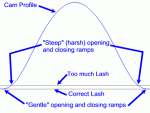
With the Ops V8 16 Litres never really seeing more than 2000 rpm and the higher pressures ( some one sat on the foot ball ) those ends of this graph , the difference time wise between “ too much lash “ and “ correct lash “ makes a noticeable difference in power delivery.Thats 2 L per pot with 4 valves btw .The lower the rpm and greater pot size , with greater pressures the bigger the power difference.It’s noticeable with theses .
You don’t recognise this ? Fair enough.

Agree with you might not notice it as much between 1100 and 12500 rpm in a 1.6 Litre or smaller bike petrol engine screaming it’s nuts off .Not disputing that .

Buts he,s not got one of those (y).

Extrapolating upwards to a ships massive diesel turning at 80-100 rpm kicking out tens of thousands of Hp those tips at the end of the graph ,^^^ the difference will be huge .
 
With the Ops V8 16 Litres...
[...]
Thats 2 L per pot with 4 valves btw
That's actually 14,64 litres, i.e. 1.83 a pop - which is the reason behind the MTU name "183 series", back in the days when they were using the same block.
But most importantly, it's 2 valves. We don't want to drive Chris H mad looking for some valves that do not exist, do we? :ROFLMAO:
 
Top